Most home bakers should buy the KitchenAid Artisan, the 5-quart tilt-head. It is quicker to load, fits under more cabinets, and comfortably handles the cakes, cookies, frostings, and occasional loaf that make up the vast majority of home baking. Step up to a Professional bowl-lift only if you routinely knead stiff bread dough or double your batches. And if bread is the entire reason you are shopping for a mixer, here is the part most buying guides bury: two of the most trusted baking test kitchens both rank a non-KitchenAid, the Ankarsrum Original, as the best mixer for dough.
That is the whole decision in a paragraph. The rest of this guide explains why, so you can be sure it is the right call for the way you bake.
The 20-second verdict. The Artisan tilt-head is the right mixer for most people. The Professional bowl-lift is a capacity-and-durability upgrade, not a magic bread machine. Bigger wattage numbers do not mean proportionally more kneading power. And no KitchenAid, tilt-head or bowl-lift, is the class leader for serious bread.
| Buy this | If you… |
|---|---|
| KitchenAid Artisan (5-qt tilt-head) | Bake weekly-ish: cakes, cookies, frostings, single loaves. Want easy bowl access, a color choice, and a smaller footprint. |
| Professional 6-qt bowl-lift | Bake bread a few times a month, double batches often, and want all-metal gears plus thermal overload protection. |
| Ankarsrum Original (or a DC bowl-lift) | Bake bread as your main reason, especially stiff or high-hydration doughs, frequently. |
If you are not yet sure a stand mixer earns its counter space at all, start with our guide on whether you actually need a stand mixer. If you already know you want a KitchenAid and just need the model, the model-by-model KitchenAid guide narrows it down. This piece is about the one fork in the road that trips people up most: tilt-head or bowl-lift.
Tilt-head vs bowl-lift: the one mechanical difference
Almost everything that separates the Artisan from a Professional flows from a single design choice: how the bowl meets the beater.
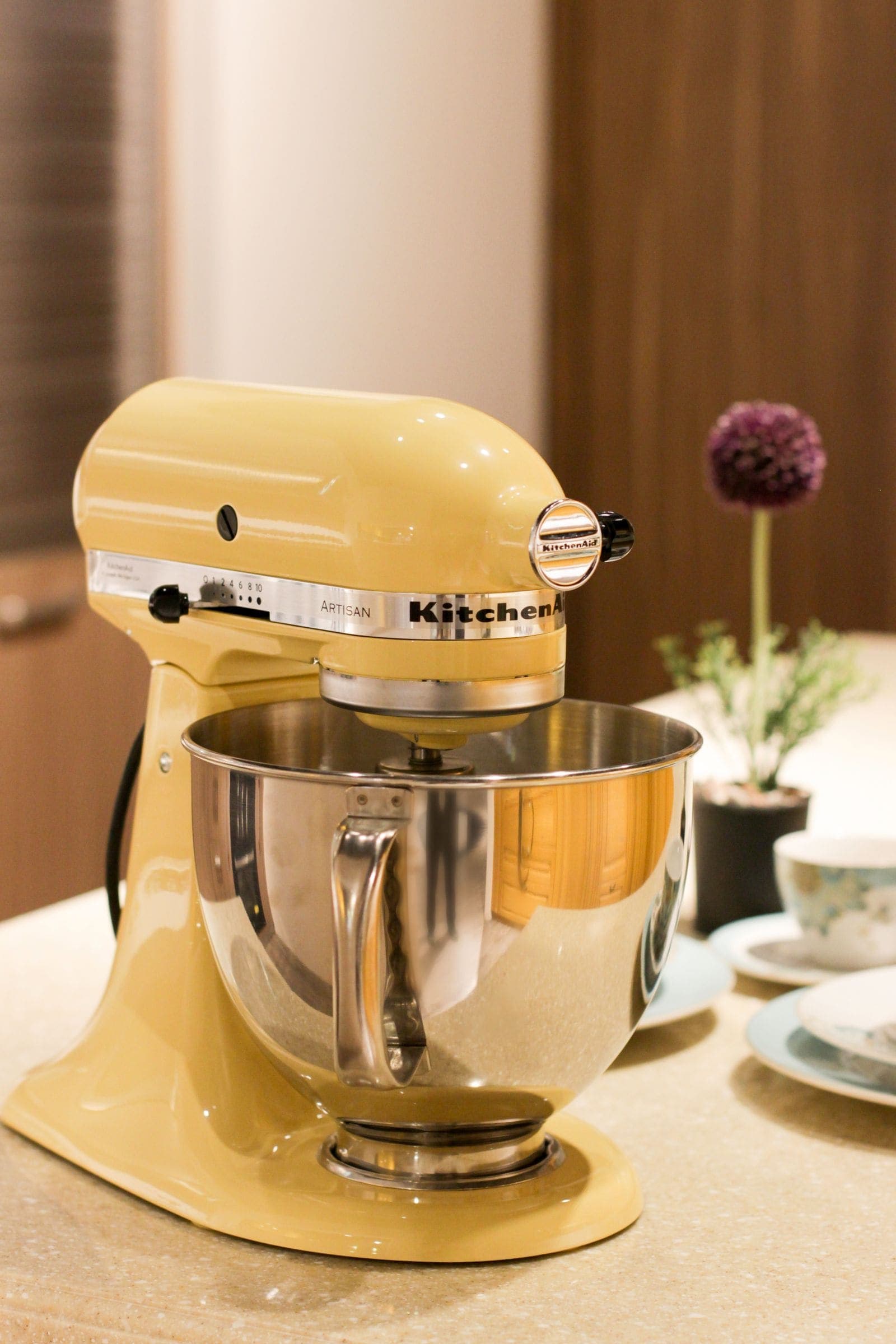
On a tilt-head like the Artisan, the motor head hinges backward. You twist the bowl into a locking base, tip the head down, and mix. To scrape or add ingredients, you tip the head up and the beater lifts clear with it. It is fast, intuitive, and easy to see into.
On a bowl-lift like the Professional, the head is fixed in place. The bowl clamps onto two arms, and a side lever cranks it up to the beater. There is no hinge to lift, which makes the whole frame more rigid, so it stays planted when heavy dough fights back. That rigidity is the real reason bowl-lifts handle stiff dough better, per KitchenAid’s own tilt-head-versus-bowl-lift explainer and independent testing from America’s Test Kitchen.
The trade-offs are predictable. Prudent Reviews, which maintains detailed spec comparisons, notes that tilt-heads are shorter and give you unobstructed access to the bowl, while bowl-lifts are taller, heavier, hold more, and are steadier under load. Neither is “better” in the abstract. The right one depends entirely on what and how much you bake.
Capacity: what each mixer actually handles
Tilt-head bowls come in 3.5, 4.5, and 5 quarts. Bowl-lift bowls come in 5, 6, 7, and 8 quarts, according to Prudent Reviews. But quart numbers alone are misleading, because a mixer that holds a lot is not the same as a mixer that can drive a lot. Here is what the makers claim each can do.
The Artisan 5-quart
KitchenAid rates the 5-quart Artisan (model KSM150) for up to 9 cups of all-purpose flour (or 6 cups of whole wheat), about 4.5 loaves of bread, 9 dozen cookies, and 7 pounds of mashed potatoes. For a household baking a couple of times a week, that ceiling is rarely a real constraint. A standard two-loaf sandwich-bread recipe, a double batch of chocolate-chip cookies, a two-layer cake plus its buttercream: all sit comfortably inside it.
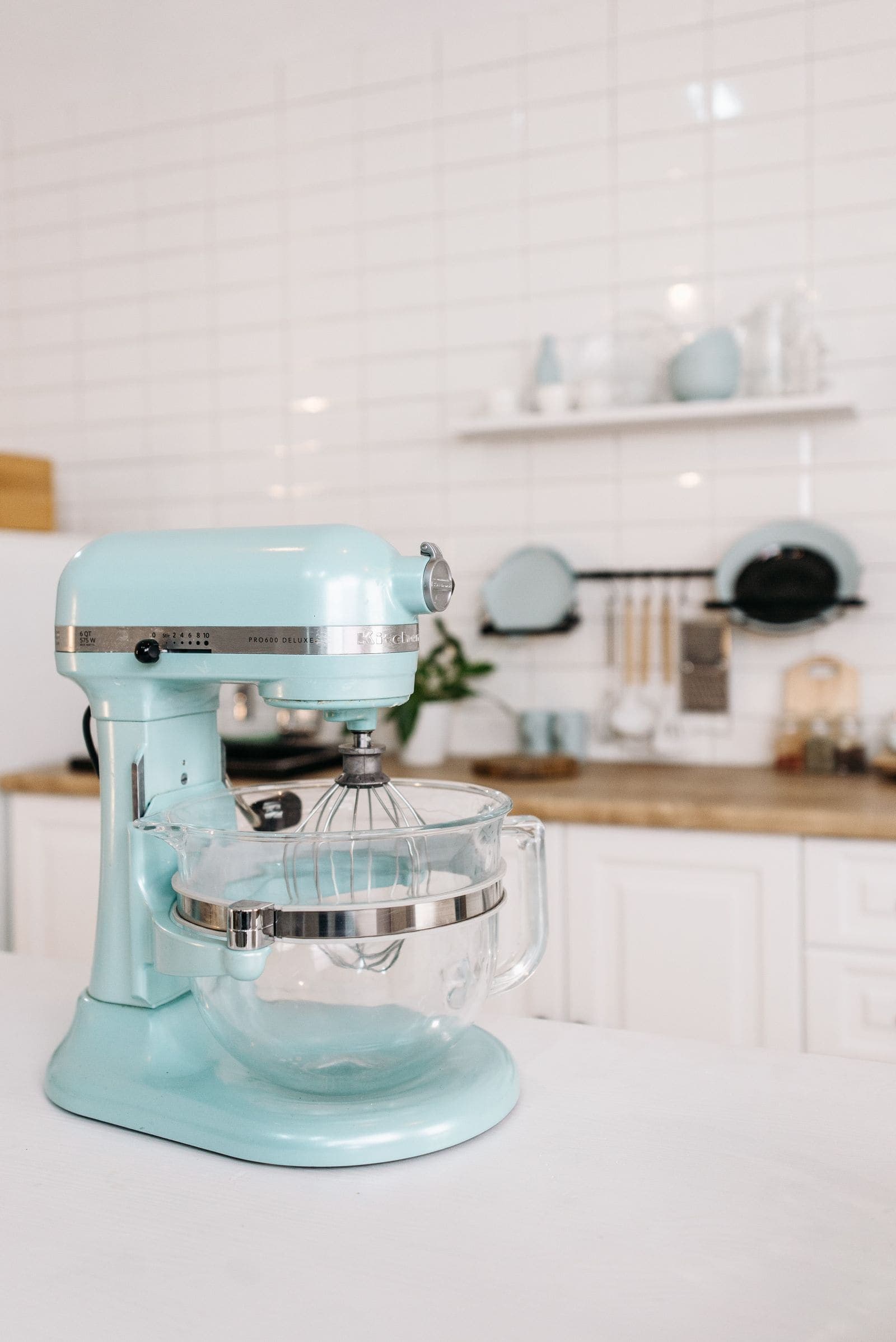
The Professional 6-quart bowl-lift
Move up to the Professional 600, the most common 6-quart bowl-lift, and KitchenAid’s claimed limits jump to roughly 14 cups of flour, about 8.25 loaves, and 13 dozen cookies, figures cited in the Mom’s Baking Co review of that model.
Treat the top of that range as marketing, not a promise. In that same hands-on review, the owner reports the Pro 600’s motor comfortably handled about four loaves at once, not the claimed eight-plus, before it began to labor. The lesson is not that the Professional is weak; it is that manufacturer capacity claims describe bowl volume, not the point where the motor stays happy. The honest working capacity of a 6-quart bowl-lift is meaningfully above the Artisan, but well short of the box.
Double batches and cookie dough
This is where the bowl-lift earns its keep. If you regularly triple a cookie recipe for a bake sale, mix big-batch pizza dough, or make frosting for a sheet cake, the extra headroom and the steadier frame matter. If your “big” bake is an occasional double batch, the Artisan will do it without complaint. Wirecutter’s long-standing advice lands in the same place: step up to a bowl-lift only if you routinely double or triple recipes.
Motors and the AC-vs-DC debate: why wattage is not power
Spec sheets love wattage because it is a big number that sounds like strength. It is one of the least reliable ways to compare stand mixers, and understanding why will save you from overpaying.
| Model | Motor rating | Drive type |
|---|---|---|
| Artisan Mini | 250 W | AC direct-drive |
| Artisan | 325 W | AC direct-drive |
| Artisan Plus (2026) | 350 W | AC direct-drive |
| Professional 5 Plus | 525 W | AC |
| Professional 600 | 575 W | AC (triac control) |
| Pro 6500 Design | 745 W (1 HP) | DC |
| Pro Line 7-qt | 969 W (1.3 HP) | DC |
Wattage figures above are drawn from Prudent Reviews’ spec tables; motor type follows the general pattern reported across sources. Confirm the exact model before buying, since regional and updated variants can differ.
Why 325 watts is enough for most people
The Artisan’s 325-watt direct-drive motor is not a compromise; it is well matched to what most people ask of a mixer. In hands-on testing summarized by TechGearLab, the Artisan whipped a cup of cream to stiff peaks in about one minute fifty seconds and creamed butter and sugar without strain. Cakes, cookies, meringues, mashed potatoes, and single loaves are all comfortably within its range. Watts are not the bottleneck for that work.
AC versus DC: torque, noise, and holding speed
Here is the nuance most guides skip. The Professional 600’s 575 watts is an AC motor with a primitive triac speed control that does not add much torque as dough resists it, per the Mom’s Baking Co breakdown of KitchenAid’s motor tiers. By contrast, the DC motors in the Pro 6500 Design, the Pro Line, and the Commercial models use PWM control that holds speed and increases torque on demand, and they run noticeably quieter. The Kitchen Revival’s explainer on AC versus DC stand mixers makes the same point.
The practical takeaway is important for your wallet. Stepping from the Artisan up to a Professional 600 buys you more capacity and an all-metal build, and the Pro 600 adds Thermal Overload Protection that shuts the motor off and cools down for roughly 30 minutes if you push it too hard. But the genuinely quieter, speed-holding, torque-on-demand experience only arrives at the DC tier, the 6500 and up. Do not pay for the Professional expecting a quiet, tireless dough machine; that is a different, pricier animal.
The speed-2 dough rule every KitchenAid shares
One rule applies across the entire KitchenAid line, tilt-head and bowl-lift alike. KitchenAid’s own bread guidance is explicit: when kneading dough, use speed 2. As of a 2024 revision, there is no longer a fixed time limit; older manuals capped kneading at four to six minutes, and that cap was removed. So the constraint is the speed you knead at, not a stopwatch. If you see a third-party page still quoting a strict time limit, it is out of date.
Bread and stiff dough: the honest answer
If bread is why you are here, read this section twice.
A bowl-lift is the better KitchenAid for dough. The rigid frame means less of the vibration and “walking” that owners report with tilt-heads under heavy dough, where the hinged head can lift slightly and the whole machine creeps across the counter. So within the KitchenAid family, a Professional beats an Artisan for bread. That much is straightforward.
But the class leader for bread is not a KitchenAid at all. America’s Test Kitchen’s overall winner is the Ankarsrum Original, explicitly because it has no kneading-speed restriction and its base-mounted motor stays steadier on stiff dough; ATK went so far as to demote KitchenAid’s own Pro Line 7-quart from its former top spot. King Arthur Baking independently names the Ankarsrum its best mixer for bread, citing that a bottom-mounted motor makes it far steadier than a top-heavy KitchenAid on the stiffest doughs.
This is the honest edge most affiliate pages will not give you: if you bake bread constantly, especially high-hydration or very stiff doughs, the right answer may be to skip the KitchenAid tier war entirely. We compare the two philosophies head-to-head in our KitchenAid vs Bosch vs Ankarsrum breakdown. And once the dough is mixed, the bake matters as much as the knead; a preheated Dutch oven is what turns good dough into a crackling-crust loaf, and a reliable kitchen thermometer is the honest way to know a loaf is done by internal temperature rather than guesswork.
None of this means the Artisan cannot bake bread. It can, up to its rated limits, at speed 2. It simply means “I want to bake serious bread” is not, by itself, a reason to jump from Artisan to Professional. It is a reason to think harder about which machine, at any tier, fits your dough.
Footprint, height, and noise
The tilt-head’s shorter stature is often oversold. Yes, tilt-heads stand about 14 inches tall closed (the Mini is 12.3 inches) while bowl-lifts run 16.4 to 17 inches, per Prudent Reviews. But there is a trap: to load a tilt-head you must tip the head fully back, which needs extra overhead clearance the closed height does not tell you. A tilt-head that fits under your upper cabinets closed may not open under them. Measure both the closed height and the head-up swing before you commit.
Weight tracks with build: the Artisan is around 23 pounds, the Pro 600 roughly 28 to 29 pounds, and the Pro Line about 32 pounds. Heavier is harder to move but sits more solidly during a hard mix.
On noise, set expectations honestly: no KitchenAid is truly quiet. Owners report tilt-heads vibrate under heavy dough, and the AC Pro 600 is described as slightly noisier than the DC bowl-lifts. If a hushed motor is a priority, that points, again, to the DC tier.
Durability, gears, and warranty
There is a persistent myth that the small plastic gear inside a KitchenAid is a modern cost-cut. It is not. As iFixit documents, that plastic worm gear is a sacrificial part by design: it is meant to fail first and cheaply to save the far more expensive motor, and the approach dates back to the Hobart-era KitchenAids, long before Whirlpool. Replacing one is a well-trodden, inexpensive repair, not a sign the machine is junk.
What genuinely shortens a mixer’s life is heavy dough duty without maintenance. Regreasing intervals stretch from every three to five years for light users down to roughly annually for someone kneading stiff dough weekly. Owners on ChefTalk and reviewers at The Solid Spoon regularly report 15- to 20-year lifespans on Pro-tier machines that are looked after. These are built to last across tiers; how hard you work them decides how much upkeep they need.
Warranties are less generous than the reputation suggests. The Artisan and most Professional models carry a one-year limited warranty. Only the Pro Line steps up to a longer term (reported at five years). If warranty length is a deciding factor, it favors the top of the range, not the middle.
Price and value: the tier ladder
Prices move constantly with KitchenAid’s frequent sales, so treat these as relative bands rather than fixed figures, and verify at checkout.
| Model (bowl size) | Where it sits | Price band |
|---|---|---|
| Classic (4.5-qt tilt-head) | Entry KitchenAid | $ |
| Artisan (5-qt tilt-head) | Best for most | $$ |
| Artisan Mini (3.5-qt tilt-head) | Small kitchens | $$ |
| Artisan Plus (5-qt tilt-head, 2026) | Upgraded Artisan | $$ |
| Professional 5 Plus (5-qt bowl-lift) | Entry bowl-lift | $$ |
| Professional 600 (6-qt bowl-lift) | Capacity step-up | $$ |
| Pro 6500 Design (6-qt bowl-lift, DC) | Quiet DC power | $$$ |
| Pro Line 7-qt (bowl-lift, DC) | Serious bakers | $$$ |
| Ankarsrum Original (7-qt) | Bread specialist | $$$ |
The value logic is clean. The Artisan and the Professional 600 sit in the same broad band, so the choice between them is about fit, not just money. The real price jump is into the DC premium tier, and that jump is only worth it for frequent, demanding dough work. For most kitchens, spending the Professional-600 premium buys capacity you will rarely use; for a serious bread baker, spending it on a mid-tier AC bowl-lift buys less than spending the same energy on the right specialist tool.
What about the new Artisan Plus (2026)?
KitchenAid launched the Artisan Plus on March 30, 2026. It is still a 5-quart tilt-head, but with meaningful refinements: a 350-watt motor, 11 speeds, Precision/Soft-Start control, a half-speed Fold setting, an integrated LED bowl light, and a Double Flex Edge beater, per Forbes Vetted and KitchenAid’s product page. The Soft-Start feature (which eases the mixer up to speed so flour does not puff out) and the built-in bowl light are the genuinely nice quality-of-life upgrades.
One caution, flagged as a single-source data point rather than consensus: America’s Test Kitchen reportedly found the Artisan Plus struggled in durability testing and did not name it a favorite. That is one test kitchen’s finding, and it deserves verification before you weigh it heavily, but it is worth knowing before you pay a premium over the standard Artisan for the newer features.
Where it fits: the Artisan Plus is a refinement of the Artisan, not a bridge to the Professional. It does nothing to change the capacity or dough-steadiness math above. If the Soft-Start and LED appeal to you and the price is close, fine; if not, the standard Artisan remains the value pick.
Which should you buy? The buy-X-if framework
Buy the KitchenAid Artisan (or Artisan Plus) if you bake weekly-ish, mostly cakes, cookies, frostings, and single loaves; you have a smaller kitchen; you want a color choice and a friendlier price; and you value easy, see-into-it bowl access. This is the right answer for most people reading this.
View the Artisan at KitchenAid
Buy the Professional 600 (6-quart bowl-lift) if you bake bread a few times a month, double batches routinely, and want the sturdier all-metal frame and Thermal Overload Protection. Just go in clear-eyed: you are buying capacity and durability, not a quieter or dramatically more powerful motor.
View bowl-lift mixers at KitchenAid
Step up to a Pro Line 7 or Pro 6500 (DC) if you work with stiff or high-hydration dough frequently and want a mixer that holds speed under load, runs quieter, and carries a longer warranty.
Consider the Ankarsrum Original if bread is your primary reason for owning a mixer and you will accept its learning curve. Two major test kitchens rank it first for dough, and it is worth taking that seriously before defaulting to a KitchenAid.
Whichever tier you land on, the attachments question is worth a look, since the pasta roller, grinder, and slicer share the same power hub across the whole KitchenAid line. And if you want the full field beyond KitchenAid, our best stand mixers guide is the hub.
How we researched this
Cookloom is reader-supported: if you buy through the links above, we may earn a commission, at no extra cost to you. We do not accept free products in exchange for coverage, and it never changes our verdict.
This is a research-based comparison rather than a first-hand test. We drew on KitchenAid’s own product specifications and bread guidance, independent testing from America’s Test Kitchen and King Arthur Baking, hands-on measurements from TechGearLab and Prudent Reviews, and long-term owner reports from ChefTalk and iFixit. Capacity and wattage figures are manufacturer or editorial spec-sheet numbers, attributed above; prices are shown as bands because KitchenAid discounts frequently. Every source is listed below, and we update this guide as test-kitchen standings and models change.
Sources
- KitchenAid — Tilt-head vs bowl-lift stand mixers
- KitchenAid — Artisan Series 5-Quart Tilt-Head Stand Mixer (KSM150)
- KitchenAid — Making bread in a KitchenAid stand mixer
- KitchenAid — Artisan Plus 5-Quart Stand Mixer
- America’s Test Kitchen — The Best Stand Mixers
- King Arthur Baking — The best stand mixer for bread
- Prudent Reviews — KitchenAid tilt-head vs bowl-lift
- Prudent Reviews — KitchenAid Artisan vs Professional
- Mom’s Baking Co — KitchenAid Professional 600 review
- Mom’s Baking Co — What is the strongest KitchenAid mixer?
- The Kitchen Revival — AC vs DC stand mixer motors
- iFixit — KitchenAid tilt-head mixers
- ChefTalk — KitchenAid Professional 600 vs Artisan
- The Solid Spoon — KitchenAid Professional 600 review
- TechGearLab — KitchenAid Artisan hands-on review
- Forbes Vetted — KitchenAid Artisan Plus stand mixer