Buy the Le Creuset Signature Round if you want the safe answer and your budget can absorb it. It’s the pot the largest number of independent test kitchens name their overall winner, and it earns that on three things a good braiser genuinely needs: a light interior that lets you watch fond build before it burns, class-leading weight for enameled cast iron, and the only warranty in the category that will replace the pot if the enamel chips. The honest asterisk most roundups bury is this — a Lodge enameled Dutch oven costing a quarter as much browns and braises nearly as well, and if hard searing and heat retention matter to you more than seeing your food, a Staub out-performs the Le Creuset on the exact numbers that build a crust. That three-way split — safe pick, smart-money pick, sear-first pick — is the whole story, and it’s why the experts don’t actually agree with each other.
So this is not a list that pretends one pot wins for everyone. Below is a verdict for each way of cooking, the measured evidence behind it, and the trade-offs the marketing copy leaves out.
The best Dutch ovens at a glance
| Pick | Best for | Size / weight | Interior | Oven-safe | Price | Buy it if |
|---|---|---|---|---|---|---|
| Le Creuset Signature Round | Best overall | 5.5 qt, ~11.4 lb | Light | 480–500°F* | $$$ | You want the consensus pick and the budget fits |
| Lodge Essential Enamel 6-qt | Best value | 6 qt, ~13 lb | Light | 500°F | $ | You refuse to spend $400 and want it backed for life |
| Staub Round Cocotte | Best for searing & heat | 5.5 qt, ~12.6 lb | Dark | 500°F (900°F lid-off) | $$$ | Searing and heat retention beat visibility for you |
| Made In Enameled Dutch Oven | Best mid-range | 5.5 qt, ~13.7 lb | Light | 580°F | $$ | You want near-Le-Creuset performance for ~$100 less |
| Cuisinart Chef’s Classic 7-qt | Best big Best Buy | 7 qt, ~16.7 lb | Light | ~400°F* | $ | You want a large pot cheap and don’t bake 500°F bread |
| Challenger Bread Pan | Best for bread (splurge) | Oval, bare iron | Dark (bare) | Very high | $$ | Sourdough is the reason you’re buying |
| Lodge Combo Cooker | Best for bread (value) | 3.2 qt, bare iron | Dark (bare) | Very high | $ | You want a bread setup for the price of lunch |
*Oven-safe ceilings are knob-dependent — see the temperature table further down. Price bands: $ = under $100 · $$ = $100–300 · $$$ = $300 and up. Weights are as measured by the reviewers cited below and vary by quart size.
How we chose (and what we didn’t do)
Cookloom is a new site, so let’s be plain about method: we have not lab-tested these pots ourselves, and we won’t pretend we did. What we’ve done instead is reconcile the published results of the most methodologically transparent tests in the category — Serious Eats (22 pots, updated June 2026), America’s Test Kitchen (three decades of testing), Food Network (21 models), Bon Appétit, New York Magazine’s Strategist, The Kitchn, and Prudent Reviews’ instrumented side-by-side, which is the only test that publishes measured heat-retention, knob-temperature, and moisture numbers. We’ve layered in aggregated owner reports from cooking forums and Reddit communities, always labeled as community-sourced.
Here’s the interesting part. When the qualitative test kitchens crown a winner, four of them (Serious Eats, ATK, Food Network, The Kitchn) name Le Creuset, and two (Bon Appétit, the Strategist) name Staub. When you look at Prudent Reviews’ instruments instead, Staub tops the heat-retention chart and Le Creuset lands near the bottom of it. That’s not a contradiction to hide — it’s the single most useful thing in this guide. The split maps cleanly onto what each cook values: visibility and ease (light interior, lighter pot, wider handles → Le Creuset) versus thermal performance (heat retention, aggressive browning → Staub). Every factual claim below is attributed to its source in plain text, and the full citation list is at the bottom.
Best overall: Le Creuset Signature Round
The verdict: For most cooks with the budget for it, this is the pot — and the agreement behind that sentence is unusually deep.
Serious Eats has kept the Le Creuset 5.5-quart Round as its winner since 2017, and its June 2026 re-test of 22 pots left it on top: the cream-colored interior enamel and wide looped handles heated quickly and seared pork shoulder to a crusty golden brown. At around 11.4 pounds it is light for the class, and while its 8-inch interior is on the smaller side, Serious Eats reported it “didn’t feel cramped.” America’s Test Kitchen, after three decades of testing, gives the 7.25-quart version (model LS2501-287FSS) its top spot too, calling it the lightest and easiest-to-use enameled Dutch oven of its size at 13.7 pounds, with a roughly 9-inch cooking surface. Food Network’s February 2026 update of 21 models made the 5.5-quart its best overall, and The Kitchn crowned Le Creuset best overall as well, singling out that light interior for monitoring browning.
Two things justify the price beyond cooking. The first is weight and ergonomics: Prudent Reviews and The Skillful Cook both note Le Creuset’s thinner walls make it the lightest heritage option with the widest handle openings, which matters a lot when the pot is full, hot, and coming out of a 325°F oven. The second is the warranty — more on that under the Lodge pick, where it’s actually a point against Le Creuset.
The honest cons. It’s expensive, and the light interior that helps you cook is the same interior that shows every stain and scuff over time (our enameled cast-iron care guide covers de-staining, which is routine, not damage). And on Prudent Reviews’ instruments it retained less heat than Staub, Made In, and several cheaper pots — its strengths are usability, not thermal mass. If you want the closest thing to a definitive head-to-head with its main rival, that’s its own piece: Le Creuset vs. Staub.
The budget reality check
Before you add it to cart, sit with one number: the Cuisinart that America’s Test Kitchen named a Best Buy performed just as well as this Le Creuset at roughly a quarter of the price, and Serious Eats rated cooking in a Lodge versus a Le Creuset as effectively equal. You are not buying a better braise for the extra $300. You’re buying lighter weight, nicer handles, a finish that survives abuse longer, a stronger warranty, and — genuinely, for some buyers — an heirloom you’ll hand down. That’s a real value proposition. It’s just not the one the price tag implies, and it’s the entire argument of our Lodge vs. Le Creuset Dutch oven comparison.
Best value: Lodge Essential Enamel 6-qt (EC6D33)
The verdict: The “you don’t need to spend $400” pick — and it’s backed better than anything above it.
Serious Eats’ budget pick is this 6-quart Lodge, which heated up quickly, browned pork well, and turned out tender, fall-apart results, all with a glossy white (light) interior and a stainless-steel knob rated to 500°F. At roughly 13 pounds it’s heavier than the Le Creuset, and it typically sells in the $55–90 range on sale — a fraction of the heritage brands.
The standout isn’t the price, though. It’s the warranty. Prudent Reviews notes Lodge is the only brand that will replace the Dutch oven if the enamel chips or cracks under normal use; every other maker here covers manufacturing defects only. For a pot you actually cook in hard, that’s the most consumer-friendly guarantee in the category.
The honest cons. The rounded bottom shrinks the flat cooking surface to about 7 inches, which Prudent Reviews and Eater both flag as a smaller sear area than a straight-walled pot. Eater also reported light out-of-box rust on the rim from shipping moisture — cosmetic, wipes off, but worth knowing. And the temperature caveat is real: the current Lodge Essential with the stainless knob is good to 500°F, but older Lodge Color models with a black phenolic knob top out at 400°F. If you’re buying to bake bread at 500°F, confirm the SKU has the stainless knob.
Also great value: Cuisinart Chef’s Classic 7-qt
If you want more capacity for less money, America’s Test Kitchen’s Best Buy is the Cuisinart Chef’s Classic Enameled 7-quart (CI670-30CR), which it found performed just as well as the Le Creuset winner at about a quarter of the price, with a light interior. The compromises are weight and durability: at 16.7 pounds it’s a heavy lift, and in ATK’s abuse testing the rim and lid chipped sooner than the premium pots. Note too that some Cuisinart models are rated only to around 400°F, so verify the specific SKU before high-heat baking. Sub-$120 alternatives like Tramontina’s enameled line and store-brand pots (Costco’s Kirkland Signature is made in France; Aldi’s seasonal Crofton recurs every fall) are how a lot of owners actually buy into cast iron without paying retail.
Best splurge for searing and heat retention: Staub Round Cocotte (5.5-qt)
The verdict: The winner when the metric is thermal performance rather than visibility.
View at ZwillingView at Amazon
Bon Appétit and the Strategist both name Staub their best overall, and Prudent Reviews’ instruments explain why. In its controlled test, the Staub had the best heat retention of any pot — a 182°F surface reading after cooling, versus 142°F for the Le Creuset and 131°F for a Tramontina — plus the best moisture distribution, credited to the flat self-basting lid whose interior spikes drip condensation back over the food. The black-matte interior, Prudent notes, produces exceptional browning and can build a light seasoning over time, and at 12.6 pounds (5.5-quart) it’s not the heaviest option here. The Skillful Cook, testing a used pot, put it bluntly: “Only Staub gave me a satisfactory sear,” crediting the squared sides and dark, textured enamel.
Staub also has the highest oven ceiling of any pick. Per Zwilling’s own spec, the nickel-steel knob makes it oven-safe to 500°F with the lid on and the body is rated to 900°F without the lid — the most headroom of anything here, which matters for screaming-hot searing and bread.
The honest cons. The same dark interior that browns so well makes it harder to judge fond and butter by eye. Prudent measured smaller square handles (3.2 inches versus Le Creuset’s 4.2) and a tiny 1.4-inch knob that ran hot at 143°F, and the spiked lid takes more effort to clean. This is a pot for cooks who prioritize the sear; if that’s not you, the visibility of a light interior is worth more.
Best mid-range: Made In Enameled Cast Iron (5.5-qt)
The verdict: Le-Creuset-adjacent performance for roughly $100 less.
Made In is the value-premium play, and Prudent Reviews’ numbers back it: second-best heat retention (177°F) and second-best moisture retention of the group, the coolest knob measured (101°F), and the largest flat cooking surface — a full 9 inches — with wide handles. It’s made in France with a stainless knob and is oven-safe to 580°F, a higher ceiling than either Le Creuset or Lodge. Serious Eats and Bon Appétit both frame it as the moderately-priced heritage alternative that costs about $100 less than a comparably sized Le Creuset.
The honest con. It’s the heaviest 5.5-quart here at about 13.7 pounds — the thicker iron that helps it hold heat is iron you have to lift. If weight is your deciding factor, that’s the one strike against it.
Best for bread: Challenger Bread Pan (splurge) and Lodge Combo Cooker (value)
The verdict: Any enameled Dutch oven bakes great bread, but a dedicated dark-interior, high-heat vessel bakes it better.
View Lodge Combo Cooker at Lodge
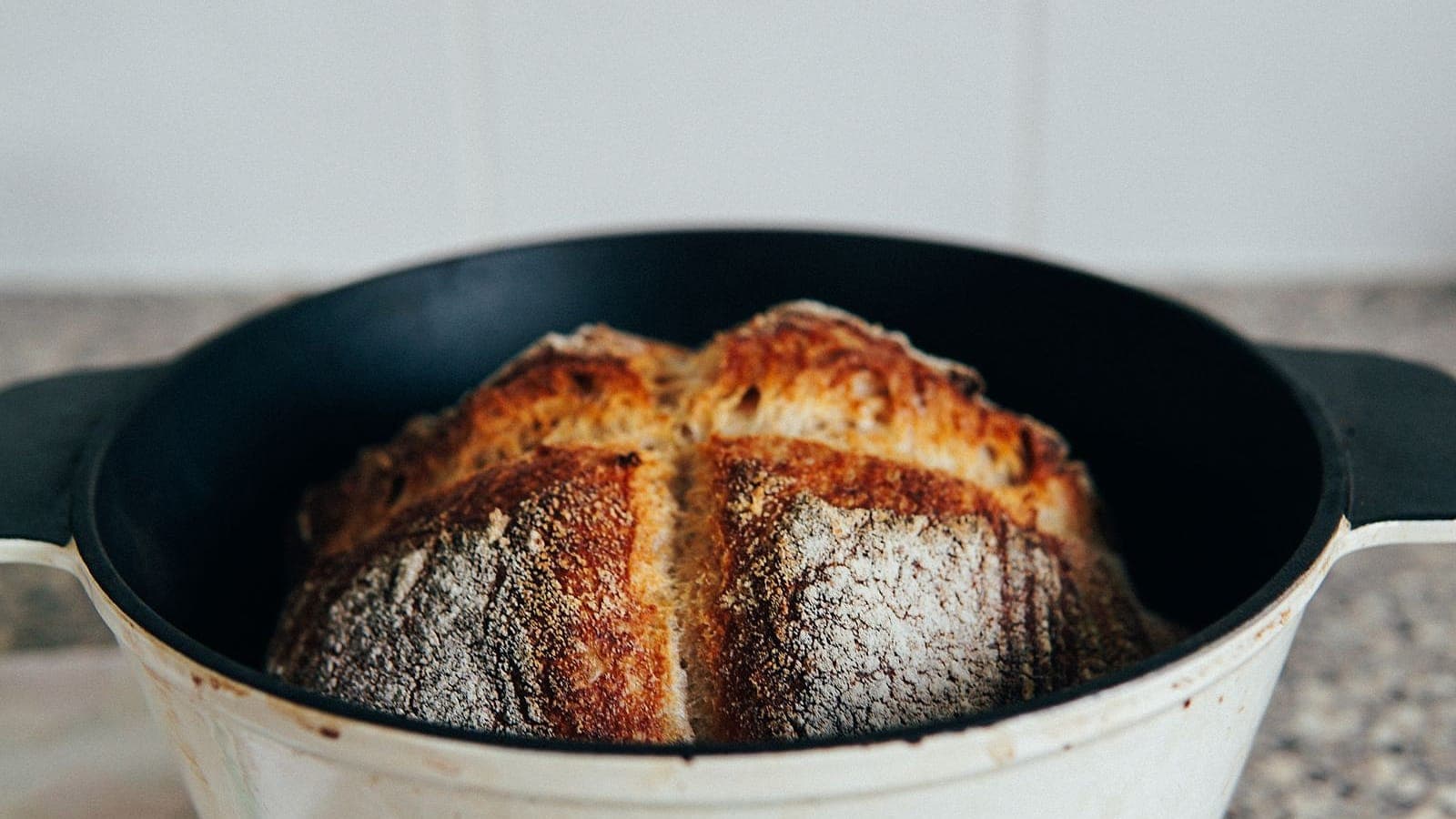
America’s Test Kitchen’s dedicated bread-oven testing explains the principle: darker interiors radiate more heat, so they bake faster and build better crust. Its overall winner is the Challenger Bread Pan (around $299) — bare cast iron, oval, with two sets of handles and room for a 1-kilogram loaf, which produced blistered, deeply caramelized crusts. Because it’s bare iron with no enamel to protect, its temperature ceiling is effectively whatever your oven does, and there’s no phenolic knob to worry about. It’s a single-purpose splurge for people whose main reason to buy is sourdough. (The Challenger is sold directly by its maker rather than through the retailers we link, so we’re not sending you to a buy page we can’t verify — search it out directly if it’s your pick.)
ATK’s Best Buy for bread, and the runaway Reddit favorite per RedRecs, is the Lodge Combo Cooker (around $50) — a 3.2-quart cast-iron skillet and lid that double as a shallow Dutch oven and a bread cloche. It’s the cheapest genuinely great bread setup there is. Among enameled pots, Staub’s black interior is the one best suited to bread, and its 900°F lid-off rating gives it the headroom; just watch the knob temperature at 450–500°F. If bread is your whole reason for buying, our Le Creuset vs. Staub breakdown weighs the enameled options head-to-head, and a good leave-in probe thermometer is the honest way to know a loaf’s crumb is set (bread is done around 205–210°F internal).
Best lightweight: two honest routes
If heft is your problem — arthritic wrists, a heavy full pot, an awkward reach into the oven — there are two real answers, and they involve a trade-off worth naming.
Within enameled cast iron, Le Creuset is the lightest at about 11.4 pounds for the 5.5-quart, thanks to thinner walls and the widest handle openings, per Prudent Reviews and The Skillful Cook — which also noted it retained heat better than the thicker Lodge despite the thinner iron. So the lightest heritage pot is also, conveniently, the overall winner.
If you want genuinely light and don’t bake crusty bread, America’s Test Kitchen’s lightweight testing points away from cast iron entirely, to fully-clad stainless: the All-Clad D3 6-quart stockpot (roughly a 3.8-pound pot) or the Best Buy Tramontina Tri-Ply Clad 6-quart (around $120). The catch, in ATK’s own words, is that these lack cast iron’s heat retention needed for crusty bread baking. Lighter pot, weaker crust — pick the one that fits how you cook.
What to look for in a Dutch oven
Size. ATK calls roughly 7 quarts the sweet spot for most households — it fits a family braise and roasts a chicken — while 5 to 6 quarts is right if storage is tight and you don’t mind cooking in batches. A 3-to-4-quart pot behaves like a heavy-duty saucepan. On a 7-quart, look for at least a 9-inch flat cooking surface so you can sear without steaming. Our Dutch oven size guide walks through the specific quart-to-household math.
Round vs. oval. Round is the default. Prudent Reviews found a round pot boiled water in 2:50 versus 3:45 for an oval, whose contents “concentrated at one end” because the shape overhangs a single burner. Round heats faster and more evenly on the stovetop, stores more easily, and comes in far more sizes and colors (Staub offers 95 round shapes versus 18 oval). Oval earns its place only for elongated cuts — a leg of lamb, ribs, a large roast. In the oven, the two perform equally.
Light vs. dark interior. Covered above, but as a buying axis: light interiors give browning visibility (ATK slightly prefers them); dark interiors radiate heat for bread, brown aggressively, and hide stains. Neither is “better” — they optimize for different things.
Knob material and oven-safe temperature. This is a real, checkable spec that decides whether you can bake bread, and it’s buried in nearly every roundup. Here’s the landscape, drawn from manufacturer specs plus Reviewed’s testing of Le Creuset lids and ATK’s notes on Tramontina:
| Pot & knob | Oven-safe ceiling |
|---|---|
| Le Creuset Signature, phenolic knob | 480°F |
| Le Creuset, stainless knob | 500°F |
| Le Creuset Classic (older), phenolic knob | 390°F |
| Lodge Essential, stainless knob | 500°F |
| Lodge Color (older), black phenolic knob | 400°F |
| Staub, nickel-steel knob (lid on) | 500°F |
| Staub, body without the lid | 900°F |
| Made In, stainless knob | 580°F |
| Cuisinart (some SKUs) | ~400°F |
| Tramontina, phenolic knob | 400°F |
| Our Place Perfect Pot (not cast iron) | ~425–450°F |
If a 500°F no-knead loaf is on your list, either buy a pot with a metal knob or check whether yours can be swapped — Le Creuset sells a stainless replacement knob for exactly this reason.
Weight, handles, and warranty. Lighter-for-its-class is a genuine advantage when the pot is full and hot; ATK’s measured spread runs from Le Creuset’s 13.7 pounds (7.25-quart) up to a Lodge 7.5-quart at 17.7. Favor large looped side handles you can grip with a mitt over small flat tabs. And read the warranty: Lodge’s chip-and-crack replacement is the outlier; everyone else covers manufacturing defects only.
Enameled vs. bare. Enameled is non-reactive (safe with tomatoes, wine, and citrus), needs no seasoning, and is low-maintenance. Bare cast iron is cheaper and, per ATK, produces a superior bread crust — but it reacts with acid and needs oil maintenance after each use. One warning that applies to all enameled cast iron: the enamel is essentially glass fused to iron, so never preheat it empty, never blast it from cold on high, and never shock a hot pot with cold water — Tasting Table and Marquette Castings both note thermal shock can craze or crack the coating. Add fat or liquid before heating and work over medium.
Who should skip enameled cast iron
Not everyone should buy one of these pots, and a roundup that won’t say so isn’t worth trusting.
Bread-only bakers. If a Dutch oven is purely a bread cloche for you, bare cast iron bakes a better crust for less money — the Challenger, the Lodge Combo Cooker, or a plain Lodge 7-quart camp oven. Enamel’s advantages (non-reactivity, no seasoning) don’t help a loaf.
Metal-utensil and camping cooks. Enamel chips if you bang it with metal tools or drop it on a hard surface, and it can’t sit in a campfire’s coals the way bare iron can. If you cook rough, buy bare and season it — start with our guides on seasoning and cleaning cast iron, and see Lodge vs. premium cast iron for the same save-vs-splurge argument applied to skillets. Our best cast-iron skillets guide covers the bare-iron world in full.
Weight-limited cooks who don’t bake bread. As above, fully-clad stainless is dramatically lighter — just accept the weaker crust.
Anyone who wants hands-off convenience. A Dutch oven rewards attention. If “set it and walk away” is the whole appeal, a slow cooker or a multicooker may serve you better on weeknights; we lay out the honest trade-offs in Dutch oven vs. slow cooker vs. Instant Pot. And style-forward direct-to-consumer pots (Great Jones, Marquette Castings) are worth a look for the aesthetics, but buy with eyes open — The Kitchn and Marquette’s own comparison testing flagged that Great Jones’ interior enamel failed at the first impact level, while Marquette tested more durably and offers a more lenient warranty.
Sources
- Serious Eats — The Best Dutch Ovens
- America’s Test Kitchen — Large Dutch Ovens
- America’s Test Kitchen — Cast Iron Bread Ovens
- America’s Test Kitchen — Lightweight Dutch Ovens
- America’s Test Kitchen — Round or Oval Dutch Oven
- Food Network — Best Dutch Ovens
- Bon Appétit — The Best Dutch Ovens
- New York Magazine, The Strategist — The Best Dutch Ovens
- The Kitchn — Le Creuset vs. Lodge Dutch Oven
- The Kitchn — Great Jones Dutch Oven Review
- Prudent Reviews — Le Creuset vs. Lodge vs. Staub vs. Caraway vs. Made In
- Prudent Reviews — Staub vs. Lodge
- Prudent Reviews — Oval vs. Round Dutch Oven
- Eater — Le Creuset vs. Lodge vs. Staub
- The Skillful Cook — Staub vs. Le Creuset vs. Lodge
- RedRecs — Best Dutch Ovens
- Hungry Onion — Enameled Cast Iron and Chipping
- Reviewed — Are Le Creuset Dutch Oven Lids Oven-Safe?
- Consumer Reports — Dutch Oven vs. Multicooker vs. Slow Cooker Chili Cook-Off
- Consumer Reports — Our Place Perfect Pot Review
- Tasting Table — The High-Heat Mistake That Ruins Enameled Cast Iron
- Marquette Castings — Dutch Oven Comparison
- Zwilling — Staub 5.5-qt Round Cocotte Spec