The short answer: For most homes, buy one 5-to-5.5-quart round Dutch oven. It roasts a 4-pound chicken, bakes a standard loaf, and comfortably feeds four with leftovers — which is why it’s the best-selling size across the major cookware brands. Go bigger, to 7 quarts, only if you batch-cook, entertain, or regularly feed five or more. Drop to 3–4 quarts if you cook for one or two, or want a nimble second pot. And unless you routinely braise long cuts of meat, choose round over oval.
A Dutch oven is a pot you buy roughly once a decade, so the size question is worth getting right the first time. The good news is that the answer is narrower than the wall of options suggests: the useful range for most households runs from about 3 to 9 quarts, and the overwhelming majority of home cooks are happiest somewhere in the middle. This guide maps size to two things that actually matter — how many people you feed and what you cook — and it flags the one honest disagreement in the field so you can decide it for yourself. For our top picks at each size, see the best Dutch ovens roundup.
The quick answer: what size for your household
Start with headcount, then adjust for how you cook. Le Creuset’s own rule of thumb is the cleanest place to begin: plan on one quart per person, then round up. By that math a family of four needs a 4-quart minimum, with a 5-to-6-quart pot as the comfortable ideal. Made In tiers its lineup the same way — a small pot (roughly 1 to 3.5 quarts) for one to four people, a medium 5.5-to-6-quart for four to six, and a large 7-quart-plus for six and up.
| Who you’re feeding | Buy this size | Why |
|---|---|---|
| 1–2 people, or a small kitchen | 3–4 qt | Hearty meals for two without a mountain of leftovers |
| Family of 3–4 (the default) | 5–5.5 qt | Roasts a chicken, bakes bread, feeds four with extra |
| Family of 5–6, or regular hosts | 6.5–7 qt | Wider base for browning; room for bigger roasts |
| Batch cooks, crowds, large roasters | 7.5–9+ qt | Doubling recipes, 6-lb-plus birds, big-batch stews |
If you can only own one, land on 5 to 5.5 quarts. It’s the size that does the most jobs acceptably, which is the whole point of a single-pot purchase.
Dutch oven size chart: quarts → servings → what it fits
Lodge publishes the most usable size-to-servings chart in the business, and it pairs neatly with the brand’s whole-chicken-by-weight guidance. Here is the combined reference. Servings assume main-course portions of roughly 12 ounces — treat them as a planning guide, not a law.
| Size | Serves* | Whole chicken it fits | Best for |
|---|---|---|---|
| 1.5 qt | ~3 | — | Sauces, small sides, reheating |
| 2 qt | ~4 | — | Grains, small sides |
| 3 qt | ~6 | Small bird | Meals for two, sides |
| 4.5 qt | ~9 | Small bird | Small-household stews and sides |
| 5 qt | ~10 | Up to ~4 lb | Bread and weeknight braises — the sweet spot |
| 6 qt | ~12 | Up to ~4 lb | Family braises, entertaining |
| 7 qt | ~14 | Up to ~6 lb | Batch cooking, big roasts |
| 7.5 qt | ~15 | Up to ~6 lb | Crowds, doubling recipes |
*Serving counts and chicken-fit figures come from Lodge’s sizing chart; a 9-quart pot handles birds up to about 9 pounds. Portion size is a definition, not a guarantee — bump the numbers down if your family eats generously.
3.5 quart: who it’s actually for
The small pots get unfairly overlooked. Boonie Hicks makes the case that a 3-to-4-quart Dutch oven is ideal for two people — “large enough for hearty meals but not so big you’ll have excessive leftovers.” A 3.5-quart in particular is a genuinely useful size for sides, a small stew, or a modest sourdough boule, and Made In slots it into the small tier meant for one to four people and lighter jobs like sauces and reheating.
There’s a second, sneakier reason to own one: as a companion to a bigger pot. If you already run a 5.5- or 7-quart as your main braiser, a 3.5-quart earns its cabinet space handling the side dishes, the smaller-batch nights, and the “I don’t want to wash the big one” cooking that happens more often than anyone admits. As a first and only Dutch oven, though, most families will outgrow it fast.
5–5.5 quart: the do-everything size
This is the size the industry quietly agrees on. Le Creuset’s best-selling round is the 5.5-quart, which the brand describes as offering the most flexibility for most people. Made In names the same 5.5-quart round its top all-around pick — big enough for a party-sized braise, a sourdough loaf, or a batch of bouillabaisse. Staub’s most popular cocotte is likewise the 5.5-quart (26cm) round, which the brand calls its most-used size, serving four to five. Across three very different companies, the recommendation converges on the same number.
The reason is versatility. A 5.5-quart fits comfortably on any burner and handles the full weeknight range — pasta sauce, a pot of soup, a three-pound roast — without feeling cramped or cavernous. The gap between a 5, a 5.5, and a 6-quart is small enough that you should let price and availability decide it; the 6-quart simply buys a little more headroom for a big braise. Aggregators of owner sentiment, like The Skillful Cook, note that cooks who size up rarely regret the extra room — worth keeping in mind, though it’s community wisdom rather than a tested finding. If you’re weighing specific premium models at this size, our Le Creuset vs. Staub comparison breaks down where the money goes.
5.5 vs 7 quart: which should you buy?
Here’s the one place the experts genuinely disagree, and it’s worth understanding rather than papering over. The manufacturers push 5.5 quarts as “the one.” America’s Test Kitchen goes the other way: it calls a 7-quart the best size for most people, with “ample room for anything from a whole chicken to a batch of baked ziti.” Its shopping criteria are specific — at least 8 inches wide across the base and at least 6 quarts of capacity — because, in its words, too-narrow pots make browning a chore. ATK’s overall winner is the Le Creuset 7¼-quart round (it fit 17 meatballs with browning room and was the lightest of its size class), and its Best Buy is the 7-quart Cuisinart, which ATK says performs just as well as its favorite at about a quarter of the price, at the cost of more weight and less long-term durability.
So who’s right? Both are, for different kitchens. The disagreement really comes down to browning surface versus weight and storage.
| 5.5-quart | 7-quart | |
|---|---|---|
| Best for | 3–4 people, weeknights, bread | 5+ people, batch cooking, entertaining |
| Browning surface | Adequate; a large roast can crowd it | Wider — easier searing, ATK’s priority |
| Weight and storage | Lighter, fits most cabinets | Heavy when full; needs real shelf space |
| Whole chicken | Up to ~4 lb | Up to ~6 lb |
| Named the pick by | Le Creuset, Made In, Staub | America’s Test Kitchen |
If you sear big cuts often and have the counter and cabinet space, ATK’s case for a 7-quart is sound. If you value a pot you can lift with one hand and stow easily, the 5.5-quart wins — and it still browns a normal weeknight portion just fine.
7–9 quart: when bigger is genuinely better
Above 7 quarts, you’re buying for volume, not versatility. Made In’s large tier (7 to 9-plus quarts) is aimed at six or more people, and it’s the right call if you regularly batch-cook stocks and stews, entertain, roast 6-pound-plus birds, or double recipes to freeze half. A big pot also gives long braises room to breathe, so a rack of short ribs isn’t stacked three deep.
The caveats are physical. A full 9-quart enameled pot is genuinely heavy, and lifting one from a low oven with mitts is a two-hand job. Measure before you buy, too: the widest pots can crowd a standard 30-inch oven or refuse to nest in your cabinets. ATK’s own Best Buy note about the value 7-quart Cuisinart — heavier than the premium winner — is a reminder that at this size, weight is part of the daily cost of ownership, not a footnote.
Round vs oval (and why round is usually right)
For a single do-everything pot, buy round. Le Creuset’s reasoning is simple: a round pot “fits better on the stovetop because the shape is consistent with the shape of the burner.” Prudent Reviews put that to a bench test and found a round pot brought water to a boil in 2 minutes 50 seconds with uniform bubbles, while an oval took 3 minutes 45 seconds with heat concentrated at one end — because an oval’s ends extend past a round burner. Its verdict called round the more versatile and practical choice for most cooks.
There’s an important honesty note, though. America’s Test Kitchen found that this stovetop penalty largely vanishes once the pot is preheated: cast iron retains heat so well that the overhanging ends brown nearly as well as the center. In other words, the oval’s slower-heating quirk is real when you’re searing on the burner but disappears in the oven and during a long braise.
That leaves a clean rule. Choose round unless you routinely cook long cuts — a whole beef tenderloin, a pork loin, a leg of lamb, a brisket, or oval bread loaves — where the elongated shape earns its keep. Le Creuset, Prudent Reviews, and Made In all land in the same place: round is the standard and most versatile shape; oval is the specialist.
What size Dutch oven for baking bread?
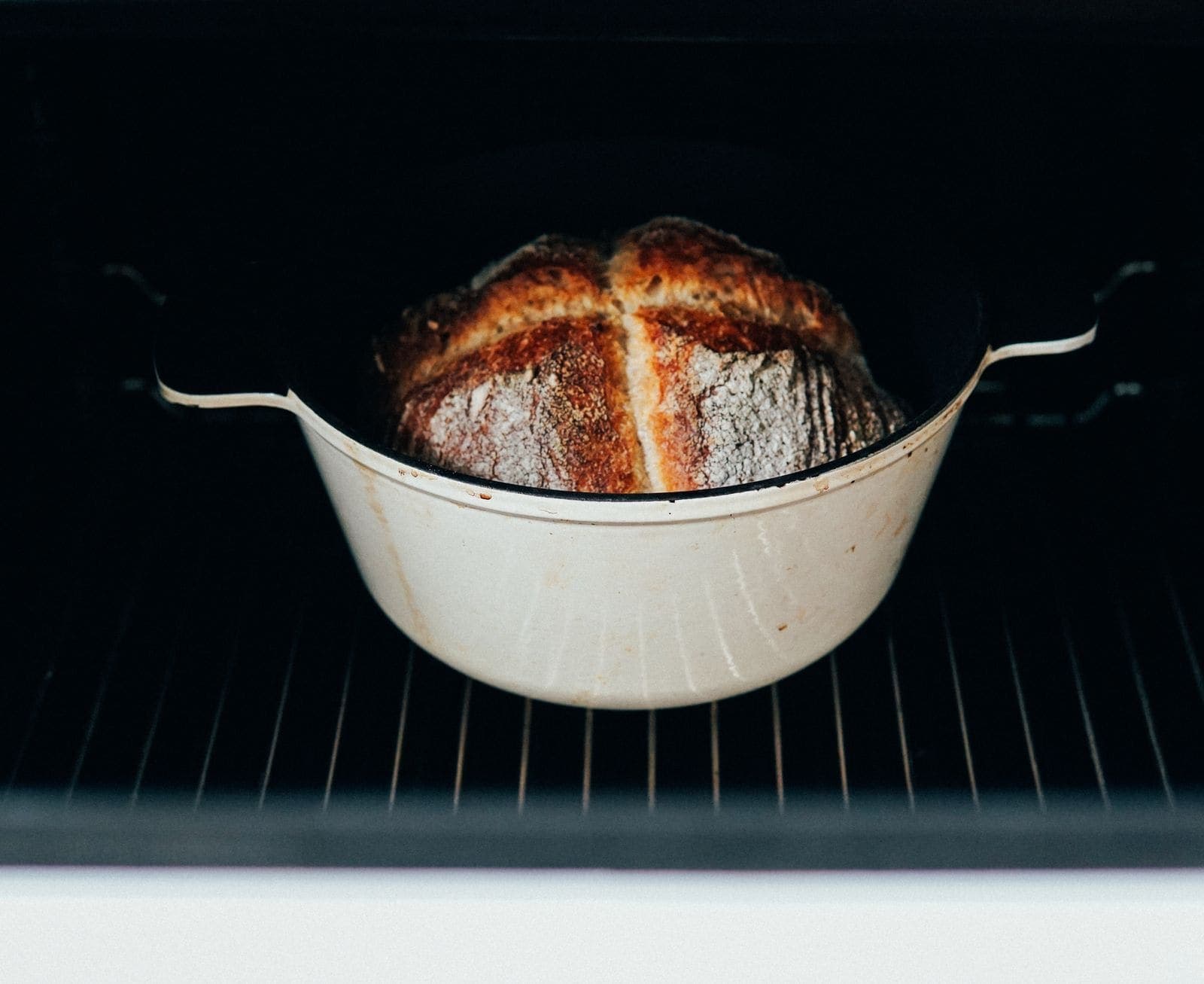
If sourdough is your reason for buying, the target is a 5-quart round. Baking specialists like Cast Iron Warehouse and DreamWhip Bakers call it the single-loaf sweet spot — big enough for most recipes, but small enough to trap steam around the dough and preserve oven spring, the burst of rise that gives an open crumb and a high loaf.
Bigger is not better here. The Takeout and DreamWhip both warn that a 7-quart is oversized for a standard loaf: with more floor to spread across, a smaller dough relaxes outward before it sets, and you get a flatter, wider loaf. The big pot earns its place only for large, high-hydration batards — think a batter built from around 500 grams of flour, roughly 950 grams of dough. For everything else, the 5-quart is the safer one-pot choice, which is a large part of why it’s such a strong all-around recommendation.
Will a whole chicken fit? (by weight)
Chicken fit is really a question of pounds, and Lodge’s chart is the cleanest guide:
- 3 to 4.5 quarts: a small chicken.
- 5 to 6 quarts: up to a 4-pound bird — the range most standard supermarket chickens fall into.
- 7 to 7.5 quarts: up to a 6-pound roaster.
- 9 quarts: up to a 9-pound bird.
For most people, this settles it: a 5.5-quart handles the everyday roast chicken with room for the lid to seal. If you like to roast larger 5-to-6-pound birds, want vegetables tucked around the chicken, or occasionally cook a turkey breast, step up to a 7-quart or reach for an oval, whose shape suits an elongated bird.
A note on bare vs enameled (and how price scales)
Almost everything above assumes an enameled cast-iron Dutch oven — the braising-season default, because the enamel coating needs no seasoning and shrugs off acidic tomato and wine braises that can turn bare iron metallic. Bare cast-iron Dutch and camp ovens still exist and cost far less, but they follow different care rules and a different price logic, so don’t size them by the same math. If you’re choosing between the two finishes, our Lodge vs. premium cast iron comparison lays out the trade-offs, and the enameled cast-iron care guide covers keeping the coating intact.
On price, think in bands rather than exact figures, because Dutch ovens discount heavily and often:
- Budget enameled ($): value lines like Tramontina’s Bestow put a capable 5.5-quart within reach of most kitchens.
- Value ($$): the ATK Best Buy Cuisinart 7-quart and Lodge’s enameled line — the latter backed by one of the category’s strongest warranties — deliver most of the performance for a fraction of the premium price.
- Premium ($$$): Le Creuset and Staub sit at the top, with the heirloom finish, resale value, and color range that justify the jump for some buyers.
Prices move constantly — the premium pots in particular swing between full retail and deep sale — so check the current number before you commit rather than anchoring on a sticker.
How we researched this
This guide synthesizes sizing guidance from the three brands that dominate the category — Le Creuset, Lodge, and Made In — cross-checked against independent testing from America’s Test Kitchen and Prudent Reviews, plus specialist baking sources for the bread-size question. Where the brands and the labs disagree — most notably on 5.5 versus 7 quarts — we’ve shown both cases rather than forcing a single verdict. Every figure here is attributed; we ran no testing of our own for this piece.
Sources
- Le Creuset: How to Choose the Right Size Dutch Oven
- Le Creuset: Round or Oval Dutch Oven?
- Le Creuset: Round Dutch Oven (product listing)
- Lodge: What Size Dutch Oven Do I Need?
- Made In: Dutch Oven Sizes
- America’s Test Kitchen: The Best Large Dutch Ovens
- America’s Test Kitchen: Dutch Oven Shopping Guide
- America’s Test Kitchen: Round or Oval Dutch Oven?
- Prudent Reviews: Oval vs. Round Dutch Oven
- OvenSpot: Staub Cocotte Sizes
- Cast Iron Warehouse: Choosing the Right Size Dutch Oven for Sourdough
- DreamWhip Bakers: Best Size Dutch Oven for Sourdough Bread
- The Takeout: What Size Dutch Oven for Sourdough Bread
- Boonie Hicks: What Size Dutch Oven Is Best?
- The Skillful Cook: What Size Dutch Oven
- Tramontina: Bestow 5.5-Quart Enameled Cast Iron Dutch Oven
- Staub 5.5-qt Round Dutch Oven (via Zwilling)