For most home cooks, the best stand mixer is still the KitchenAid Artisan 5-quart tilt-head (KSM150). It is the one machine that does nearly everything a home kitchen asks of it, it plugs into the largest attachment ecosystem in the category, and it holds its value better than anything else you can buy. If you want a single, safe recommendation and you do not bake bread in volume, buy that and stop reading.
But the honest picture in 2026 is more contested than most buying guides admit, and the gap matters if you bake seriously. America’s Test Kitchen’s latest round of testing did not crown a KitchenAid at all — its overall winner is the motor-in-base Ankarsrum Original, with the cheaper KitchenAid Classic, not the Artisan, taking its best-value slot. Meanwhile, ATK reports that KitchenAid’s newer premium Artisan Plus overheated and shut down during durability testing. So the real answer depends on one question: are you a cakes-and-cookies baker, or do you knead stiff dough week after week? Below, we split the field by use case so you can skip the guesswork.
The best stand mixers at a glance
| Pick | Best for | Type | Bowl (usable) / weight | Motor | Price band | Buy it if |
|---|---|---|---|---|---|---|
| KitchenAid Artisan 5-qt (KSM150) | Most home cooks | Tilt-head planetary | 5 qt (~3 qt usable) / ~20.7 lb | 325W direct-drive | $$ | You want one versatile mixer and the full attachment hub |
| KitchenAid Classic 4.5-qt (K45SSWH) | Best value | Tilt-head planetary | 4.5 qt / lighter | Direct-drive | $$ | You want KitchenAid capability for less money |
| Ankarsrum Original (6230) | Serious / high-volume bread | Motor-in-base | 7 L (~5.25 qt usable) / ~18–19 lb | Motor-in-base (retailer-listed ~600W) | $$$ | You bake bread often and want no heat ceiling |
| Bosch Universal Plus | High-volume mixed baking | Motor-in-base (belt) | 6.5 qt / ~12.7 lb | Belt-driven motor-in-base | $$$ | You knead multiple loaves at a time |
| Cuisinart Precision Master (SM-50) | Budget | Tilt-head planetary | 5.5 qt | 500W direct-drive | $ | You want the most mixer for the least money |
| KitchenAid Artisan Mini 3.5-qt (KSM3316X) | Compact / small-batch | Tilt-head planetary | 3.5 qt (~1.9 qt usable) / ~16 lb | Direct-drive | $$ | Your kitchen or your batches are small |
| KitchenAid 7-qt Bowl-Lift (KSM70) | Splurge / big batches | Bowl-lift planetary | 7 qt (~5.25 qt usable) / ~25.6 lb | Direct-drive | $$$ | You want maximum KitchenAid power and capacity |
Price bands: $ = under $200 · $$ = $200–500 · $$$ = $500+. Weights and usable-capacity figures reflect America’s Test Kitchen’s measurements and retailer listings.
One caveat before you compare that “Motor” column: wattage is not comparable across drive types. A KitchenAid’s 325-watt direct-drive motor and a Bosch or Ankarsrum motor-in-base rated at 500–600 watts are engineered completely differently, and the bigger number does not mean the better machine. Treat watts as a rough within-brand signal, not a cross-brand scoreboard. More on that below.
How we chose (and what we didn’t do)
Cookloom is a young publication, and we are not going to pretend we have kneaded a decade of sourdough on every machine here. We haven’t. Instead, this guide synthesizes the most rigorous independent testing available and labels every claim by its source, so you can see exactly where a verdict comes from.
We leaned most heavily on two lab programs that buy their own units and run standardized batches: America’s Test Kitchen, whose 2026 round tested creaming, whipping, and stiff-dough kneading across drive types, and Consumer Reports, whose scored tests cover cake batter, egg whites, and whipped cream. For bread specifically — the use case where the field diverges most — we weighed King Arthur Baking, which recommends by dough behavior rather than brand loyalty. For longevity, repairability, and ownership patterns we drew on Prudent Reviews and a long-term owner account at Amy Bakes Bread, both of which we flag clearly as single-owner or community-sourced rather than lab results.
The most important thing to say up front is that the “best overall” label is genuinely split. Wirecutter and most affiliate roundups default to a KitchenAid Artisan tilt-head. America’s Test Kitchen’s 2026 winner is the Ankarsrum. We are not going to paper over that disagreement to make the page feel tidier — we are going to map it to what you actually bake.
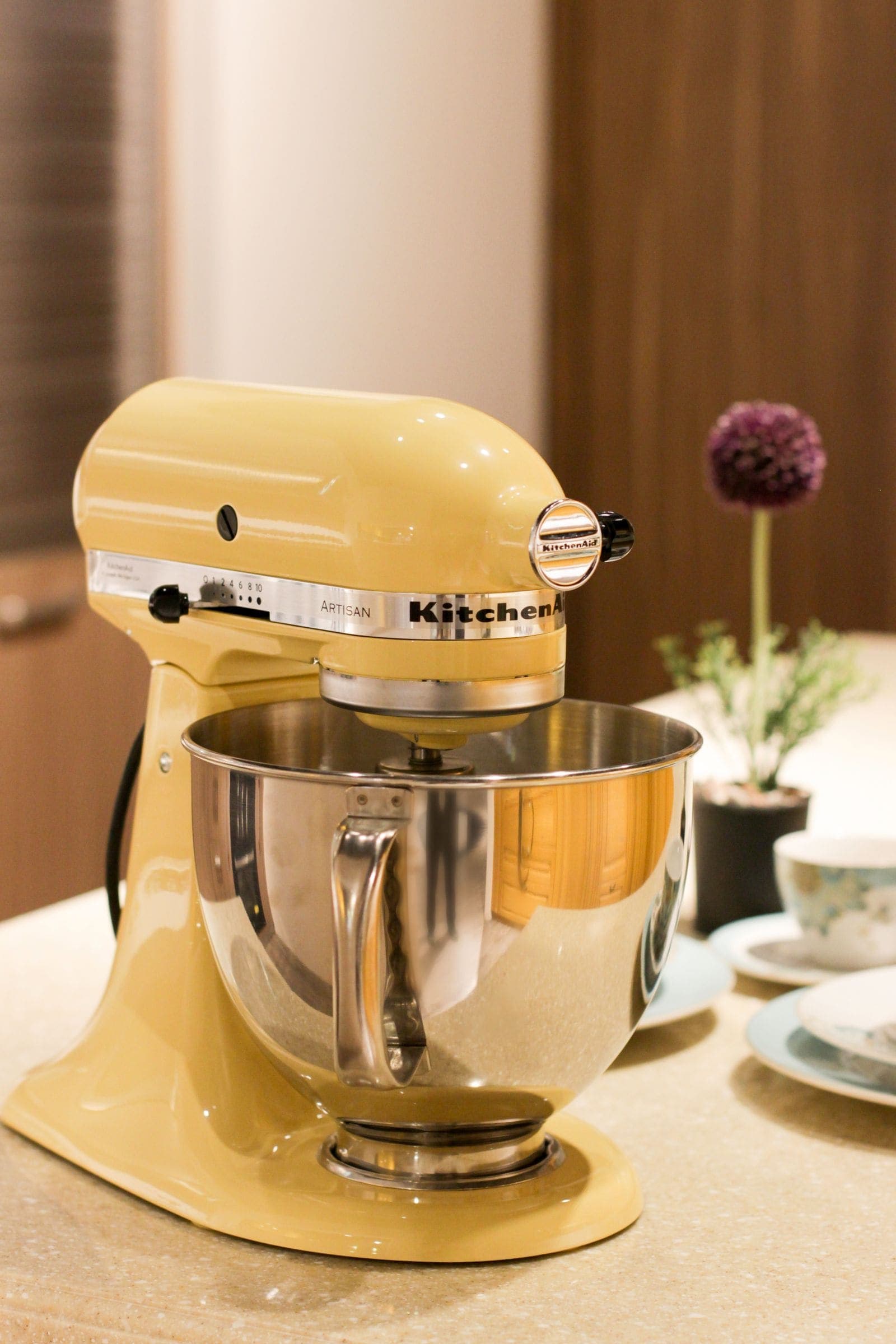
Best overall for most people: KitchenAid Artisan 5-qt Tilt-Head (KSM150)
The Artisan earns the default recommendation less because it wins any single test outright and more because it does everything competently while opening a door nothing else can. KitchenAid lists it with 10 speeds, a 5-quart stainless bowl, and access to more than ten power-hub attachments — the pasta rollers, meat grinders, and spiralizers that turn a mixer into a small kitchen system. That ecosystem is the real moat, and it is why the Artisan holds resale value and why a used one is easy to sell.
On raw performance, the reviews are fair rather than fawning. America’s Test Kitchen calls it a “competent mixer” that finished every batch it was given, but notes the 5-quart bowl holds only about 3 quarts of usable working volume, and that the machine “rocked and got very warm” under heavier loads. Consumer Reports has long kept KitchenAid tilt-heads among its recommended models for everyday mixing. Translation: for cookies, cakes, frostings, the occasional loaf, and the full run of attachments, this is the right machine for the largest number of people. It is only when you push into frequent, stiff-dough kneading that its limits start to show — which is exactly the split the rest of this guide is built around.
If you are weighing the Artisan against KitchenAid’s step-up Professional line, our Artisan vs. Professional comparison breaks down when the bowl-lift upgrade is worth it.
The value reality check
Here is the finding most roundups quietly skip: when America’s Test Kitchen priced performance against cost, its best mid-priced pick was not the Artisan but the cheaper KitchenAid Classic 4.5-quart (K45SSWH). ATK found its “across-the-board performance knocked out many competitors” that were bigger and more expensive. The Classic gives up a little bowl capacity and the polished styling, but for a lot of kitchens it delivers the same core capability for meaningfully less money.
So before you reach for the Artisan on reputation alone, ask whether you actually need the extra half-quart and the nicer finish. If you are trying to decide between KitchenAid’s tiers — Classic, Artisan, and Professional — our guide to which KitchenAid mixer to buy walks through the differences that matter and the ones that are mostly marketing.
Best for serious and high-volume bakers: Ankarsrum Original + Bosch Universal Plus
If you bake bread on a schedule — weekly sourdough, batches of bagels, stiff pizza dough — this is the section that should change your shortlist. Both of these machines are motor-in-base designs: instead of a motor in an overhead head driving a beater down into the bowl, the motor sits underneath and the bowl does more of the work. The practical payoff is stability and, critically, heat headroom. Planetary mixers concentrate load and warmth in the head; motor-in-base machines are built to run long, heavy kneads without hitting the thermal wall that made KitchenAid’s newer Artisan Plus overheat in ATK’s durability testing.
Ankarsrum Original (6230) is America’s Test Kitchen’s overall winner for 2026. ATK praised its “powerful performance” and “excellent visibility” into the bowl, and reported that it kneaded pizza and bagel dough “quickly and effortlessly.” Retailer listings put its bowl at 7 liters (about 5.25 quarts usable), its weight around 18–19 pounds, and — notably in a category where KitchenAid offers just one year — its base warranty at seven years. King Arthur Baking independently names the Ankarsrum its best mixer for bread, explaining that the motor-in-base design makes it “much steadier,” that it handles “the stiffest bread doughs,” and that its roller mimics hand kneading. There is a real learning curve: the Ankarsrum mixes nothing like a KitchenAid, and cake batter and small batches are not its strength. But for a dedicated bread baker, it is arguably the last mixer you will buy.
Bosch Universal Plus is the other serious-baker answer, and it suits a slightly different person. It is a belt-driven motor-in-base machine with a 6.5-quart bowl, and at roughly 12.7 pounds it is far lighter than you would expect for its capacity — America’s Test Kitchen rates it “recommended,” noting strong performance but the need to switch attachments mid-recipe. Its real party trick is throughput: manufacturer and retailer materials describe it kneading up to around 14 loaves’ worth of dough in a single batch. One long-term owner writing at Amy Bakes Bread reports running a Bosch for more than nine years with no motor issues and reaching for it for “multiple loaves weekly” — while, in the same account, saying she burned out two KitchenAid motors kneading bread. We flag that last point as a single owner’s experience, not a lab result, but it rhymes with the structural story: for heavy, repeated kneading, motor-in-base machines are simply built for the duty cycle.
Which of the two? If you want maximum dough volume and the lightest heavy-duty machine, lean Bosch. If you want the smoother learning payoff, the longer warranty, and the pick two independent programs rate at the very top, lean Ankarsrum. We go deeper on the trade-offs — including where a KitchenAid still makes more sense — in our KitchenAid vs. Bosch vs. Ankarsrum comparison.
Best budget: Cuisinart Precision Master (SM-50)
The Cuisinart Precision Master is the value spoiler that looks better than the Artisan on a spec sheet: 12 speeds, a 5.5-quart bowl, and a 500-watt direct-drive motor against KitchenAid’s 325 watts. Homes & Gardens calls it the best bet under $300 and notes it goes on sale often, which can drop it into genuine bargain territory.
Just remember the wattage caveat from earlier — within the same direct-drive design, more watts helps a little, but it does not vault the Cuisinart past better-built machines. America’s Test Kitchen recommends the SM-50 “with reservations,” reporting that it “struggled to whip egg whites” and needed frequent scraping because of gaps between the attachment and the bowl. That is the honest shape of a budget stand mixer: it will handle cookie dough, cake batter, and light bread perfectly well, and it will occasionally make you work for a perfectly whipped meringue. For a first mixer, a dorm or starter kitchen, or a gift, it is a lot of capability for the money.
Even cheaper, still recommended
If your ceiling is lower still, Consumer Reports points to two options that punch above their price. The Hamilton Beach Professional All-Metal (63240) is a compact tilt-head that CR found “equally good at whipping egg whites and kneading,” and the Pioneer Woman 5-quart is one CR says “outperforms many pricier ones.” Neither has KitchenAid’s attachment universe, but if you just need a competent mixer and not a platform, they deliver.
Best compact and small-batch: KitchenAid Artisan Mini 3.5-qt
Small kitchens have a real pick here rather than a compromise. The KitchenAid Artisan Mini (KSM3316X) is America’s Test Kitchen’s “best small” mixer, and ATK reports it “aced nearly every test” — the lone exception being high-hydration pizza dough, which is a lot to ask of any 3.5-quart machine. Consumer Reports separately credits it with “excellent results in quickly whipping egg whites.” You give up usable volume — figure under 2 quarts of real working capacity — and it still takes standard KitchenAid tilt-head attachments, so the ecosystem comes with it. For couples, small households, or anyone baking in modest batches on a tight counter, the Mini is the rare downsize that does not feel like one.
If weight is the problem, not counter space
Compactness and light weight are two different needs, and they point to different machines. If your real issue is lifting and moving the mixer — an accessibility concern for a lot of home bakers — America’s Test Kitchen’s “best lightweight” pick is the NutriMill Artiste at about 11.65 pounds, with a 500-watt motor and roughly 4.6 quarts of usable capacity. ATK found it “aced whipped cream and egg whites.” It gives you near-full capacity in a package you can actually pick up one-handed, which the Mini’s small footprint does not address.
Best splurge: KitchenAid 7-qt Bowl-Lift (KSM70)
If you want the biggest, most capable KitchenAid and the attachment ecosystem to go with it, the 7-quart Bowl-Lift (KSM70) is the machine. This is a bowl-lift design rather than a tilt-head: the bowl clamps to arms that raise it into the beater, which is sturdier under load than a hinged head. America’s Test Kitchen rates it “highly recommended,” describing cake batter that came out “smooth as silk” and bread dough that turned “gorgeous and elastic,” with about 5.25 quarts of usable capacity. Consumer Reports agrees, calling it excellent at cake and pancake batter and at whipping egg whites, and noting that it runs quietly. It is heavy — around 25.6 pounds — so give it a permanent home on the counter.
Two honest footnotes. If you want to go even bigger, KitchenAid’s Commercial 8-quart earns Consumer Reports’ top marks for cream, egg whites, and cake batter, at roughly four figures. And if your splurge is really about bread, remember that the Ankarsrum above is the dedicated baker’s premium pick, not this — the 7-quart is the splurge for a do-everything KitchenAid household. Whichever big mixer you choose, knead the dough in the machine and bake the loaf in a heavy pot: our guide to the best Dutch ovens covers the vessel that turns good dough into a bakery-style crust.
What to look for in a stand mixer
Drive type is the first fork in the road. Tilt-head planetary mixers (most KitchenAids, the Cuisinart) are lighter, cheaper, and easy to load. Bowl-lift planetary mixers (the KSM70) trade convenience for rigidity under heavy loads. Motor-in-base machines (Ankarsrum, Bosch) are the specialists: steadier and cooler through long kneads, with a steeper learning curve and less finesse on small or delicate batches. Decide which of these three you are before you compare brands. If you want to go deeper, we break down the tilt-head vs. bowl-lift trade-off in the Artisan-versus-Professional guide.
Usable capacity is not the number on the box. A 5-quart bowl does not mean 5 quarts of working room — America’s Test Kitchen measured the Artisan’s usable volume at roughly 3 quarts. Match usable capacity to your typical batch, not to the marketing figure.
Watts mislead across drive types. This is worth repeating because it is the most common way buyers get talked into the wrong machine. A 325-watt direct-drive KitchenAid and a 600-watt motor-in-base Ankarsrum are not on the same scale. Higher watts do not equal better mixing across designs; they only offer a loose comparison within the same design.
The attachment ecosystem is a real, lasting advantage. KitchenAid’s power hub is the one feature no competitor matches at scale, and it is the reason so many people buy in. Whether the add-ons are worth it depends on how you cook — we sort the genuinely useful from the drawer-filling in our guide to KitchenAid attachments worth buying.
Repairability and the sacrificial gear. KitchenAid mixers use a nylon worm gear that is designed to strip when the machine is overloaded — a fail-safe that sacrifices a cheap part to protect the motor. Repair communities like The Fresh Loaf note that “most KitchenAid problems can be solved with a new worm gear and new grease,” an inexpensive DIY fix. Read that as both a reassurance (the machine is repairable) and a warning (heavy dough is what strips the gear).
Warranty and longevity. KitchenAid’s warranty is a short one year, though Prudent Reviews reports owners commonly getting around 15 years of service and, with care, far longer — while also noting some owners feel older units were built better than recent production. The Ankarsrum’s seven-year base warranty is an outlier in the category. And there is a genuine vintage angle: community sources like The Takeout report that pre-1986 Hobart-built KitchenAids can run 40-plus years and turn up used for around the price of a nice dinner.
Who should skip a stand mixer
The most honest thing a buying guide can do is tell you when not to buy. A stand mixer is a large, heavy, expensive object, and plenty of good bakers do not need one.
- You bake a few times a year. A hand mixer whips cream, beats egg whites, and creams butter and sugar for a fraction of the price and storage. Reach for a stand mixer when the frequency justifies the counter space.
- You are bread-first and cakes-rarely. If dough is your whole reason for wanting a mixer, a food processor kneads small batches fast, and a motor-in-base machine handles big ones better than any planetary mixer — a mid-range tilt-head is the awkward middle you may not want.
- Your kitchen is genuinely tiny. Before committing 20-plus pounds to a permanent counter spot, be honest about whether it will get used enough to deserve the real estate.
If you are still on the fence, we made a whole guide for exactly this decision: do you need a stand mixer?
Sources
- America’s Test Kitchen — The Best Stand Mixers
- Consumer Reports — Best Stand Mixers From Consumer Reports’ Tests
- King Arthur Baking — The Best Stand Mixer for Bread
- KitchenAid — Artisan Series 5-Quart Tilt-Head Stand Mixer (KSM150)
- KitchenAid Product Help — Kneading Times and Speeds
- Prudent Reviews — KitchenAid Mixer Review
- Homes & Gardens — KitchenAid vs. Cuisinart Stand Mixers
- Amy Bakes Bread — KitchenAid, Bosch, and Ankarsrum Review
- The Fresh Loaf — Diagnosing the Ills of a KitchenAid K5SS
- The Takeout — How to Identify a Vintage KitchenAid Mixer