Stainless steel is the workhorse material of serious kitchens: it sears and browns beautifully, builds fond for pan sauces, goes in the oven, shrugs off metal utensils, and lasts for decades with no coating to wear out. The catch is that quality lives entirely in the construction — you want fully-clad stainless, where steel and aluminum are bonded through the whole pan, never a cheap disc-base pan. Our benchmark is the All-Clad D3 Stainless 12-Inch Fry Pan, the tri-ply, made-in-USA standard most roundups measure against. The best value, by a wide margin, is the Tramontina Tri-Ply Clad 12-Piece Cookware Set — genuine fully-clad tri-ply for a fraction of premium money. And if you want a heavier 5-ply build, the Made In Stainless Clad 10-Piece Set and the USA-made Heritage Steel Titanium Series 5-Piece Essentials Set deliver it. One honest caveat up front: stainless isn’t nonstick, but the water-drop preheat trick (covered below) makes it behave.
At a glance
| Pick | Best for | Ply | Made in | Oven-safe | Price |
|---|---|---|---|---|---|
| All-Clad D3 Stainless 12-Inch Fry Pan | Best skillet / the benchmark | Tri-ply | USA | 600°F | $$$ |
| All-Clad D3 Stainless 10-Piece Cookware Set | Best full set | Tri-ply | USA | 600°F | $$$$ |
| Made In Stainless Clad 10-Piece Set | Best 5-ply value-premium | 5-ply | Italy | 800°F | $$$$ |
| Tramontina Tri-Ply Clad 12-Piece Cookware Set | Best value | Tri-ply | NSF-certified | 500°F | $$ |
| Heritage Steel Titanium Series 5-Piece Essentials Set | Best US-made | 5-ply | USA | 800°F | $$$ |
Price bands: $ budget · $$ value · $$$ premium · $$$$ flagship. Oven-safe temperatures are the maker’s stated ceilings.
The one thing to check: fully-clad vs disc-base
If you remember nothing else, remember this. Good stainless cookware is fully clad: alternating layers of stainless steel and aluminum are bonded through the entire pan, walls included. Because aluminum spreads heat far better than steel does, a fully-clad pan heats evenly across the whole cooking surface and up the sides — no hot ring in the middle, no cool edges. Cheap stainless is usually disc-base (impact-bonded): an aluminum disc is stuck to the bottom only, so the base heats while the walls stay comparatively cool and food browns unevenly. Every pan in this guide is fully clad. This single distinction matters more than brand, price, or number of layers.
Once you’re buying fully clad, the next question is ply count. Tri-ply means three bonded layers — steel, aluminum, steel. Five-ply adds more aluminum (and sometimes more steel) for even heat and better retention, usually at a higher price. It’s worth being clear that 5-ply is a refinement, not a requirement: the tri-ply All-Clad D3 has been the reference pan for decades. Among our picks, the All-Clad D3 and Tramontina are tri-ply; the Made In and Heritage Steel sets are 5-ply.
Ply construction also drives one spec that trips people up: oven-safe temperature. A fully-clad pan with no plastic parts can take real oven and broiler heat, but the ceiling varies by maker. The All-Clad D3 is rated to 600°F, the value tri-ply Tramontina to about 500°F, and the 5-ply Made In and Heritage Steel sets all the way to 800°F. If you finish steaks under the broiler or move pans straight into a hot oven, check that number before you buy.
What stainless does best (and where it doesn’t)
Stainless earns its keep on the tasks that matter most to good cooking. It sears and browns without a coating getting in the way, so you get a deep crust on steak, chicken thighs, and mushrooms. It builds fond — those browned bits stuck to the pan — which you deglaze into a pan sauce that a nonstick pan simply can’t give you. It’s oven- and broiler-safe, takes metal utensils and metal whisks without a scratch worry, and has no coating to fail, so a well-made clad pan is genuinely a decades-long purchase.
Where it asks something back: eggs and delicate fish stick more than they would on a coated pan, and premium clad is expensive. The honest move is to match the pan to the job. For eggs, omelets, and crêpes, a nonstick pan is easier — see our best nonstick cookware picks (and whether it’s safe, in our nonstick safety guide). If you want a coating without PTFE, look at ceramic cookware, or weigh the two in our ceramic vs nonstick comparison. For heat retention and a naturally slick seasoned surface, a cast-iron skillet is the tool; for braises and soups, a Dutch oven. A complete kitchen usually runs stainless plus one nonstick pan.
The picks
All-Clad D3 Stainless 12-Inch Fry Pan — the benchmark
The All-Clad D3 Stainless 12-Inch Fry Pan is the pan nearly every roundup measures against, and for good reason: it’s fully-clad tri-ply, made in the USA since 1971, and oven- and broiler-safe to 600°F. Testing consensus across the major review outlets treats it as the standard for even heating and long-term durability — the reference other pans are graded against rather than a flashy newcomer. The tradeoff is price ($$$ for a single skillet) and a flared, keep-you-honest handle some cooks love and some don’t. If you buy one stainless pan for the rest of your cooking life, this is the safe answer. For the wider skillet field, see our best stainless steel skillet guide.
All-Clad D3 Stainless 10-Piece Cookware Set — best full set
Want the benchmark across your whole rangetop? The All-Clad D3 Stainless 10-Piece Cookware Set is the heirloom option: the same fully-clad tri-ply build and 600°F ceiling in a matched set of skillets, saucepans, a sauté pan, and a stockpot. It’s a flagship-priced purchase ($$$$), but per-piece it costs less than buying D3 open-stock, and it’s the set most likely to outlast the kitchen it’s in. If you’re comparing complete kitchens, our best cookware sets roundup puts it in context.
Made In Stainless Clad 10-Piece Set — best 5-ply value-premium
The Made In Stainless Clad 10-Piece Set is the direct-to-consumer challenger: 5-ply construction, crafted in Italy, oven-safe to a high 800°F, with a stay-cool handle. Selling direct lets Made In offer an All-Clad-grade build for less than a comparable legacy-brand set, which is why it’s become a default recommendation for cooks who want more aluminum and a higher oven ceiling without paying the very top of the market. It still lands at a flagship band ($$$$) for the full ten pieces — you’re paying for 5-ply, not cutting a corner. Deciding between the two heavyweights? Our All-Clad vs Made In breakdown is built for exactly that call.
Tramontina Tri-Ply Clad 12-Piece Cookware Set — best value
The Tramontina Tri-Ply Clad 12-Piece Cookware Set is the value champion, full stop. It’s genuine fully-clad tri-ply — the important kind of construction — is NSF-certified, and is oven-safe to 500°F, at a fraction of premium prices. This is the set reviewers keep circling back to as the smart-money pick: you get the even-heating clad build that actually matters, and you skip the badge premium. The 500°F ceiling is lower than the 5-ply sets and the finish is a touch less refined, but for most home cooks this is the rational default. It also anchors our best budget cookware set guide if you’re shopping the low end hard.
Heritage Steel Titanium Series 5-Piece Essentials Set — best US-made
The Heritage Steel Titanium Series 5-Piece Essentials Set is the specialist’s choice: 5-ply, made in the USA, oven-safe to 800°F, and built with a titanium-strengthened 316Ti cooking surface that’s more corrosion-resistant than standard stainless — with no coatings anywhere. The Essentials set is a smaller, considered kit rather than a fill-every-cabinet haul, which suits cooks who’d rather own a few excellent pieces ($$$) than a big box of them. If made-in-USA and a hardier surface rank high for you, this is the pick.
How we chose
We’re a new publication and we say so plainly: we have not run our own lab tests on these pans, so nothing here is dressed up as first-hand measurement. Instead, we built these picks from the broad consensus of established equipment testers and each maker’s published specifications, then weighted everything toward the one factor that reliably separates good stainless from bad — fully-clad construction. Construction facts (ply count, made-in country, oven-safe ceilings, NSF certification) come from the manufacturers: All-Clad’s D3 specs, Made In’s Stainless Clad line, and Tramontina’s Tri-Ply Clad set. The technique guidance below follows standard cooking convention as documented by sources like All-Clad and Food Network.
How to keep food from sticking
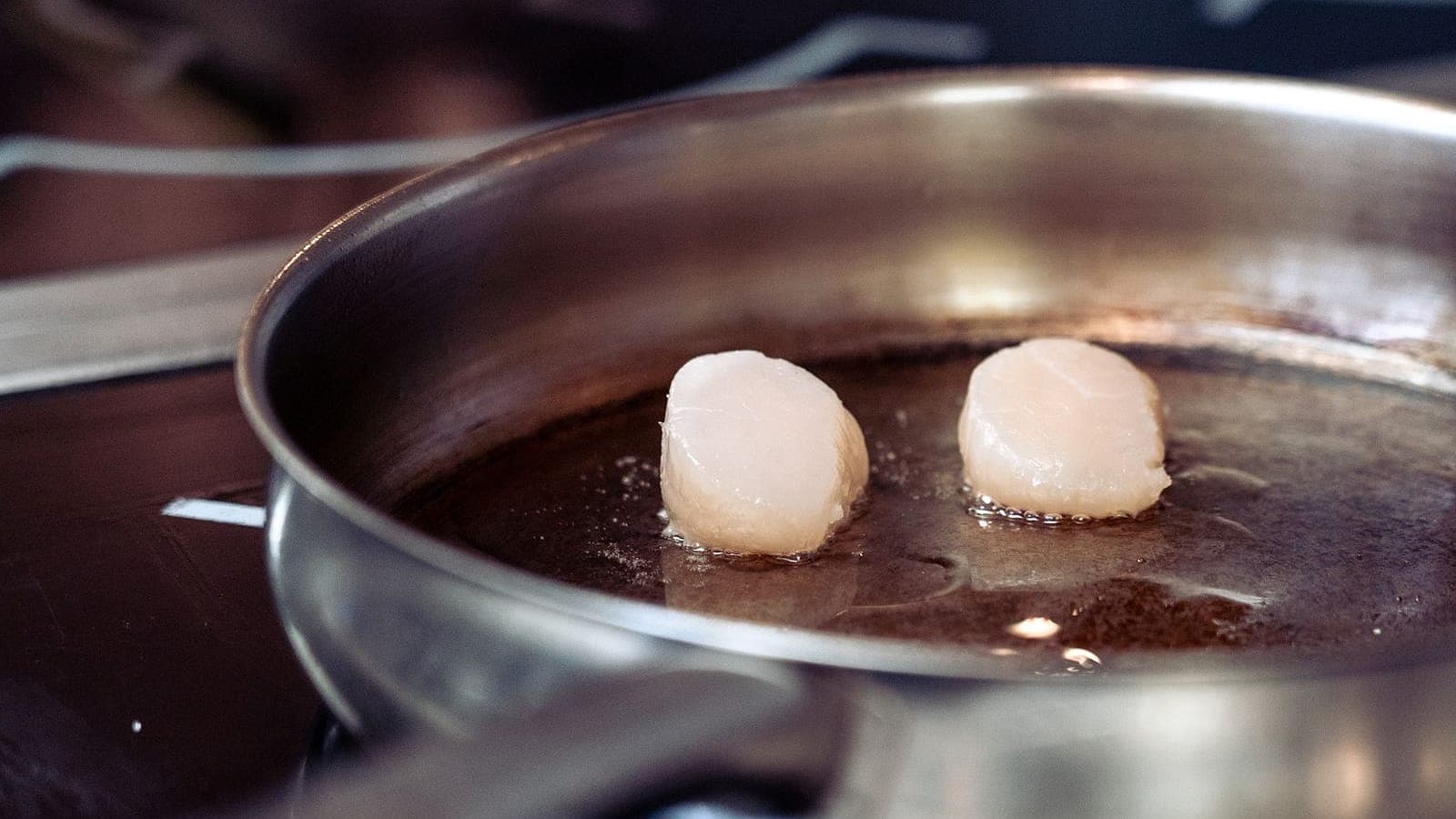
Stainless food sticks for one main reason: the pan is too cool. The fix is a short, standard routine. Preheat the dry pan for about two minutes over medium heat. Then run the water-drop (Leidenfrost) test: flick a few drops of water in, and when they bead up and skate across the surface like mercury — rather than sizzling and evaporating on contact — the pan is ready. Now add oil (it should shimmer, not smoke), then add your food.
Here’s the part beginners fight: food sticks at first and then releases on its own once a proper sear forms. Don’t force it. If a piece of chicken resists the spatula, give it another minute and it will let go. Two things sabotage this — heat that’s too high (smoking oil, scorched fond) and food added straight from the fridge, which drops the pan temperature. Once you’ve seared, deglaze the browned fond into a quick pan sauce; that fond is a stainless superpower a nonstick pan can’t offer. Our full walkthrough lives in how to cook on stainless steel without sticking.
Buying a set vs a skillet
A set costs less per piece and everything matches, but it always includes a few pieces you may rarely use. Open-stock lets you buy exactly what you cook with — for many people that’s one 12-inch skillet, a 3-quart saucepan, and a stockpot, and nothing else. Neither approach is wrong; it depends on how you cook. If you want a matched kitchen in one purchase, start with our best cookware sets roundup, or the best budget cookware set if price leads. If you’d rather build up piece by piece, the best stainless steel skillet is the one pan to buy first.