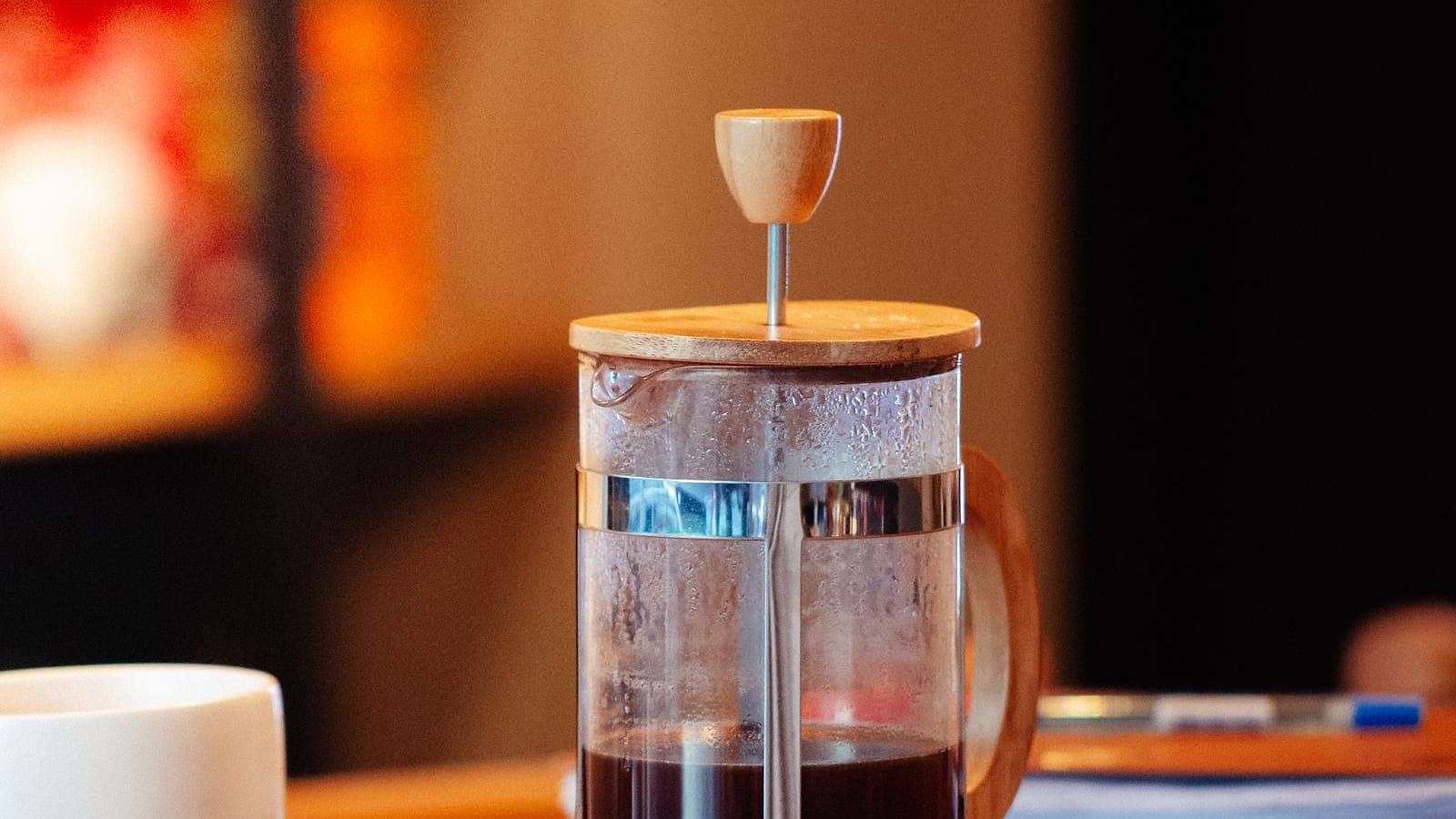
The best French press for most people is the Bodum Chambord — the cheap, handsome, endlessly repairable press most of us picture when we hear the words. It makes the richest, most full-bodied cup of any everyday brewer because the coffee steeps in full contact with the water, and a metal mesh, not paper, lets the coffee’s oils through into the cup. If the one thing you dislike about press coffee is the silt at the bottom of the mug, the Espro P3 — Wirecutter’s pick — fixes exactly that with a patented double micro-filter that brews grit-free. But whichever you choose, the whole method rests on a single rule: grind coarse. Fine grounds slip through the mesh and turn the cup muddy and bitter, and that one mistake is the number-one reason French press coffee disappoints people.
At a glance
| Pick | Best for | Filter | Price |
|---|---|---|---|
| Bodum Chambord (34 oz) | Most people — the classic | Single steel mesh | $ |
| Espro P3 | A clean, grit-free cup | Double micro-filter | $$ |
Why a French press
A French press is the simplest hot brewer there is: coffee and water sit together in a carafe, steep, and then a mesh plunger separates them. That full-immersion steeping is what gives the cup its signature weight. Nothing is rushing through a bed of grounds the way it does in drip or pour-over — the coffee simply soaks, and every particle gets the same long contact with the water.
The metal filter matters just as much as the immersion. A paper filter traps the fine oils and colloids that carry a lot of coffee’s body and aroma; a steel mesh lets them pass. The result is a heavier, rounder, more sumptuous cup — think of the difference between whole milk and skim. It is the fullest expression of a coffee’s body you can get without an espresso machine.
There is a trade-off, and it is worth being honest about it: those same oils and micro-fines that make the cup rich also mean a little sediment settles at the bottom. That is the nature of the style, not a defect. A good grind keeps it to a minimum; a fine grind makes it a problem. And because a press needs no paper filters and no electricity — just hot water and four minutes — it is also the cheapest, most travel-friendly, most repairable way to make genuinely good coffee at home.
Best classic: Bodum Chambord
The Bodum Chambord is the French press most people already have a picture of in their head. The design dates to the 1950s, and it has barely needed to change: a borosilicate glass beaker in a chrome-finished steel frame, a domed lid, and that instantly recognizable rounded handle. It is made in Portugal, it looks good enough to bring to the table, and the 34-ounce size brews enough for two or three mugs at once.
What makes it the pick for most people is the combination of price and repairability. It costs very little, and when the glass eventually cracks — or the mesh screen wears out after a few years — you replace that one part rather than the whole press. Bodum sells the beakers and filter assemblies separately, so a Chambord is the rare cheap kitchen tool you can keep alive almost indefinitely. Full body, keeps the oils, easy to find parts for: it is the honest default.
The one caveat is the filter itself. The Chambord uses a single fine steel mesh, and a single mesh always lets some of the finest particles through. Grind coarse and press gently and it is barely noticeable; grind fine or plunge hard and you will taste the silt. If that trade never bothers you — and for most drinkers it doesn’t — this is all the French press you will ever need.
Best upgrade (grit-free): Espro P3
If sludge is the thing that keeps you from loving press coffee, the Espro P3 is the fix. It is Wirecutter’s pick, and the reason is its filter: instead of one mesh screen, the P3 uses a patented double micro-filter, far finer than the standard single mesh. The two stacked filters catch the fine particles a normal press lets through, so the cup pours noticeably cleaner — closer to the clarity of a pour-over while keeping most of the body a press is prized for.
The double filter does a second, quieter job. Because it seals against the sides of the carafe as you press, it isolates the brewed coffee from the spent grounds. In an ordinary press, the coffee keeps sitting on the grounds after you plunge, and it keeps extracting — which is why the last mug can taste bitter and over-brewed. The P3’s sealed filter effectively stops the brew, so a carafe stays drinkable longer. The glass is also thicker and more durable than a typical press beaker.
The costs are real but modest: it is pricier than the Chambord, and there are a couple more parts to rinse at cleanup since it is a two-piece filter. If you don’t mind a little sediment, you don’t need it. If grit is the dealbreaker, it is money well spent.
How to brew a better press
The method is short, and the standard specialty-coffee guidance is easy to remember:
- Grind coarse. Aim for something like coarse sea salt. This is the load-bearing step — see below.
- Use about a 1:15 ratio. Roughly 1 gram of coffee for every 15 grams (milliliters) of water. Scale it to your carafe and adjust to taste.
- Heat water to just off the boil — around 195–205°F. If you don’t have a thermometer, boil it and let it rest for about 30 seconds.
- Add water, stir, and cap. Pour all the water in, give it a quick stir to wet every ground, then set the lid on with the plunger up.
- Steep about four minutes. Then press the plunger down slowly and steadily.
- Pour it all off. Decant every drop into mugs or a carafe. Coffee left sitting on the grounds keeps extracting and turns bitter fast.
Now the rule everything hinges on: the grind must be coarse. A French press is the most grind-sensitive brewer in the kitchen precisely because its filter is so open. Fine grounds do two bad things at once — they slip straight through the mesh to muddy the cup, and their huge surface area over-extracts during a four-minute steep, pulling out harsh, bitter flavors. Coarse grounds stay put and extract evenly. If your press coffee is ever gritty, muddy, or bitter, the grind is the first and usually only thing to fix.
That is also why a burr grinder is the single best upgrade you can make — more than a fancier press. A burr grinder produces an even, consistent particle size, while a blade grinder chops beans into a mix of boulders and dust, and that dust is exactly what ruins a press. Our grinder guide is written for espresso, but the same machines serve every brew method; just remember a press wants a much coarser setting than espresso. See our picks in the best coffee grinders.
French press vs other methods
A French press isn’t better or worse than drip or pour-over — it makes a different cup, and you match the brewer to how you like to drink. Against a drip machine or a pour-over, the press gives you more body and a heavier mouthfeel, with the oils left in; the trade is a less pristine, slightly sedimented cup. If you want a bright, clean, tea-like cup instead, that’s the territory of pour-over. If you want walk-away volume with a machine that holds water in the ideal 195–205°F window — the range the Specialty Coffee Association certifies for — look at a drip maker. And if you want smooth, make-ahead coffee, that’s cold brew.
One thing a French press is not is an espresso maker. Despite the plunger, there is no real pressure involved — you are steeping, not forcing water through a puck at nine bars. Espresso is a different, pressurized process entirely, which is why it produces a concentrated shot with crema instead of a full mug. We break down the difference in espresso vs. coffee.
For the full lineup of brewers and how to choose between them, start with our guide to the best coffee makers.