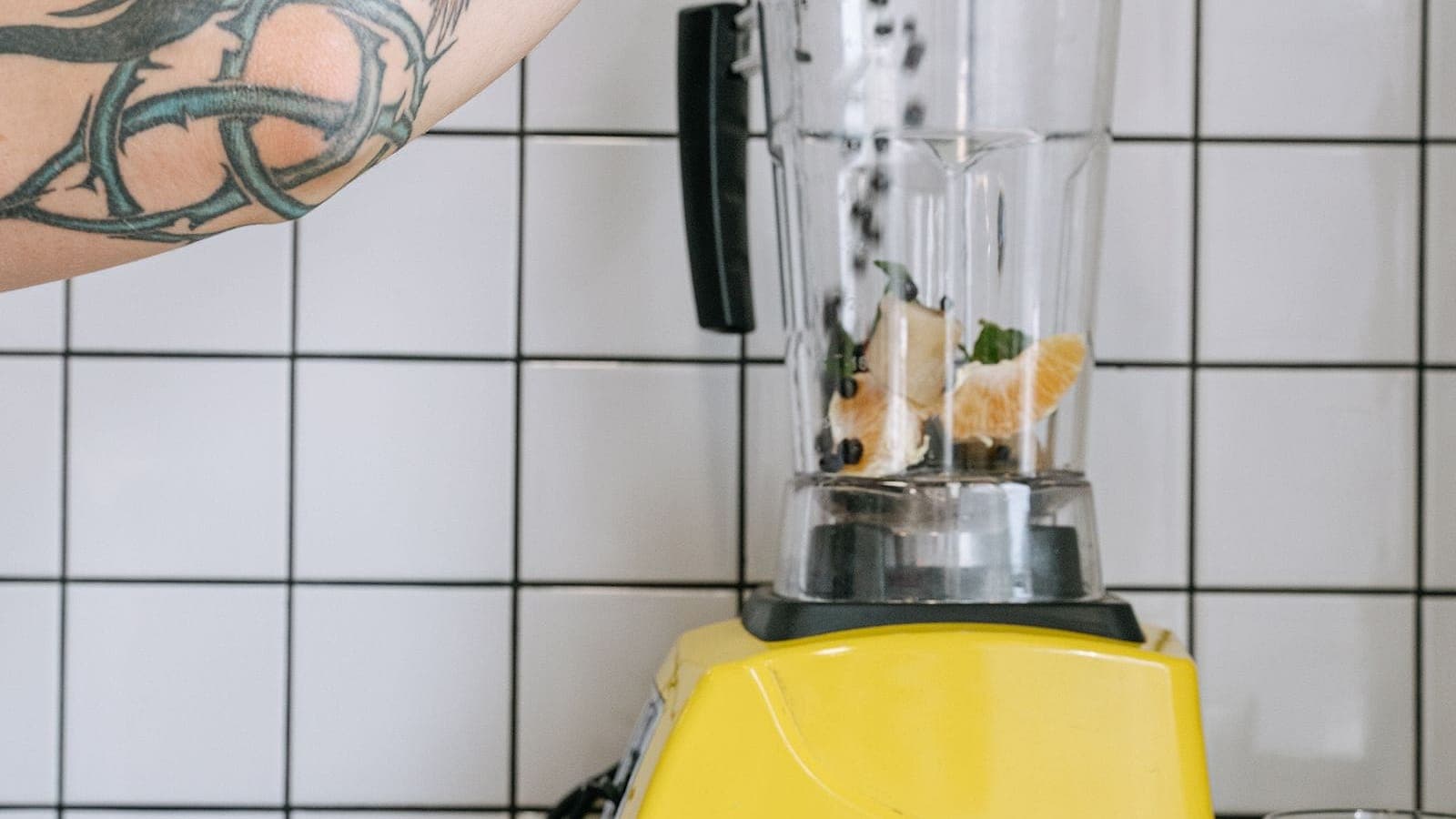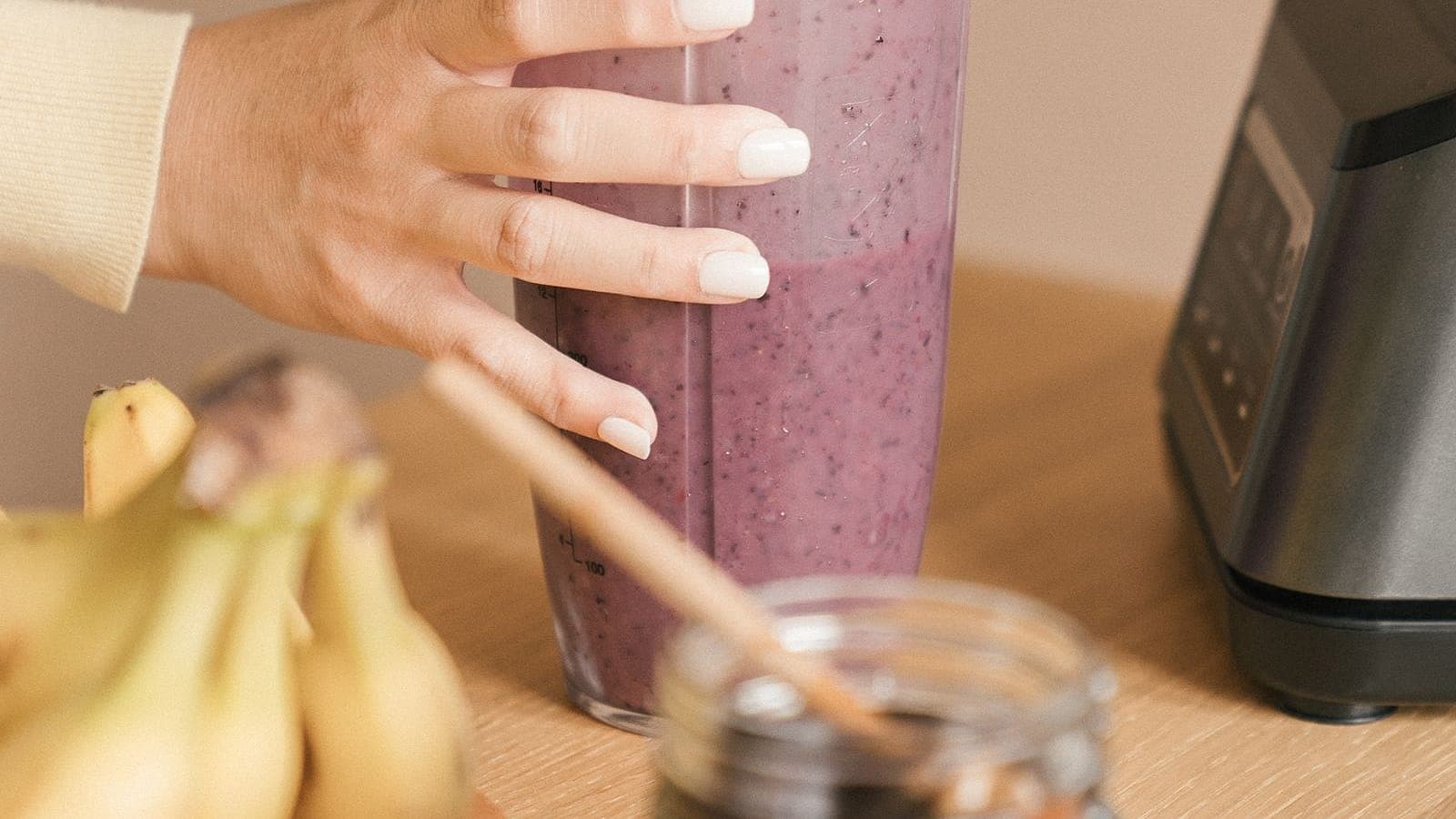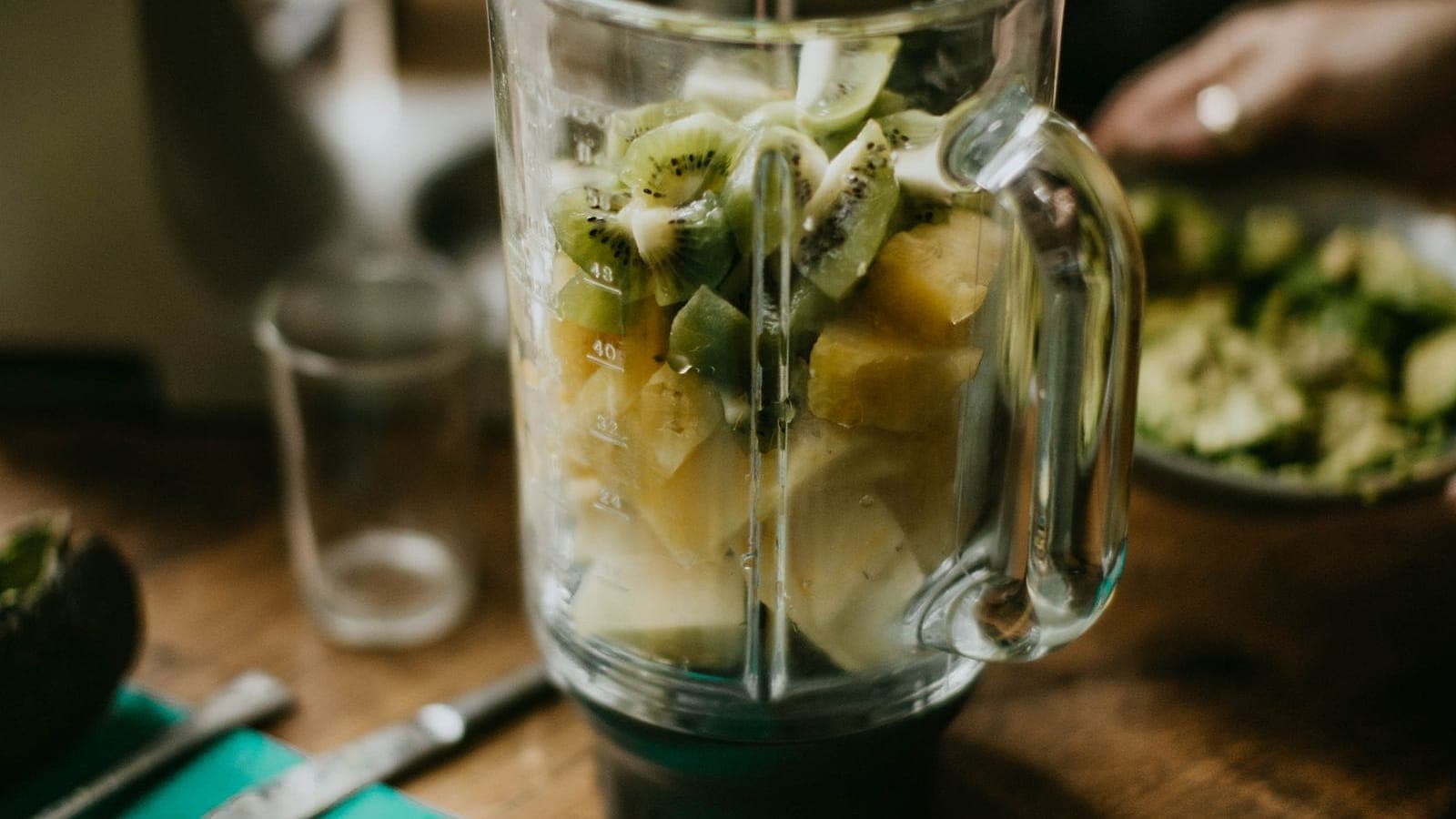
They sit on the same shelf, they both have a motor and a blade, and they both turn whole ingredients into something else — so it’s reasonable to assume a blender and a food processor are two names for roughly the same machine. They’re not. They’re built for opposite jobs. A blender is a liquid tool: it draws food down into a small blade cluster at the bottom of a tall jar, spins it into a whirlpool, and gives you something smooth and pourable — smoothies, soups, purées, sauces, drinks. A food processor is a dry-and-solid tool: a wide blade sweeps just above a low, flat bowl, and swappable disks let it chop, slice, shred, grate, and knead. The rule of thumb is nearly that simple — if the result you want is a liquid, reach for a blender; if it’s chopped, sliced, shredded, or a dough, reach for a food processor. Most kitchens are happiest with both, but if you’re buying one first, buy for the food you actually make most.
Liquid and smooth → blender. Chopped, sliced, shredded, or dough → food processor. When you’re unsure, picture the finished result, not the ingredient going in.
The 30-second answer
If you’re standing in the store deciding right now, this table is the whole argument:
| Blender | Food processor | |
|---|---|---|
| Bowl shape | Tall, narrow jar | Wide, low bowl |
| Blade | Small cluster fixed at the bottom | Broad blade near the base, plus swappable disks |
| Needs liquid? | Yes — liquid forms the vortex | No — it works dry |
| Signature result | Smooth, pourable | Chopped, sliced, shredded, kneaded |
| Typical jobs | Smoothies, soups, sauces, drinks | Chopping, slaw, dough, dips |
| Struggles with | Dry, solid, chunky work | Thin liquids and silky-smooth drinks |
Everything below is just the reasoning behind that grid.
How they actually differ
The difference isn’t marketing — it’s geometry, and once you see it you can predict what each machine will do with anything you drop in.
A blender is tall and narrow, with a small set of blades locked at the very bottom. Those blades don’t reach most of the food directly; instead, they fling the bottom layer outward and up, which pulls the top layer down in a continuous loop. That loop — the vortex — only forms if there’s enough liquid to carry solids through it. Give a blender liquid and it will chase a mixture toward silky smoothness better than almost anything. Give it a dry pile of onions or a stiff dough and the vortex never starts: food either packs against the walls and spins uselessly, or the bit near the blades gets pulverized to mush while the rest sits untouched.
A food processor inverts every one of those choices. The bowl is wide and shallow, so ingredients sit in a broad, thin layer close to a broad blade. Nothing needs to circulate through a whirlpool — the blade simply sweeps the whole layer, chopping with quick pulses instead of a sustained blend. Swap the S-blade for a slicing or shredding disk and food is pushed past a fixed edge for even planks or shreds; fit the dough blade and the wide bowl has room to gather flour and water into a ball. That same open, dry-friendly design is exactly why a processor is poor at thin liquids: a low bowl with a bottom-mounted blade shaft tends to leak, and there’s no vortex to pull a soup toward smooth.
Short version: the blender’s tall jar and small low blades are optimized for smooth with liquid; the processor’s wide bowl and broad swappable blades are optimized for texture without much liquid. Neither is better — they’re aimed at different targets.
What a blender does better
Reach for a blender whenever the finish line is a liquid or something close to one:
- Smoothies and milkshakes
- Blended soups and hot soups
- Purées
- Sauces and salad dressings
- Nut milks
- Cocktails and crushed-ice drinks
- Thin batters (pancakes, crêpes)
The common thread is that every item on that list is pourable and wants to be smooth. That’s the vortex doing its job.
What a food processor does better
Reach for a food processor whenever the finish line is a texture — chopped, sliced, shredded, or kneaded — rather than a liquid:
- Chopping onions, herbs, and nuts
- Slicing and shredding vegetables and cheese
- Pie and pastry dough (and pizza dough, on many models)
- Pesto and chunky dips
- Breadcrumbs
- Grinding meat
- Nut butter — thick, low-liquid grinds
Notice how little liquid any of these involve. That dryness is precisely what a blender can’t handle and a processor is designed for.
Where they overlap
The two lists are clean, but the middle is where honest advice matters, because the machines do genuinely overlap on a few jobs.
Purées. Both can purée. A blender makes soups and dips silkier and thinner; a food processor makes them thicker and a touch chunkier and copes better when there’s very little liquid. For a velvety soup, the blender wins; for a stiff spread you want to stay stiff, the processor is fine.
Nut butter. This one usually goes to the food processor — it’s a thick, low-liquid grind, and the wide bowl gives the paste somewhere to gather. The exception is a powerful blender with a tamper, the plunger that pushes stubborn ingredients back down into the blades so a stiff mixture keeps moving. That’s a specific capability, not a given, and it’s one of the clearest dividing lines between premium blenders — we walk through where it matters in our Vitamix vs. Blendtec comparison.
Hybrid gear that blurs the line. Some kitchen systems mount a blender pitcher and a processor bowl on a single motor base, so one appliance genuinely covers both jobs — Consumer Reports’ highest-scoring personal blender, the Ninja Professional Plus Kitchen System, doubles as a light processor that chops and handles dough. If saving counter space is the priority, that category is worth a look in our best personal blenders guide. On the lighter end, many immersion blenders ship with a small chopping-bowl attachment that handles onions, herbs, and nuts in modest batches — enough that soup-and-salsa cooks may not need a full processor at all. We cover those in our best immersion blenders roundup.
Can a blender replace a food processor (and vice versa)?
The overlap tempts people to buy one machine and hope it stretches. Here’s the honest answer in both directions.
A blender replacing a food processor: mostly no. A blender’s whole design fights dry, solid work. Ask it to chop an onion and you get uneven rubble on top and purée at the bottom; ask it to knead dough and the vortex simply never forms. There’s no liquid to circulate, so the food won’t move past the blades evenly. For chopping, slicing, shredding, and dough, a processor isn’t a nicety — it’s the tool that physically does the job.
A food processor replacing a blender: only partway. A processor can purée a thick mixture like hummus, and in a pinch it will rough-blend a chunky soup. But it can’t spin a thin drink smooth, and a low bowl with a bottom blade shaft tends to leak and blend unevenly once the mixture is genuinely soupy. For smoothies, shakes, and any drink you want silky, the blender is the right machine.
So the two aren’t redundant — they’re complements. The moment you try to make one cover both territories, the physics that make each good at its own job start working against you.
Which should you buy first?
If budget or counter space means picking one to start, buy for your real habits, not your aspirational ones:
- You live on smoothies, soups, and drinks → blender first. Start with our best blenders guide.
- You cook from scratch — lots of chopping, slaw, dips, and dough → food processor first.
- Tight on budget or space but you want both jobs → a blender-plus-processor kitchen system, or a solid blender paired with an inexpensive hand chopper.
- You mainly make soup → an immersion blender is the cheapest path, since it purées right in the pot with almost nothing to clean.
Whichever you choose first, you’re not locked in. Adding the second machine later is common, and the two will divide the work cleanly once they’re both on the counter.