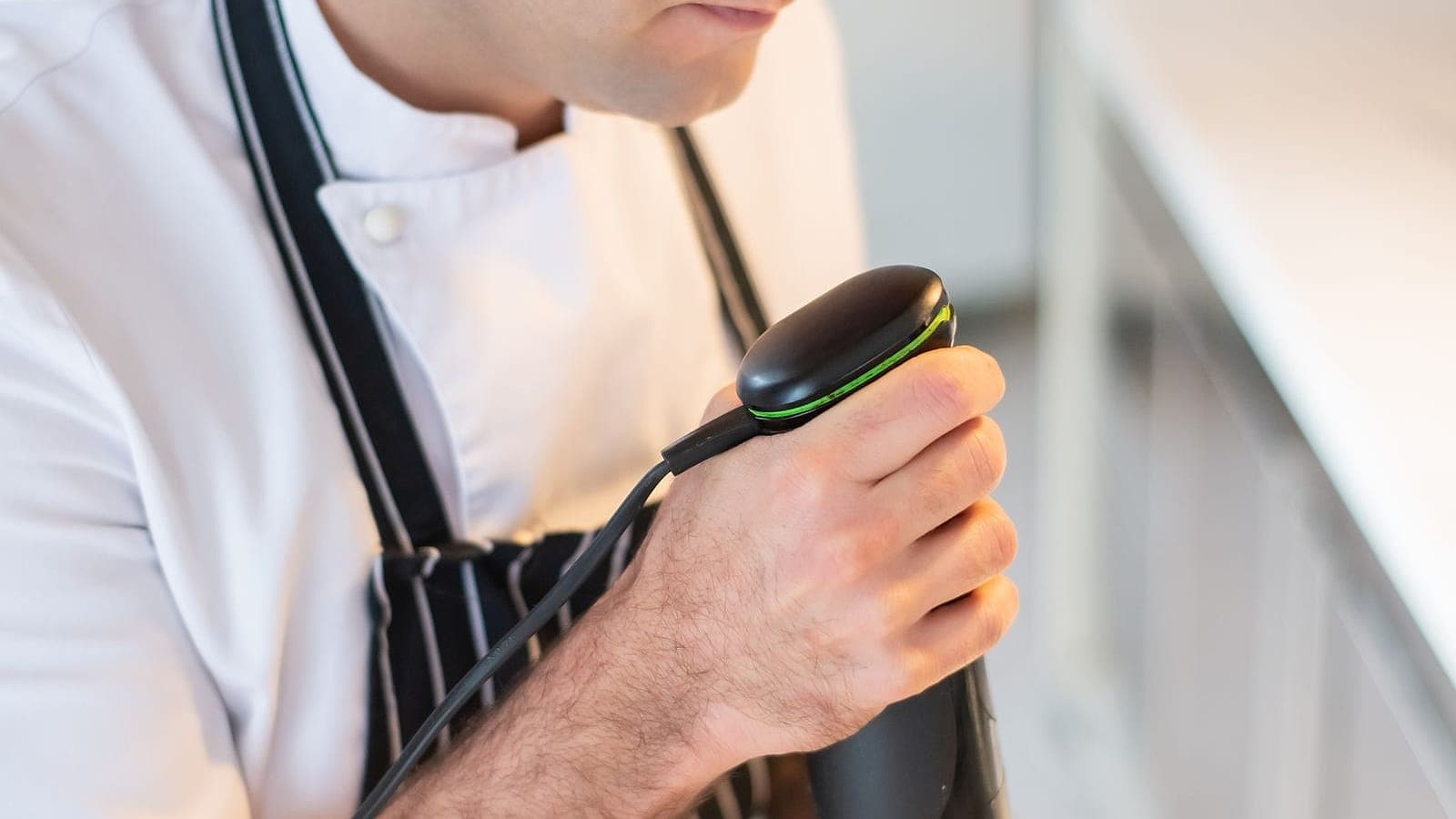
The best immersion blender for most kitchens is the Breville Control Grip — reviewers rate its bell-shaped base the most effective at fighting suction of any hand blender they’ve tested, which means it purées soup right in the pot with almost no splatter, and it arrives with accessories you’ll actually use: a 42-ounce jug, a chopping bowl, and a whisk. If you want most of that capability for less money, the Braun MultiQuick 7 is the value pick.
Here’s the honest framing before you spend a cent: an immersion blender is a companion to a countertop machine, not a replacement. It exists to solve one annoying problem beautifully — puréeing hot soup without ladling it, batch by batch, into a jar and back. For ultra-smooth smoothies or big frozen drinks, you still want a countertop blender. Buy a hand blender for what it’s great at, and it’s one of the highest-value tools in the kitchen.
One thing most gear guides bury, stated plainly: Cookloom hasn’t run these blenders through our own kitchen yet. Every verdict below synthesizes the published conclusions of independent testers, cross-checked against the patterns owners report. Hands-on verdicts get layered in as units come through the Cookloom kitchen.
Our picks at a glance
| Pick | Best for | Power | Accessories | Price band |
|---|---|---|---|---|
| Breville Control Grip | Splatter-free soup, most cooks | Corded (see note) | 42-oz jug, chopping bowl, whisk | $$ |
| Braun MultiQuick 7 | Value, everyday blending | Corded; 500–600W tier | Whisk, chopper, beaker | $$ |
We publish a wattage only where testers place a model in a clear power tier. Both picks are corded, and for hand blenders raw watts matter less than the base design and the accessories — the 600-watt All-Clad covered further down is the pure-power option.
How we chose
There is no shortage of hand-blender roundups written by people who never puréed a pot of soup with one. This first version of our guide leans on published testing too — the difference is we say so, and we held that outside evidence to a high bar.
We synthesized the conclusions of the independent test kitchens whose blender programs include hand blenders — the same programs behind roundups like America’s Test Kitchen and Wirecutter — and cross-checked every finalist against the patterns owners report: splatter, motor fade under load, and how well the accessories hold up. A model earned a spot only when the evidence lined up. Where reviewers converge, we tell you; where a pick asks you to give something up, we say that too.
Best overall — Breville Control Grip
Who it’s for: anyone who makes soup and is tired of the mess — the cook who wants to purée butternut squash or tomato bisque directly in the pot without redecorating the backsplash.
The verdict: the most effective splatter control of any hand blender tested, in a body that’s comfortable to hold, with a genuinely useful accessory kit.
The Control Grip’s advantage is its bell-shaped base. Reviewers found it the most effective at breaking suction of any immersion blender they tested — the shape lets liquid circulate instead of clamping the blade guard to the bottom of the pot, which is what causes the sudden lurch and the splatter across your stovetop. In practice that means you can run it in a full pot and keep your kitchen clean.
The ergonomics match the performance. It uses a trigger-style grip that’s easy to hold at the angle soup-puréeing actually requires, with 15 speeds so you can start slow (the key to not wearing your dinner) and build up. And it doesn’t nickel-and-dime you on attachments: the box includes a 42-ounce blending jug, a chopping bowl, and a whisk, so it covers smoothies for one, small chopping jobs, and whipped cream out of the gate.
The honest cons: it’s corded, like every pick here, so you’re working near an outlet. And the fuller accessory kit is more to store than a bare stick blender — a fair trade for the versatility, but worth a thought if your drawers are already full.
Best value — Braun MultiQuick 7
Who it’s for: cooks who want strong everyday blending and a real accessory set without paying the premium — and who like the idea of dialing power with their hand rather than hunting for a speed button.
The verdict: the best balance of features and price in the category, with two features that punch above the cost.
The MultiQuick 7’s signature trick is its ACTIVEBlade shaft, which flexes under load so the blade can reach and break down more of what’s in the jar — reviewers credit it with more complete blending, fewer stubborn chunks left behind. The second is SmartSpeed: a squeeze-for-speed trigger where pressing harder blends finer, so you control texture by feel instead of stopping to change a setting. Testers place it in the 500–600W tier, which is why it blends noticeably faster and finer than the entry-level 300-watt sticks. It comes with a whisk, a chopper, and a beaker.
The honest cons: it doesn’t quite match the Breville’s splatter control — the anti-suction base is the Control Grip’s standout, and this is where you feel the price difference. It’s also corded. For most people, the savings are worth it; if a spotless stovetop is your priority, spend up for the Breville.
Also worth knowing
The premium, pure-performance option — All-Clad. If build quality and raw speed matter more to you than a box of accessories, All-Clad’s hand blender is the one to know about. It’s the highest-wattage option here at 600 watts, and reviewers found it finishes tasks roughly 30 to 40 seconds faster than a typical 300-watt stick. The catch: it’s accessory-free — no whisk, no chopper — so it makes the most sense for cooks who prize pure performance and heirloom-grade build and already own a food processor for chopping duty. (It doesn’t have a Cookloom gear entry yet.)
The budget end. Capable stick blenders exist for under $40 — the Mueller is a commonly recommended example — and they’re fine for the occasional pot of soup. Just know what you’re trading away: the anti-suction base design, the build quality, and the accessories. For light, infrequent use they’re reasonable; for anything more, the Breville and Braun earn their price.
What to look for
A few things separate a hand blender you love from one that lives in a drawer:
- Anti-suction / splatter control. The single biggest quality-of-life difference. A well-designed bell base lets liquid circulate so the blade doesn’t grab the pot and fling soup — this is the Breville’s whole case.
- Power. Around 300 watts handles everyday soup; 500–600-watt models blend faster and finer, which matters if you purée often or work with thicker mixtures.
- Accessories. A whisk, a chopper, and a jug or beaker turn a one-trick stick into a small kitchen system. Both of our picks include a useful set.
- Corded vs cordless. Both picks here are corded, which means consistent power and no charging — at the cost of needing an outlet nearby.
Care note: don’t run the motor continuously past the maker’s stated limit, and detach the blending wand to hand-wash it rather than submerging the motor body.
Immersion vs countertop — which do you need?
Get an immersion blender if your pain point is soup, sauces, purées, small chopping jobs, and the occasional single smoothie — and if counter and storage space are tight. It’s the cheaper, more compact tool, and it does those jobs better than a countertop machine because you bring the blade to the food.
Get a countertop blender if you want ultra-smooth smoothies, frozen drinks by the pitcher, nut butters, or hot-soup batches with a silkier finish than a stick can deliver. If your priority is single-serve smoothies specifically, a personal blender may be the better-value buy. And if you find yourself reaching for the chopper attachment constantly — for heavy chopping, shredding, or dough — that’s a sign you actually want a food processor; our blender vs. food processor guide walks through the line between them. Many kitchens end up with an immersion blender and one countertop machine, and they rarely overlap.