Buy a German knife if you want one durable, forgiving blade that shrugs off winter squash, the occasional bone, and a careless cut against the board, hones back to sharp in seconds, and never asks you to learn a whetstone. Buy a Japanese knife if you prize a thinner, harder, more precise edge that glides through fish, herbs, and tomato skin, holds its sharpness far longer, and you are willing to treat it with a little care. Here is the honest part: no laboratory crowns one tradition better than the other. They are built for different jobs and different cooks. The metallurgy behind the split is real but widely misunderstood — and three of the most repeated talking points about it are flat wrong. Below is what the evidence actually says, and which knife fits you.
German vs Japanese knives at a glance
| German | Japanese | |
|---|---|---|
| Typical steel | X50CrMoV15 (Wüsthof, Zwilling) | VG-MAX, moly-vanadium, CROMOVA 18; SG2 or carbon at the high end |
| Hardness (maker-reported HRC)* | ~56–58 | ~56–61 mainstream; 63–67 premium |
| Factory edge angle (per side) | ~15–20° (modern Wüsthof 14.5°) | ~10–15° (Shun 16°) |
| Blade profile | Curved belly, pointed tip | Flatter gyuto, or flat sheepsfoot santoku |
| Weight, 8-inch (measured) | ~250–258 g | ~170–210 g |
| Bolster | Often full (Wüsthof) or half (Zwilling) | Usually none |
| Best honing tool | Grooved or ribbed steel | Smooth ceramic rod or strop |
| Sharpening | Easier, forgiving, more often | Harder (whetstone, skill), needed less often |
| Chip resistance | Higher | Lower — hard, thin edge |
| Price band, 8-inch | $$–$$$ | $$–$$$$ |
| Best for | Heavy, rustic prep; beginners; low-fuss upkeep | Precision slicing; long retention; careful cooks |
* HRC figures are manufacturer-reported. Independent bench testing has read several points lower on the same knives, so treat these as relative positions, not absolutes. Prices are shown as bands ($ budget to $$$$ premium), not exact figures.
The 60-second verdict
If most of your cooking is weeknight volume — breaking down chicken, halving squash, chopping onions three at a time on whatever board is handy — a German knife is the safer, cheaper-to-own choice. It tolerates abuse, re-trues on a honing steel in seconds, and forgives a beginner’s technique.
If you cut with intention — slicing sashimi-thin, mincing herbs without bruising them, prepping vegetables where a clean face matters — a Japanese knife rewards you with a keener edge that lasts longer between sharpenings. In exchange, it wants a wood or poly board, a gentler hand, and eventually a whetstone.
Most serious home cooks end up owning both: a German workhorse for rough jobs, a Japanese knife for the delicate ones. If you can only buy one, answer a single question honestly — will you match your habits to the knife, or do you want the knife to survive your habits? That answer picks the tradition.
Steel and hardness: the tradeoff that explains everything
Almost every argument about these knives traces back to one property: how hard the steel is, measured on the Rockwell C scale (HRC). Harder steel takes and holds a finer edge. It is also more brittle. That is not a marketing spin; it is the central finding from the most rigorous source in this space.
Why harder holds longer — and chips sooner
Metallurgist Larrin Thomas, who runs Knife Steel Nerds, is blunt about the physics: there is no steel that is “a ‘10’ in both toughness and edge retention. Or even a 7 in both.” Push hardness up and, in his words, you reduce toughness by more than you gain in edge retention. In plain terms, a blade around 58 HRC can survive accidental contact with a bone, a frozen edge, or a hard plastic scraper. Take that same knife to 64 HRC and the identical contact can lift small pieces out of the edge.
Geometry compounds the effect. In one of Thomas’s controlled impact tests, a more obtuse edge withstood roughly 2 foot-pounds of force with almost no damage, while a far more acute edge chipped at just 0.3 foot-pounds — close to a sevenfold difference driven by shape alone. This is the authority worth internalizing: “harder is always better” is a myth. Harder is better at one thing (holding a keen edge) and worse at another (surviving contact). Which matters more depends entirely on what you cut.
The steel overlap nobody mentions
German knives from Wüsthof and Zwilling use X50CrMoV15, a chromium-molybdenum-vanadium stainless that lands around 56–58 HRC. Japanese steels run a wider range: Shun’s VG-MAX is reported near 60–61 HRC, MAC’s moly-vanadium blend near 59–61, and premium SG2 or carbon blades climb to 63–67.
But here is the part most comparisons skip. Global’s popular G-2 uses CROMOVA 18 at roughly 56–58 HRC — the same neighborhood as German steel. The dramatic hardness gap only exists at the premium Japanese end. A German Wüsthof and a Japanese Global are metallurgically closer than the “soft German, hard Japanese” story suggests. The country of origin does not set the hardness; the specific steel does.
One honesty note on the numbers. When TechGearLab put these knives on its own hardness tester, it read several points below the makers’ claims — Wüsthof around 54, MAC around 53, Shun around 51. Bench readings vary with method, so treat manufacturer HRC as a guide to relative hardness rather than gospel, and don’t let any single low reading rewrite the ranking.
Edge angle: sharper, yes — but the gap has closed
The old rule of thumb: German knives are ground to about 20° per side, Japanese to 10–15° per side, and the sharper Japanese angle is why they cut better. The first half is outdated.
Modern German grinding has caught up. Wüsthof’s PEtec process sharpens the Classic line to 14.5° per side, a figure the company says was validated by Germany’s FGW testing institute. Meanwhile, Shun grinds the Classic line to 16° per side.
Read that again: in a head-to-head, the German Wüsthof carries the more acute factory edge than the Japanese Shun. The stereotype of a blunt German “club” versus a razor Japanese blade collapses on the exact two knives people most often compare. The Japanese advantage in real sharpness comes less from the angle number and more from a thinner blade behind the edge and harder steel that can be finished finer — not from a dramatically smaller degree count. And always read these figures per side: a 15° per-side edge is a 30° included edge, so a knife described as “15 degrees” elsewhere may mean something different depending on how it’s measured.
Blade shape and how you actually cut
Angle aside, the biggest day-to-day difference is the curve of the blade — because it dictates your motion.
German chef’s knives have a pronounced curved belly. That rounded profile is built for rock-chopping: keep the tip planted, rock the heel up and down, and sweep through a pile of herbs or onion. It is intuitive, fast for volume, and the reason German knives feel natural to most Western cooks.
Japanese knives tend to run flatter. A gyuto — the Japanese take on the Western chef’s knife — has a gentler curve suited to a push-and-pull or tap-chop stroke, lifting the whole edge and driving it forward through the food. A santoku goes further: a flat edge with a rounded sheepsfoot tip and no real point. That flat profile excels at straight up-and-down chopping, but the missing point means a santoku cannot pierce or make fine tip work the way a pointed chef’s knife can.
The categories are converging. A gyuto and a German chef’s knife do the same job; the difference is how much belly you want under your hand. If you rock-chop by instinct, a curvier German blade will feel right. If you already push-cut or want to learn, a flatter Japanese profile suits it.
Weight, balance, and the bolster question
Pick both up and the difference is immediate. Measured weights tell the story: a Wüsthof Classic 8-inch runs about 258 g (9.1 oz) and a Zwilling Pro near 250 g, while a MAC MTH-80 is 181 g (6.4 oz), a Shun Classic sits in the 6.6–7.4 oz range, and a Global G-2 is around 170 g (6 oz).
German knives are heavier, with a thicker spine and more handle-forward balance. The upside, as reviewers at TechGearLab and Prudent Reviews describe it, is that the heft “does the work” — you let the knife’s mass fall through a dense sweet potato instead of forcing it. The downside is fatigue; over a long prep session, smaller hands feel the weight. Japanese knives are lighter and more nimble, which makes fine, repetitive work less tiring but gives you less mass to power through tough produce.
Then there is the bolster, the collar of steel where blade meets handle. Wüsthof’s Classic uses a full bolster running to the edge. It protects your grip and adds balance, but it blocks the heel of the blade — so when you sharpen, you cannot easily grind the last portion of edge near the handle, and over years of sharpening that can leave a stubborn dull spot. Zwilling’s Pro line uses a curved half-bolster that leaves the heel usable, MAC uses a half bolster, and most Japanese knives skip the bolster entirely — cleaner to sharpen full-length, though with less hand protection.
Toughness vs edge retention in a real kitchen
This is where the metallurgy becomes a lived experience.
A softer German blade around 57 HRC does not so much chip as roll — the thin edge deforms sideways under stress. The fix is a few passes on a honing steel, which straightens the edge back to sharp in seconds. It is a self-correcting system, which is exactly why German knives forgive rough use.
A harder Japanese blade around 61 HRC holds its edge far longer under normal cutting. But when it fails, it fails differently: instead of rolling, it chips. Bone, frozen food, a glass or stone board, or lateral prying pressure can take a small bite out of the edge — and a chip cannot be honed away. It has to be ground out on a whetstone, which removes far more material than a routine touch-up. Shun does not hide this; its own FAQ concedes that “microchipping is a downside of a hard steel blade.” Owners report the same in the field, and Kai (Shun’s parent) answers it with a repair program rather than a denial.
The practical rule: a German knife is more forgiving of what you cut and how. A Japanese knife rewards discipline about both, and punishes carelessness more expensively.
Maintenance: which is more work?
Honing: grooved steel vs ceramic rod
Both traditions need regular honing, but not with the same tool. A German knife loves a grooved (ribbed) honing steel — Wüsthof suggests the fine slot for routine honing and a coarser one to sharpen once or twice a year. Do not run a hard Japanese edge on that grooved steel; the ridges can chip it. For Japanese blades, use a smooth ceramic rod or a leather strop, as House Digest and others advise. Same daily habit, different hardware.
Sharpening: difficulty and frequency
German steel is easier and more forgiving to sharpen — it responds to a pull-through, a honing rod, or a whetstone without much skill, but because it is softer, you sharpen more often. Japanese steel is harder to sharpen well; it really wants a whetstone of 1000 grit or higher and a steady hand to hold the angle, but you need to do it far less frequently. If a whetstone sounds intimidating, our guide on how to sharpen a knife walks through both approaches step by step.
Stainless vs reactive carbon: busting “Japanese = rusty”
The single most persistent myth is that Japanese knives are high-maintenance carbon steel that rusts if you look at them wrong. For the knives most home cooks actually buy, this is simply false. Global, MAC, and Shun are all stainless. Reactive carbon steels — shirogami, aogami, and similar — exist and do require diligent drying and oiling, but they are a specialist subset, not the norm on the shelf. That said, even stainless like VG-10 can develop pitting if left wet or crusted with acidic food, so no knife of either origin is truly maintenance-free.
Boards and the dishwasher
Two rules apply to every knife here, German or Japanese. First, never put either in the dishwasher — the heat, harsh detergent, and jostling ruin edges and handles. Second, cutting surface matters, and it matters more the harder your steel is. Glass, granite, stone, ceramic, and very hard bamboo boards dull and can chip fine edges; use end-grain wood or an HDPE poly board instead. Our full routine lives in the guide on how to care for kitchen knives.
The German contenders
Wüsthof Classic 8-inch
The reference-standard German chef’s knife: fully forged X50CrMoV15, a full bolster, and a PEtec edge ground to 14.5° per side. At about 258 g it is a substantial, confidence-inspiring blade, and TechGearLab named it “Best Overall” with a 91/100. The full bolster is the one caveat — it protects your grip but complicates heel sharpening down the line. If you want one durable knife to do everything and outlast you, this is the default answer.
Zwilling Pro 8-inch
Zwilling’s Pro is the close alternative, also forged from X50CrMoV15 at roughly 250 g. Its signature is a curved half-bolster that leaves the full heel exposed — so unlike the Wüsthof, you can sharpen the entire edge without fighting the bolster. Handling is a touch more contemporary. If the Wüsthof’s full bolster gives you pause, or you simply prefer the grip, the Pro is the sensible swap.
View at ZwillingView at Amazon
The Japanese contenders
MAC MTH-80
The MTH-80 has been a Wirecutter pick since 2013, and TechGearLab rates it “Best for Precision” at 85/100. Its moly-vanadium steel runs about 59–61 HRC, it weighs a nimble 181 g, and it carries a half bolster with dimples along the blade to reduce sticking. The trade is that its thin, keen edge is delicate: keep it away from bones and frozen food. For a first Japanese knife that still handles everyday prep, it is the most-recommended blade in this comparison.
Shun Classic 8-inch
The Shun is the showpiece — VG-MAX steel near 60–61 HRC clad in a Damascus-patterned body, ground to 16° per side, and named “Best Upgraded” by TechGearLab at 90/100. It is the hardest, keenest option here, which is precisely why a small chip appeared during hard-use testing. Shun’s answer is a genuine safety net: Kai offers free lifetime sharpening and a low-cost microchip repair (about $15). Buy only from authorized dealers — the Classic is a common counterfeit target, and you want the real steel and the warranty. Choose it if you will respect its limits.
Global G-2 8-inch
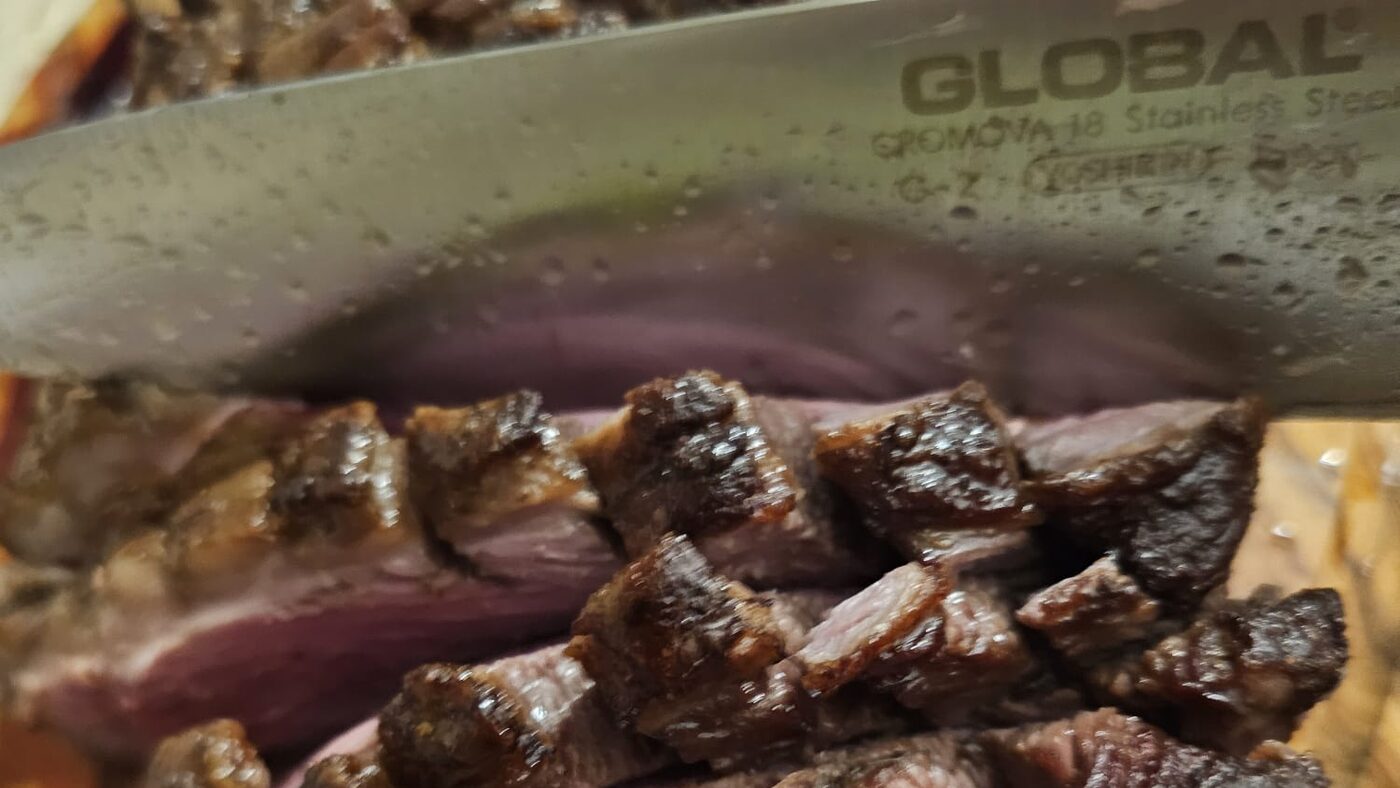
The Global is the value entry and the polarizing one. Its CROMOVA 18 steel sits around 56–58 HRC — German territory, remember — and the whole knife is a single seamless piece of stainless, dimpled handle included, at a feathery 170 g. That one-piece design is easy to clean and impossible to loosen, but the handle divides people: reviewers at Nothing But Knives note it can feel slippery when wet, and it is a genuine love-it-or-hate-it grip. Try it in hand if you can. As a lightweight Japanese knife at a friendlier price, it is a strong pick for the right hand.
For what it is worth, this is one of the few knives here we have used ourselves rather than only researched: over years as a daily driver, the dimpled handle stayed secure even with mildly oiled hands, and the low weight read as control rather than flimsiness. That is one kitchen’s experience against a widely reported complaint — both are worth knowing before you buy. Our full notes and rating are on the best chef’s knives guide.
How we researched this
Cookloom is a new publication, and we will always tell you the basis for a recommendation. We have not run our own knife-testing program, so nothing here rests on in-house cutting trials or invented anecdotes. Instead, this comparison synthesizes the most credible published sources and reports each finding to its origin.
The metallurgy comes from Knife Steel Nerds, run by metallurgist Larrin Thomas, cross-checked against a steel guide for X50CrMoV15 and makers’ own specs from Shun and Wüsthof on PEtec. Handling, weight, and edge-angle comparisons draw on Prudent Reviews’ Shun vs Wüsthof breakdown and MAC review, a Global G-2 review from Nothing But Knives, and profile explainers from Cutlery and More and Made In. Maintenance guidance follows House Digest. Where independent bench numbers (TechGearLab’s hardness readings) disagreed with manufacturer claims, we said so rather than picking the flattering figure. As Amazon Associates and affiliate partners, we may earn a commission on the links above; it does not change which knives we recommend.
Buy German if…
- You cook in volume and value durability over a paper-thin edge.
- You break down poultry, cut winter squash, or occasionally hit a bone or pit.
- You want to hone back to sharp in seconds and not learn a whetstone yet.
- You are new to sharp knives and want a forgiving first blade.
Primary pick: Wüsthof Classic 8-inch. Alternative: Zwilling Pro 8-inch, especially if you want an unobstructed heel for easier sharpening.
Buy Japanese if…
- You prize the sharpest possible edge and the longest time between sharpenings.
- Your cutting is precise: fish, herbs, vegetables where a clean face matters.
- You will use a wood or poly board and keep the blade off bone and frozen food.
- You are willing to hone with a ceramic rod and eventually learn a whetstone.
Primary pick: MAC MTH-80, the most beginner-friendly Japanese knife here. Choose Shun Classic if you want the keenest, most beautiful blade and will respect its limits (the Kai repair program is real insurance). Choose Global G-2 if you want a lighter Japanese knife at a lower price and the seamless handle suits your grip.
Buy neither — start cheaper — if…
If this is your first real chef’s knife and you are not yet sure how you cut, there is no shame in starting below both camps. A stamped, lightweight Victorinox Fibrox 8-inch ($) has earned budget-favorite status for years: it is sharp enough, tough, easy to sharpen, and cheap enough that learning on it carries no anxiety. Use it for six months, learn your own habits, then buy the German or Japanese knife that fits them.
View at AmazonView at Victorinox
For the full field, see our best chef’s knives roundup and our best budget chef knives guide. Not sure how many knives you actually need? Start with what knives do you need.
Sources
- Knife Steel Nerds — Knife steels rated by a metallurgist: toughness, edge retention, and corrosion resistance
- Knife Basics — X50CrMoV15 steel guide
- Shun — Blade steels
- Prudent Reviews — MAC knives review
- Prudent Reviews — Shun vs Wüsthof
- Nothing But Knives — Global G-2 chef’s knife review
- Wüsthof — What is PEtec
- Cutlery and More — German vs Japanese chef’s knives
- Made In — Japanese vs German knives
- House Digest — How to sharpen Japanese vs German knives