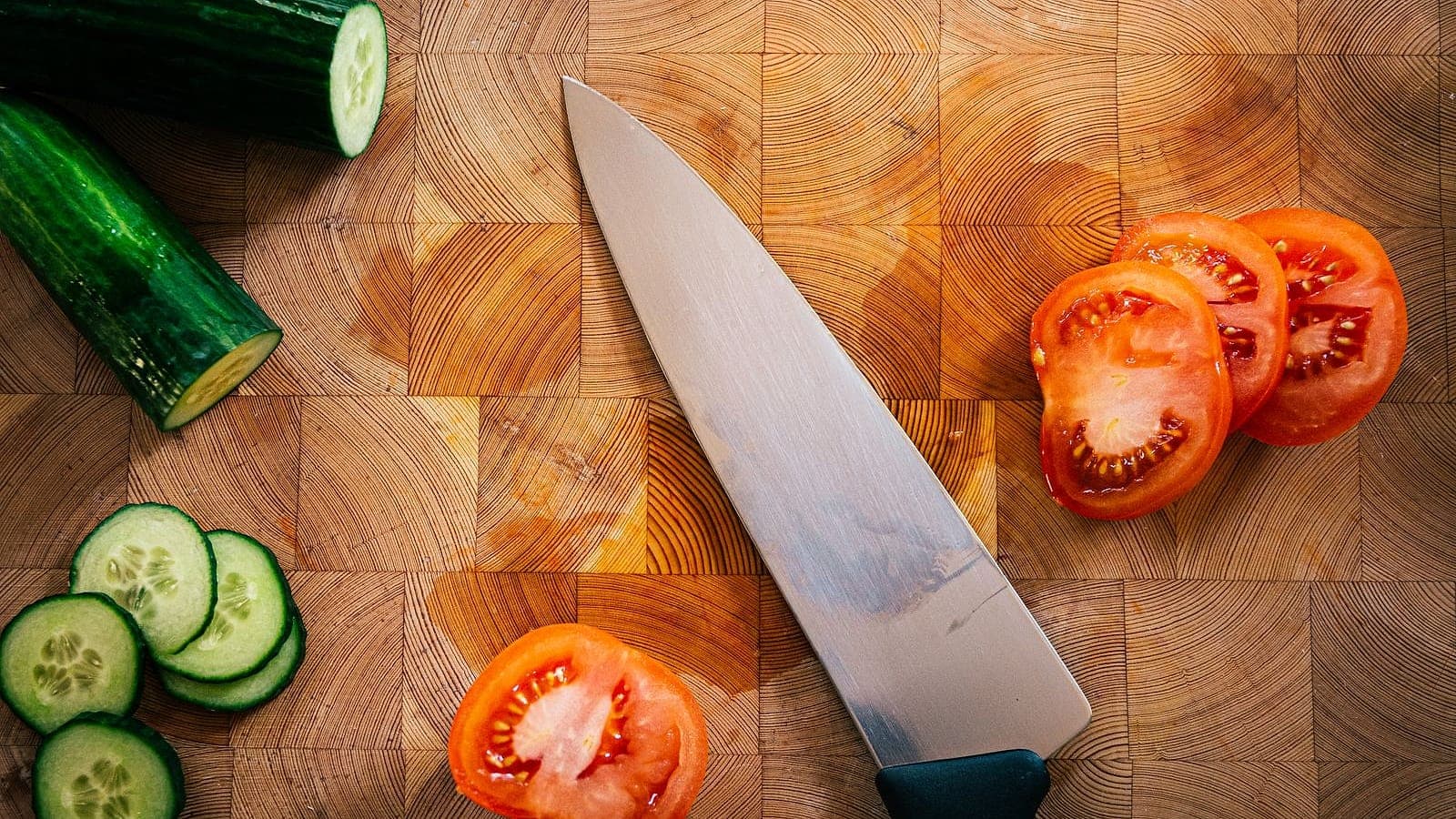
For most home cooks, the best chef’s knife is the Victorinox Fibrox Pro 8-inch. It is not the flashiest blade you can own or the sharpest one on this page, but it slices cleanly, shrugs off years of real kitchen use, and costs about $50 — and nothing else here does more for the money. If you want one confident recommendation and you are ready to stop reading, buy that and get cooking.
Here is the part most buying guides quietly tidy away: the experts do not agree on a single champion, and the disagreement is worth understanding before you spend. America’s Test Kitchen crowns that roughly $50 stamped Victorinox as its overall winner, ahead of forged knives three times the price. Wirecutter and Forbes Vetted instead hand the title to the MAC MTH-80, a roughly $145 Japanese-made blade they call the sharpest all-rounder in the drawer. Both camps are right, because they are answering different questions. Buy the Victorinox and stop if value is what you’re after. Step up to the MAC if you cook most days and want the best-cutting knife your hand will actually notice. Everything below sorts the rest of the field — German, Japanese, budget, small-hands, splurge — by the cook you really are.
The best chef’s knives at a glance
| Pick | Best for | Origin / style | Steel & HRC | Forged / stamped | Weight | Edge angle (per side) | Price band | Buy it if |
|---|---|---|---|---|---|---|---|---|
| Victorinox Fibrox Pro 8” | Most cooks / value | Swiss, Western | X50CrMoV15, 54–56 | Stamped | ~5.8–5.9 oz | ~15° | $$ | You want the most knife for the least money |
| MAC MTH-80 | Best-cutting all-rounder | Japan (Seki), hybrid | Chrome-moly-vanadium, 59 | Roll-forged | ~6.4–6.8 oz | Thin (factory) | $$$ | You cook daily and want maximum sharpness |
| Wüsthof Classic 8” | Best German | Germany (Solingen) | X50CrMoV15, 58* | Forged | ~9.1 oz | 14–14.5° | $$$ | You like a heavier rock-chopper with a full bolster |
| Zwilling Pro 8” | Easier-to-sharpen German | Germany (Solingen) | FRIODUR ice-hardened, 55–58 | Forged | — | ~15° | $$$ | You want to sharpen the whole edge, heel included |
| Shun Classic 8” | Best Japanese | Japan | VG-MAX core, 60–61 | Forged (Damascus) | ~6.7 oz | 16° | $$$$ | You maintain your knives and want a keen, beautiful blade |
| Mercer Genesis 8” | Best budget forged | German-style | X50CrMoV15, ~56 | Forged | — | 15° | $$ | You want a forged knife with a bolster under $50 |
| Global G-2 8” | Lightest / most nimble | Japan | CROMOVA 18, 56–58 | Stamped (one-piece) | ~6 oz (170 g) | 15° | $$$ | You want the lightest blade and don’t mind a metal handle |
| Miyabi (Kaizen II / Birchwood) | Splurge | Japan | FC61 / SG2, 60–63 | Forged (Damascus) | — | ~9.5–12° | $$$$–$$$$$ | You want extreme sharpness and will baby it |
Price bands reflect typical retail, not a live price: $ budget · $$ affordable · $$$ mid-premium · $$$$ premium · $$$$$ luxury.
*Wüsthof lists the Classic at around 58 HRC; independent testing by TechGearLab measured closer to 54. Treat every hardness number here as manufacturer-reported and not a cross-brand scoreboard — HRC and the word “forged” are engineering choices, not scores. More on why below.
How we chose (and what we did not do)
Cookloom is a young publication, and we are not going to pretend we have julienned a decade of onions across every knife on this list. We haven’t. Instead, this guide synthesizes the most rigorous independent testing available and labels every finding by its source, so you can see exactly where each verdict comes from.
We leaned hardest on the labs that buy their own knives and run standardized cutting tests: America’s Test Kitchen, whose latest round put dozens of blades through tomatoes, butternut squash, and hours of repetitive chopping, and Serious Eats, which has tracked this category for years. We weighed Wirecutter and Forbes Vetted, whose testers land on the MAC MTH-80 rather than a value pick, and we noted which knives working and celebrity chefs actually reach for, drawing on The Kitchn. For the metallurgy — what HRC really tells you, and what it doesn’t — we relied on Knife Steel Nerds. Manufacturer spec sheets supplied steel types, edge angles, weights, and warranty terms, and owner reports filled in how each knife behaves after a year on the magnet strip.
The most important thing to say up front is that the “best overall” label is genuinely contested. Most affiliate roundups default to whichever premium Japanese blade cut fastest on the day. America’s Test Kitchen’s winner is a stamped $50 Swiss workhorse. We are not going to paper over that split to make the page feel tidier — we are going to map it to what you actually cook.
Best overall for most people: Victorinox Fibrox Pro 8”
View at AmazonView at Victorinox
The Victorinox Fibrox Pro is the rare recommendation that experts and thrifty home cooks agree on. America’s Test Kitchen names it their overall winner, and the reason is almost subversive: this is a stamped knife — Victorinox itself lists it as “Forged: No” — cut from a sheet of high-carbon stainless steel (X50CrMoV15), yet it beat forged knives costing three times as much. At roughly 5.8 ounces it is light and quick, the blade is thin enough to glide through a tomato skin, and the textured Fibrox handle stays grippy with wet or greasy hands. It carries NSF certification for commercial kitchens, is made in Switzerland, and comes with a lifetime warranty against defects. Line cooks have bought it by the case for decades for a reason.
The trade-offs are honest ones. The molded plastic handle feels utilitarian next to a riveted hardwood grip, there is no bolster or forged heft, so the knife feels featherweight rather than substantial, and the steel is on the softer side (a manufacturer-reported 54 to 56 HRC), which means the edge dulls sooner than a harder Japanese blade. But softer steel is also easy steel: a few passes on a honing rod bring it right back, and it forgives the occasional bone or frozen edge that would chip a premium knife. For the overwhelming majority of kitchens, this is the correct knife, and the money you save is better spent on learning to sharpen it than on a fancier blade you’ll neglect.
One point of frequent confusion: the Fibrox Pro and the cheaper-looking Victorinox Swiss Classic share the same stamped blade — the difference is the handle. If you find the rounded Swiss Classic grip more comfortable, you are not giving up any cutting performance.
Best-cutting upgrade: MAC MTH-80
If you cook most nights and want to feel the difference every time the blade meets the board, the MAC MTH-80 is the knife the performance-first reviewers keep choosing. It has been Wirecutter’s top pick for more than a decade, and Forbes Vetted calls it flatly “the sharpest knife in the drawer.” The MTH-80 is a Japanese-Western hybrid, roll-forged in Seki from a chrome-moly-vanadium steel that lands around 59 HRC — harder than a German knife, so it holds its edge longer, but not so hard that it feels brittle. The spine is ground thin, roughly 2 to 2.5 millimeters, and the dimples along the blade help release sticky food. The result is a knife that falls through an onion with almost no effort, and it ships wickedly sharp out of the box.
Two caveats keep it out of the “best for everyone” slot. The handle is shorter than most Western knives, which people with large hands notice, and the thin, keen edge is less forgiving of abuse than the Victorinox — this is a cutting-board knife, not a bone-and-squash bruiser. MAC backs it with a 25-year warranty, and if you treat it well it will reward you daily. Think of the MAC as the upgrade you buy once you already know you love to cook.
Best German: Wüsthof Classic 8”
The Wüsthof Classic is the archetypal German chef’s knife, and Serious Eats has named it their best Western pick since 2018. Forged in Solingen from a single billet of X50CrMoV15 stainless, it has real heft — around 9.1 ounces — with a full, triple-riveted bolster that runs from spine to heel. That weight is the point: a German knife wants to rock-chop, and the Classic’s curved belly and forward balance let it roll through a pile of herbs or a mound of onions with momentum doing much of the work. Wüsthof puts a precision-honed edge on it at 14 to 14.5 degrees per side, keener than the traditional German 20 degrees, and the steel (a manufacturer-reported 58 HRC, though TechGearLab measured closer to 54) is tough and easy to bring back on a rod.
The heft cuts both ways. Cooks with smaller hands or wrist fatigue may find a full workday with the Classic tiring, and the full bolster — that satisfying finger guard — blocks the heel of the blade from touching a sharpening stone, so the last inch of edge is harder to maintain over years. If either of those bothers you, the alternative below solves both. To go deeper on the fundamental split in feel and steel, see our guide to German vs. Japanese knives.
The easier-to-sharpen alternative: Zwilling Pro 8”
View at ZwillingView at Amazon
Zwilling — Wüsthof’s cross-town Solingen rival — builds the Pro with the same German virtues but one clever fix. Its steel is FRIODUR ice-hardened and SIGMAFORGE-forged from a single piece, landing around 55 to 58 HRC with an edge near 15 degrees per side. The difference that matters day to day is the bolster: instead of a full block, the Pro uses a curved “demi” bolster that leaves the entire cutting edge, heel included, exposed to your stone or rod. If you plan to maintain your own knife for the long haul, that detail alone can make the Zwilling the smarter German buy.
Best Japanese: Shun Classic 8”
The Shun Classic is the knife people photograph. Its blade is a VG-MAX cutting core wrapped in 68 layers of Damascus stainless, the rippling pattern is genuinely functional as well as pretty (it reduces drag and sticking), and it is finished with a D-shaped Pakkawood handle that fills the hand beautifully. This is a properly hard Japanese blade — around 60 to 61 HRC — ground to a keen 16 degrees per side, so it takes and holds an edge that a German knife can’t match. America’s Test Kitchen ranks it as their upgrade pick, and it is the knife Bobby Flay reaches for. Kai backs it with a lifetime warranty and a microchip repair service.
Now the honest caveat, and it is a real one: that hardness is bought with brittleness. Reviewers and owners report microchipping when the Shun meets hard ingredients — a chicken bone, a frozen edge, a hard squash rind, even a glass cutting board. This is a knife for careful cooks who hand-wash, hone gently, and keep it on a board of wood or plastic; treat it like a workhorse and it will chip. The D-shaped handle is also biased toward right-handed users. If you are willing to give it that care — and our guide to caring for kitchen knives covers exactly how — the Shun rewards you with a cutting experience that few knives at any price can equal.
Best budget forged: Mercer Genesis 8”
If you specifically want a forged knife — with the heft, the bolster, and the balance that implies — but you don’t want to spend German money, the Mercer Genesis is the answer, and it is Serious Eats’ pick for the best chef’s knife under $50. It is forged full-tang from X50CrMoV15, the same steel family Wüsthof uses, with a half bolster and a grippy Santoprene handle that many culinary schools issue to first-year students. At around 56 HRC and 15 degrees per side, it behaves like a lighter, plainer German knife, and it is a genuine step up in feel from a stamped blade for not much more money.
Its weakness is edge retention: the Genesis dulls faster than pricier knives and needs regular honing to stay at its best. Budget in a honing rod and the habit of using it. If price is truly your top priority, we compare the full field of value blades — including where the Genesis wins and where it doesn’t — in our roundup of the best budget chef’s knives.
Even cheaper, still recommended: the stamped Mercer Millennia
Worth a clarification, because the model names trip people up. America’s Test Kitchen’s “Best Buy” is not the forged Genesis — it is Mercer’s stamped Millennia, which ATK found performs “just as well” for under $30. The Millennia gives up the forged bolster and heft of the Genesis but keeps a comfortable handle and a capable stamped blade. If you want the lowest possible price for a knife that still cuts honestly, the Millennia is it; if you want the reassurance of forged construction and a bolster, pay a little more for the Genesis. Both are legitimate.
Best lightweight: Global G-2 8”
The Global G-2 is the lightest knife on this list — around 170 g (6 oz) — and its distinctive one-piece stainless design makes it a favorite for cooks with smaller hands or anyone who finds a hefty German knife tiring. It is stamped from CROMOVA 18 steel (about 56 to 58 HRC), ground to roughly 15 degrees per side, and the seamless metal body means there are no rivets or handle seams to trap food, which is genuinely hygienic. The dimpled, sand-filled handle is Global’s signature: it shifts the balance point and gives the knife a nimble, precise feel that its fans adore.
That handle is also the knife’s most polarizing feature. It is smooth metal, and some cooks find it slippery when wet or greasy — this is a love-it-or-hate-it grip, so try to hold one before you commit if you can. If the lightweight, agile character appeals and the metal handle suits you, few knives are as easy on the wrist through a long prep session.
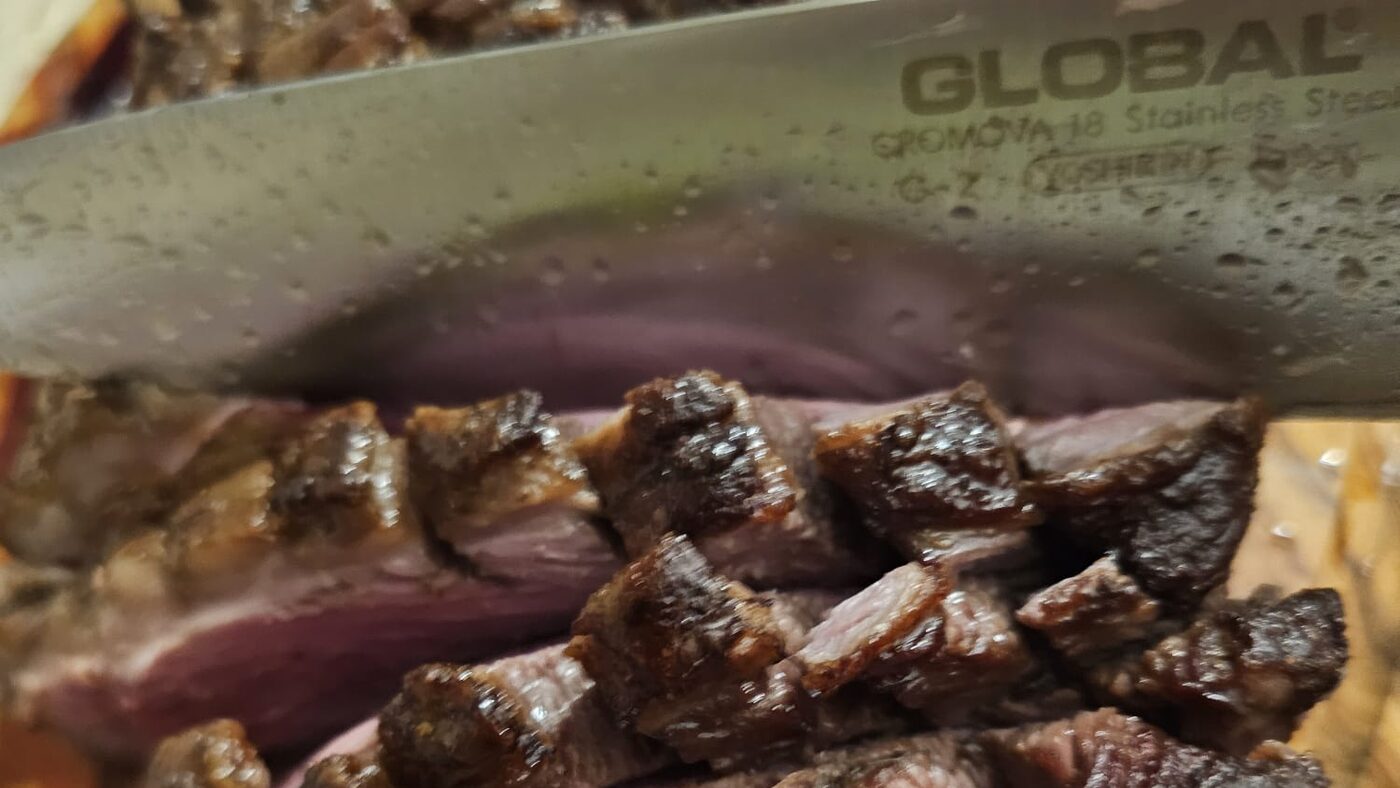
What we found using it. This is the first knife here we have used ourselves rather than only researched, and two things are worth correcting. First, “for small hands” undersells it: our tester wears XL gloves and runs the G-2 as an everyday main knife, where the low weight reads as control and less fatigue over a long prep session rather than as a knife that is too small. Second, the slippery-handle warning did not hold up in our use — the dimples stayed secure even with mildly oiled hands, though we did not run a deliberate oil-soaked test, and a blade this sharp deserves dry hands regardless. The factory edge was genuinely keen, held for a long stretch of daily cooking, and came back readily on a stone. We rate it 4.4 out of 5, and the gear card on this page carries our measured notes and our own photo of the knife.
Best splurge: Miyabi
If you want the sharpest, most beautiful blade in a home kitchen and you’re prepared to care for it accordingly, the splurge is Miyabi. Made in Seki by Zwilling’s Japanese division, the range spans from the Kaizen II — an FC61 steel core in 48 layers of Damascus, around 60 to 62 HRC, at roughly $190 — up to the Birchwood SG2, a 101-layer blade hardened to about 63 HRC that runs closer to $365. Both are ground to an extraordinarily acute edge, in the range of 9.5 to 12 degrees per side, which is what gives them their almost unreal sharpness.
That acuteness is a commitment, not a convenience. A blade this hard and this thin is unforgiving: no bones, no frozen food, no twisting or prying, and hand-washing only. This is a knife for the cook who already sharpens their own blades and treats a knife as a precision instrument. If that’s you, a Miyabi is a joy. If you’re not sure it’s you, it isn’t — buy the Victorinox and put the difference toward groceries. (Miyabi doesn’t carry a Cookloom gear card because we haven’t assessed a specific model in depth yet; we name it here so the splurge tier is honest and complete.)
What to look for in a chef’s knife
Steel and hardness (HRC). Rockwell hardness, or HRC, measures how well steel resists deforming — Knife Steel Nerds memorably calls it “the megapixels of knife steel specs,” a single number people overweight. Higher hardness means better edge retention but lower toughness, so it chips more easily. German knives sit around 56 to 59 HRC (tough, easy to resharpen); Japanese knives run about 60 to 66 (keener, longer-lasting edge, more chip-prone). The steels worth recognizing: X50CrMoV15 in German blades, VG-MAX or VG-10 in Japanese ones, CROMOVA 18 in Global, and SG2 or FC61 at the Miyabi end. Crucially, HRC is not comparable across brands as a score — it’s one input, alongside geometry and heat treatment.
Edge angle. A lower angle per side is sharper but more delicate. German knives are typically ground around 14 to 15 degrees per side; Japanese blades often 12 to 16; a Miyabi as low as 9.5. Sharper geometry cuts more cleanly but demands gentler use and more attentive maintenance.
Forged vs. stamped. This is the myth worth puncturing. Forging heats and hammers steel into shape and usually adds a bolster and heft; stamping cuts the blade from a rolled sheet. Marketing treats “forged” as automatically better — but a well-made stamped knife performs every bit as well, and America’s Test Kitchen’s stamped Victorinox beat forged rivals costing far more. Don’t pay for the word.
Tang and balance. A full tang (the steel running the length of the handle) adds durability and a planted, balanced feel, which is why forged German knives feel so solid. But balance is personal: a blade-forward German knife rewards a rocking motion, while a lighter Japanese knife balances nearer the hand for precise, controlled cuts.
Cutting style: rock-chop vs. push-cut. German knives, with their curved belly, are built to rock — the tip stays on the board while the handle pivots up and down. Japanese knives, flatter and lighter, favor a push or pull cut, gliding forward and back. Neither is better; the right one matches how your hands already want to move.
Size: 8 inches is the default. An 8-inch blade is long enough to break down a squash and nimble enough to mince garlic, which is why it’s the standard recommendation. Go to 7 inches or a santoku if you have smaller hands or want a lighter tool; step to 10 inches only if you routinely prep large volumes. If you’re still building your kit from scratch, our guide to what knives you actually need explains why a chef’s knife, a paring knife, and a serrated knife cover almost everything.
Which exact model to buy (and the look-alikes to skip)
Knife lines are a maze of near-identical model names, and counterfeits of the premium Japanese brands are common. Buy the exact model below, and buy from the maker or an authorized seller — not a bargain third-party listing that could be a fake.
| Knife | Exact model to buy | Watch out for |
|---|---|---|
| Victorinox Fibrox Pro 8” | Model 5.2063.20 (black Fibrox handle) | The Swiss Classic is the same blade with a rounded handle — fine to buy, just a different grip. Avoid unbranded look-alikes. |
| MAC MTH-80 | ”Professional Series 8-inch with dimples, MTH-80” | Don’t confuse it with MAC’s cheaper Chef Series or the smaller Superior line. |
| Wüsthof Classic 8” | 1040100120 (full bolster) | The Classic Ikon is a different, contoured-handle line; the Wüsthof Gourmet is the stamped budget range, not the forged Classic. |
| Zwilling Pro 8” | 38401-203 (curved demi bolster) | Distinct from the Professional “S” and Four Star lines; confirm the curved bolster. |
| Shun Classic 8” | DM0706 | Counterfeits exist — buy from Shun/Kai or an authorized dealer and keep the paperwork for the microchip repair service. |
| Mercer Genesis 8” | M20608 (forged) | The Mercer Millennia is the stamped, cheaper line — a good knife, but not the forged Genesis. |
| Global G-2 8” | G-2 (20 cm) | Frequently faked; buy from Global or an authorized seller and check the dimpled, sand-filled handle and etched logo. |
Who should skip an expensive chef’s knife
The most useful thing a buying guide can tell you is when not to spend. For a large share of home cooks, an expensive knife is money in the wrong place.
The reason is simple, and it’s about maintenance more than metal. A sharp, well-kept $50 knife will out-cut a neglected $200 one every single time, because sharpness is a state you maintain, not a spec you buy once. The University of Rochester Medical Center’s health library notes that a dull blade takes more force to push through food and is more likely to slip — so keeping any knife sharp is the thing that actually matters at the board. Spend the difference between a budget knife and a premium one on the two habits that keep an edge alive: a honing rod for weekly touch-ups, and a proper sharpening a few times a year. Our walkthrough on how to sharpen a knife shows both.
So skip the premium knife if you cook occasionally, if you know you won’t hand-wash and hone a delicate Japanese blade, or if you simply want a workhorse you can treat like a tool. Buy the Victorinox Fibrox Pro, add a $10 honing rod, and you’ll out-prep most people with a knife block worth ten times as much. If you want to weigh every value option side by side, our best budget chef’s knives roundup goes deeper.
Sources
- America’s Test Kitchen — The Best Chef’s Knives
- Wirecutter — The Best Chef’s Knife
- Serious Eats — The Best Chef’s Knives
- Forbes Vetted — MAC MTH-80 Chef’s Knife Review
- The Kitchn — Chefs’ Favorite Knives
- Knife Steel Nerds — Rockwell Hardness
- Cutlery and More — German vs. Japanese Chef’s Knives
- TechGearLab — Kitchen Knife Reviews
- University of Rochester Medical Center — Health Encyclopedia