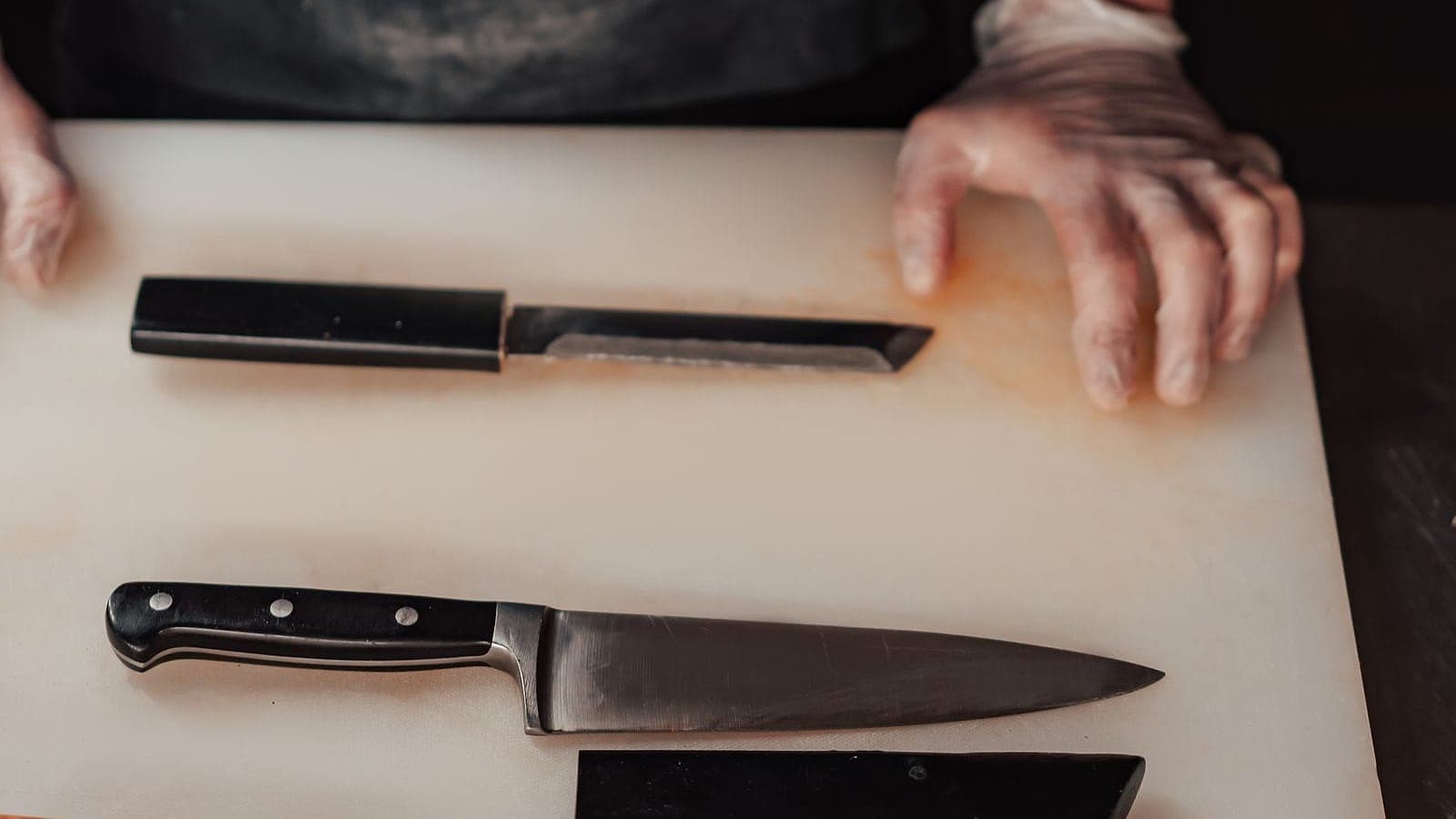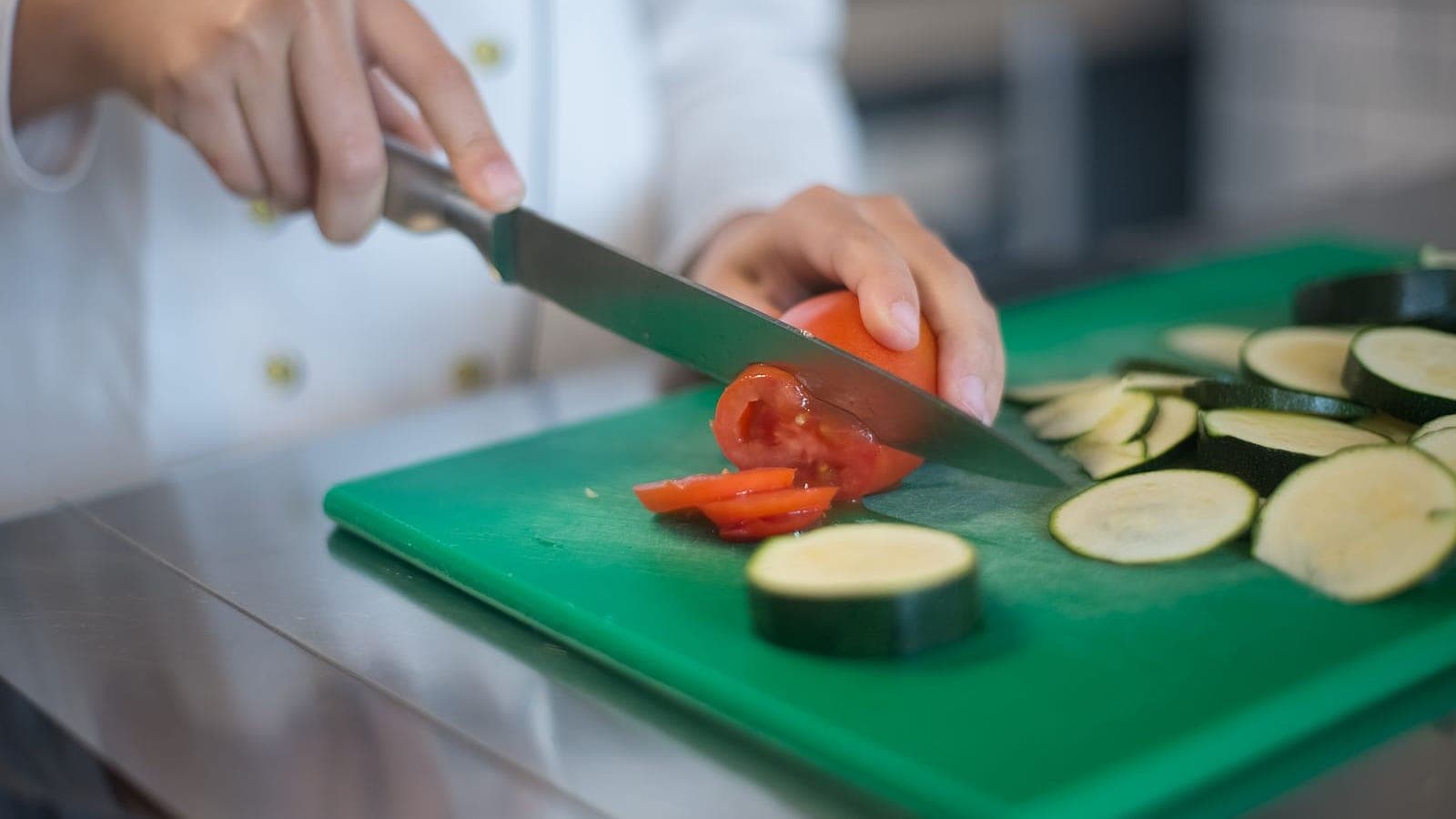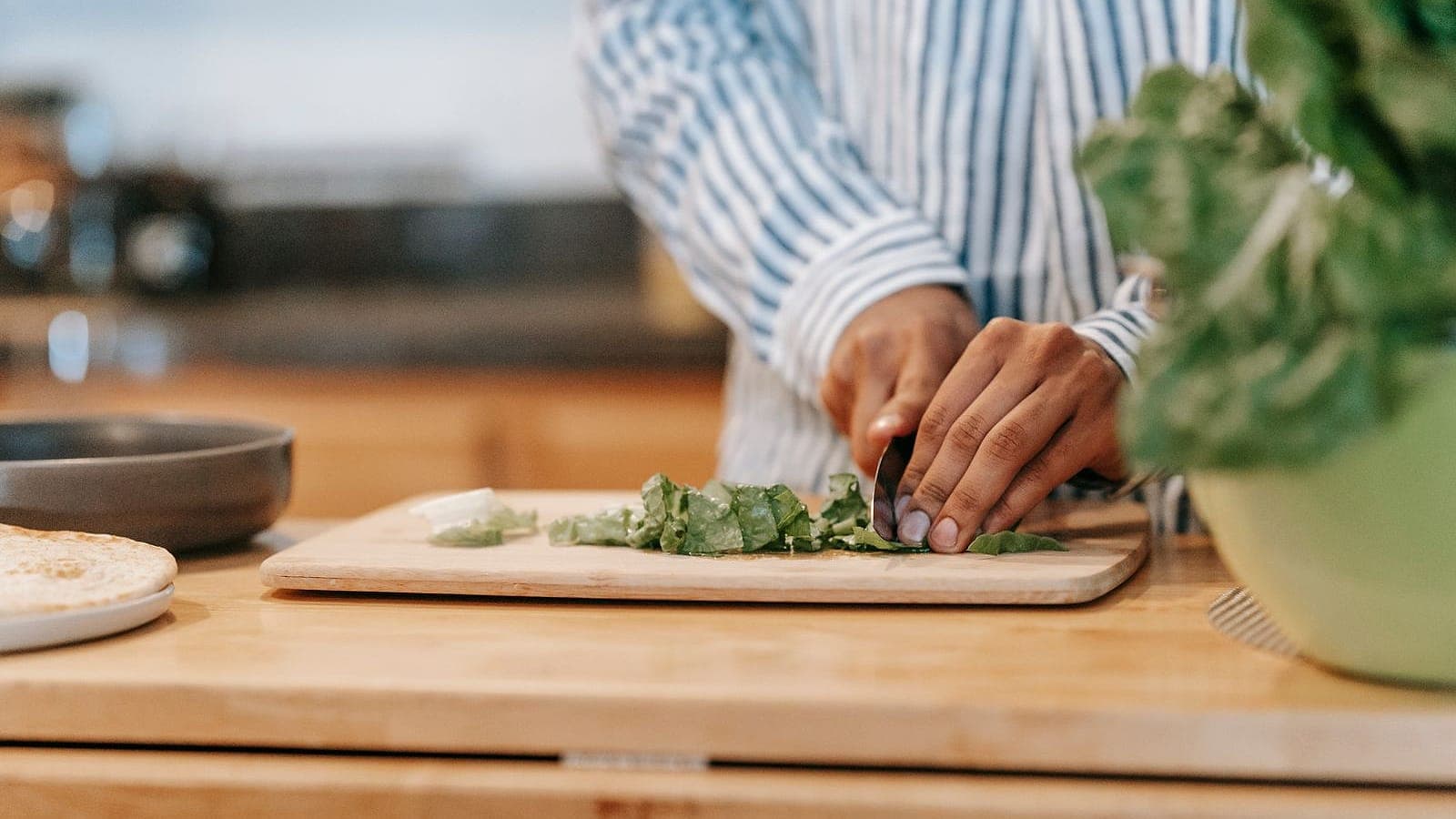
A good knife is the one tool you touch every time you cook, and it asks for very little in return: wash it by hand and dry it right away, cut on a surface that gives, store it so nothing touches the edge, and keep it sharp. Do those four things and a mid-priced knife will out-perform an expensive one that lives in the dishwasher and gets dragged across a glass board. Everything below is the specifics — sourced, and honest about where the advice gets nuanced.
The 30-second verdict
- Wash it right: hand-wash with warm water and mild soap the moment you’re done cutting, then dry it immediately. Skip the dishwasher — even knives labeled “dishwasher-safe.”
- Cut on the right surface: wood or soft plastic. Never glass, stone, granite, or ceramic — they roll a fresh edge within a few cuts.
- Store it so nothing touches the edge: a magnetic strip, an in-drawer tray, or a block (inserted spine-down, and only when the knife is bone-dry). Never loose in a drawer.
- Keep rust in check: dry every knife promptly; carbon-steel knives need it most. Light rust comes off with Bar Keepers Friend.
- Keep it sharp: hone often, sharpen when honing stops helping. A dull knife isn’t just frustrating — it’s the more dangerous one.
Wash it right (and skip the dishwasher)
The two-minute hand-wash
The habit that protects a knife best is also the simplest. America’s Test Kitchen’s Lan Lam frames the timing perfectly: wash your knife when you’re done cutting, not when you’re done cooking. A blade left to sit with onion, tomato, or citrus residue is a blade slowly corroding.
Wüsthof’s own care guidance is the template: wash right after use in warm water with a mild soap, then dry immediately with a soft cloth, and skip abrasive sponges that can scratch the finish. Shun suggests holding the knife flat against the back wall of the sink, washing each side in turn, then rinsing and towel-drying immediately — a method that keeps your hand away from the edge and gets the blade dry before water can spot it. However you do it, the non-negotiable step is the last one: dry it now, not later.
Why even “dishwasher-safe” knives shouldn’t go in
Here’s where a lot of internet advice overstates its case, so it’s worth being precise. A few manufacturers do label certain knives dishwasher-safe. Victorinox says household knives with synthetic handles are technically dishwasher-safe, but in the same breath recommends washing all large knives by hand (and never wooden handles). Zwilling says some knives are dishwasher-safe but only at low temperatures, and adds that the less you use the dishwasher, the more you’ll get out of the knife. In other words: even the makers who allow it advise against it.
Plenty of others — Wüsthof, Global, Shun, Mercer, Made In, Misen — say never. The reasons stack up:
- Detergent corrodes. Global warns that powerful detergents are harmful to its steel; Messermeister points to “aggressive alkalis, acids, and salts” causing corrosion, pitting, or rust; ATK simply lists the corrosivity of the detergent as a core problem.
- Heat harms handles and temper. Messermeister notes high heat can swell, crack, and splinter wood handles and even soften the steel by altering its tempering. ATK’s reporting — quoting a materials specialist from MIT and a professional cutler — describes drastic temperature swings that lead to splitting and cracking.
- Knocking dulls and chips. Loose in a rack, blades jostle against other items. Wüsthof cites knives rubbing; Messermeister warns the collisions can dull, nick, or even chip the edge.
- Spotting and rust. Shun notes that washing dissimilar metals together can cause brown spotting that’s difficult or impossible to remove.
So the honest rule is a tiered one: premium, wooden-handled, and carbon-steel knives should never see a dishwasher, and even a synthetic-handled stainless knife that’s technically cleared for it will simply last longer washed by hand. The dishwasher never makes a knife better; at best it’s a shortcut that costs you edge life.
Never soak it in the sink
Leaving a knife submerged in a sink of soapy water is the worst of both worlds. It’s the same prolonged-moisture exposure that starts corrosion, and — as Shun points out — it’s a genuine hazard: a blade you can’t see is a blade you might grab by the edge when you reach in. Wash it, dry it, put it away. Don’t let it lurk.
Carbon versus stainless: both get dried, one urgently
Not all steels forgive the same. ATK’s testing found carbon steel corrodes fastest — visible change after as little as ten minutes of moisture — while even a stainless chef’s knife is “less corrosion-resistant” than you’d hope, and rust “will come eventually” if you leave water on it. The takeaway isn’t to fear stainless; it’s that immediate drying matters for every knife and is simply more time-sensitive for carbon. If you own a reactive carbon blade, treat drying as part of using it, not a chore for afterward.
Cut on the right surface
Your cutting board does as much for your edge as your washing routine — arguably more, because the edge meets it thousands of times a meal.
What’s kind to an edge — and the self-healing trick
The friendly surfaces are the ones that give. Wood is the classic for a reason John Boos explains well: when the blade presses in, the wood fibers separate and then close back up, so the board effectively heals around each cut instead of grinding the edge flat. Soft plastic works on the same principle — Shun groups wood, wood composite, and polyethylene (HDPE) together as excellent choices. Rubber boards flex slightly under the blade, which the cooking site Foodal notes helps keep the edge sharper, and Wüsthof points to TPU as another blade-friendly option.
The edge-killers: glass, stone, and metal
The surfaces that ruin a knife are the hard, unyielding ones: glass, granite, marble, ceramic tile, and metal. This isn’t folklore. America’s Test Kitchen examined knife edges under a microscope at MIT and found that on glass or metal, the blade knocks against the surface and rolls the edge over — and it happens within a few cuts, not over months. Wüsthof puts it plainly: these materials are too hard for the narrow edge, dulling it within a few uses. Shun’s list of surfaces that dull a blade very quickly reads the same — tile, ceramic, marble, granite, glass.
Kitchen knife steel typically runs somewhere around 54 to 64 on the Rockwell hardness scale (per the knife retailer SharpEdge), which is hard enough to hold a keen edge but no match for stone or tempered glass. You don’t need to memorize the numbers; you need to remember that a beautiful glass board is a knife’s enemy no matter how easy it is to wipe down.
End-grain versus edge-grain
Among wood boards, end-grain (the checkerboard-looking ones, where you cut into the ends of the wood fibers) is the gentlest — the woodworking maker Boardsmith describes end grain as significantly kinder to an edge and more self-healing, because the blade slips between fiber ends rather than shearing across them. Edge-grain boards (long, parallel grain) are less plush but still firmly in the knife-friendly camp compared with plastic, and far ahead of anything glass or stone. Either wood is a good choice; end grain is the luxury upgrade for your edge.
The wood-versus-plastic hygiene question, settled
The old worry that wood is less sanitary than plastic doesn’t hold up. Research out of UC Davis in the 1990s, led by food-safety scientist Dean Cliver, found that bacteria worked into a wood surface don’t multiply and gradually die off, while a knife-scarred plastic board can become nearly impossible to fully clean and disinfect. Modern ATK reporting agrees there’s no reason to believe a well-scrubbed wood board is any less hygienic than plastic, provided you clean it with soap and hot water — and its robotic testing found wood and plastic dulled knives at about the same rates. Pick the material you’ll actually keep clean.
Scrape with the spine, not the edge
One small habit undoes a lot of good board choices: scooping chopped food off the board by dragging the sharp edge across it. As the food site The Takeout memorably puts it, that’s like sharpening the knife in reverse. Flip the knife and use the dull spine to corral and lift your mise en place. It’s a two-second change that saves your edge every single time you cook.
A quick note on bamboo, because guidance conflicts: knife makers including Wüsthof and Shun steer you away from it as too hard and quicker to dull, while ATK groups it among acceptable surfaces. The fair framing is that bamboo is far safer for an edge than glass or stone, but harder than maple, walnut, or beech — and the people who make knives would rather you didn’t use it. And whatever your board, slice rather than hack, and keep bones and frozen food off it (another Shun caution).
Store them so they stay sharp
Where a knife lives between uses decides how often you’ll need to sharpen it — and how safe it is to grab.
Never loose in a drawer
Tossing knives loose into a drawer is the single most common way home cooks quietly destroy their edges. As Tasting Table reports (citing Food & Wine), the result is a drawer of dull, chipped tools — every open and close slides the blades against each other and against everything else in there. It’s also the classic way to slice a finger reaching in blind. Loose-in-a-drawer is the anti-pattern; almost anything else is better.
A magnetic strip (and the spine-first technique)
A magnetic strip is a favorite for good reason: it saves counter and drawer space, holds knives of wildly different sizes, and keeps blades in the open air where they dry rather than in a damp slot. ATK’s testing of magnetic strips suggests choosing one at least three-quarters of an inch thick so it holds securely.
Technique matters here more than people realize. The knife specialist Oishya advises always making contact by touching the spine to the magnet first, then rolling the blade down — never slapping the knife on flat, and never sliding or dragging the edge along the metal to reposition it, which grinds the edge on the steel. A wood-faced strip is gentler on the blade than bare metal. Done right, a strip is arguably the kindest home for an edge you can buy.
In-drawer trays and blade guards
If you’d rather keep knives hidden — child-safe, off the counter — an in-drawer knife tray gives each blade its own channel so nothing touches anything else. The one trade-off is airflow: a covered tray dries more slowly than an open strip, so make sure blades (especially carbon) are fully dry before they go in.
Blade guards and edge sheaths are the answer for drawers, bags, and travel — they cover the edge so a loose knife can’t chip or cut. A traditional wooden saya (often magnolia) offers total edge protection, but comes with a carbon-steel caveat: sealed inside, trapped moisture can rust a carbon blade within days. Dry the knife thoroughly before it goes in its sheath, every time.
The knife block, honestly
The block gets a bad reputation it only half deserves, so here’s the balanced version.
On the edge, orientation is everything. ATK’s knife-storage testing measured it directly: a knife stored blade-down in a standard vertical slot was unable to cleanly cut paper after just 70 in-and-out strokes, while the same knife stored on its spine showed no damage after 200 strokes. So a block absolutely can dull a knife — but only if you insert it edge-down. Slide it in spine-down and the block protects the edge just fine.
On hygiene, the concern is real but manageable. A 2013 NSF study ranked the knife block among the germiest items in the kitchen, because the deep, dark, hard-to-dry slots are, as The Takeout describes, ideal conditions for bacteria and mold. The fix is the same rule that governs everything else here: only ever insert a completely dry knife, and clean the block out periodically.
Put those together and the block is fine — edge-safe when you load it spine-down, sanitary when you keep it dry — but it’s less forgiving of a wet knife than an open strip. The knife-care consensus roughly ranks storage best to worst as: a hardwood-faced magnetic strip, then a wooden saya, then a slotted in-drawer tray, then a spine-supported block, then a tight-slot block, and dead last, loose in a drawer. ATK’s short version: a magnetic strip, a universal block, or an upright wooden block are your best bets. The point isn’t that blocks are bad — it’s that any of these beats the drawer.
Keep rust and patina in check (for carbon knives)
If all your knives are stainless, skim this section — but don’t skip the last line. If you own carbon steel, this is where it earns its keep.
Carbon steel takes a keener edge and is easier to sharpen than stainless, which is exactly why serious cooks love it. The trade-off is reactivity: without the chromium that makes stainless resist corrosion, carbon steel patinas and rusts. As the knife shop Chef Knives To Go bluntly notes, water sitting on carbon steel will rust it.
First, tell the two apart, because they look alike to a beginner. Patina is a thin, stable, protective layer of oxidation — grey, blue, or bronze — and, as the retailer Chubo explains, it can actually help slow future oxidation (though it never makes the knife truly rust-proof). Rust is the destructive one: orange-red, flaky, and spreading. The knife shop Zahocho offers a clean test to know which you’re looking at: wipe the discolored area with a cloth. If color transfers to the cloth, it’s rust; if nothing transfers, it’s patina you can leave alone.
Preventing rust on carbon steel comes down to a few habits, per Chef Knives To Go: wipe the blade during use when you’re cutting acidic or wet foods, dry it immediately and thoroughly after washing, store it dry, and give it a light coat of oil for longer storage — camellia oil is the traditional choice, with food-grade mineral oil as an easy substitute.
If light rust does appear, Bar Keepers Friend is the standard remedy. The knife retailer Knifewear’s method: dust the rusty spots, add a tiny splash of water to make a paste, let it sit a few minutes, then start gently with a soft sponge and escalate to fine steel wool only if you need to. One honest limit — BKF removes surface rust, not pitting; once corrosion has eaten into the steel, that damage is permanent, which is the whole argument for drying knives before rust ever starts.
And the line for everyone: stainless is far more forgiving, but it is not rust-proof. Dry it too.
Hone regularly (and what that actually does)
Honing is the maintenance most home cooks skip and most pros do daily. It doesn’t remove metal or create a new edge — it realigns the existing one. In normal use the thin edge rolls slightly out of true, and drawing it across a honing rod straightens it back to center, restoring bite between actual sharpenings. German-style knives are typically honed on a grooved steel rod; harder Japanese steels prefer a smooth ceramic rod.
The key thing to internalize is that honing is not sharpening. Honing keeps a sharp edge performing; sharpening restores an edge that honing can no longer save. When your knife slips on a tomato skin even after honing, it’s time to actually sharpen — and that’s its own skill, covered step by step in our guide to how to sharpen a knife.
A dull knife is the dangerous one
It sounds backward, but a sharp knife is the safer knife — and this is the one safety claim worth stating carefully, sourced to medicine rather than folklore. The University of Rochester Medical Center’s guidance is direct: a dull blade needs more pressure to cut, increasing the chance that the knife will slip with great force behind it. A sharp edge bites exactly where you set it down; a dull one skates across the food and then goes wherever that extra force sends it. Escoffier’s culinary school reaches the same conclusion — a sharp knife is actually safer than a dull one.
The rest is technique that any knife owner can adopt. WebstaurantStore’s kitchen-safety guidance covers the essentials: when a knife falls, do not try to catch it — step back and let it land. Carry a knife with the blade pointed down at your side. And cut away from your body, not toward it. Escoffier adds two more that cost nothing: stabilize your board with a damp towel or a nonslip mat underneath so it can’t skid, and never leave a knife sitting in a sink where someone can reach in on it.
None of this is about being timid with a sharp knife. It’s the opposite — a sharp, well-kept knife under control is the calmest tool in the kitchen. The care routine and the safety case are the same story: a maintained edge does what you tell it to.
Whatever you’re working with — a budget workhorse or one of the best chef’s knives money can buy — these habits are what separate a knife that stays excellent for a decade from one that’s dull and pitted inside a year. The knife doesn’t care what it cost. It cares how you treat it.
How we researched this
This guide synthesizes published care guidance from knife manufacturers and independent testing rather than any first-person testing of our own. For the dishwasher question we compared manufacturer positions from Wüsthof, Messermeister, and Global against America’s Test Kitchen’s reporting. Cutting-surface claims draw on ATK’s microscope-based board testing and John Boos on grain. Storage guidance leans on ATK’s 70-stroke knife-storage test and its magnetic-strip review. Rust and patina guidance comes from Zahocho, Chef Knives To Go, and Knifewear. The safety section is sourced to the University of Rochester Medical Center. Where sources disagree — bamboo boards, “dishwasher-safe” labeling, block hygiene — we’ve flagged the disagreement rather than papering over it.
Sources
- America’s Test Kitchen — Can You Put a Chef’s Knife in the Dishwasher?
- America’s Test Kitchen — Which Cutting Board Is Right for You?
- America’s Test Kitchen — The Best Magnetic Knife Strips
- America’s Test Kitchen — Knife Storage
- Wüsthof — How to Clean Your Wüsthof Knives
- Messermeister — Why Aren’t Knives Dishwasher Safe?
- Global Cutlery — Knife Care
- John Boos — End Grain vs. Edge Grain Cutting Boards
- Tasting Table — Storing Your Knives in a Drawer Is Not Worth the Risk
- Zahocho — Patina on Japanese Knives: A Comprehensive Guide
- Chef Knives To Go — Carbon Steel Knife Care
- Knifewear — Bar Keepers Friend Removes Rust From Your Knives
- University of Rochester Medical Center — Knife Safety