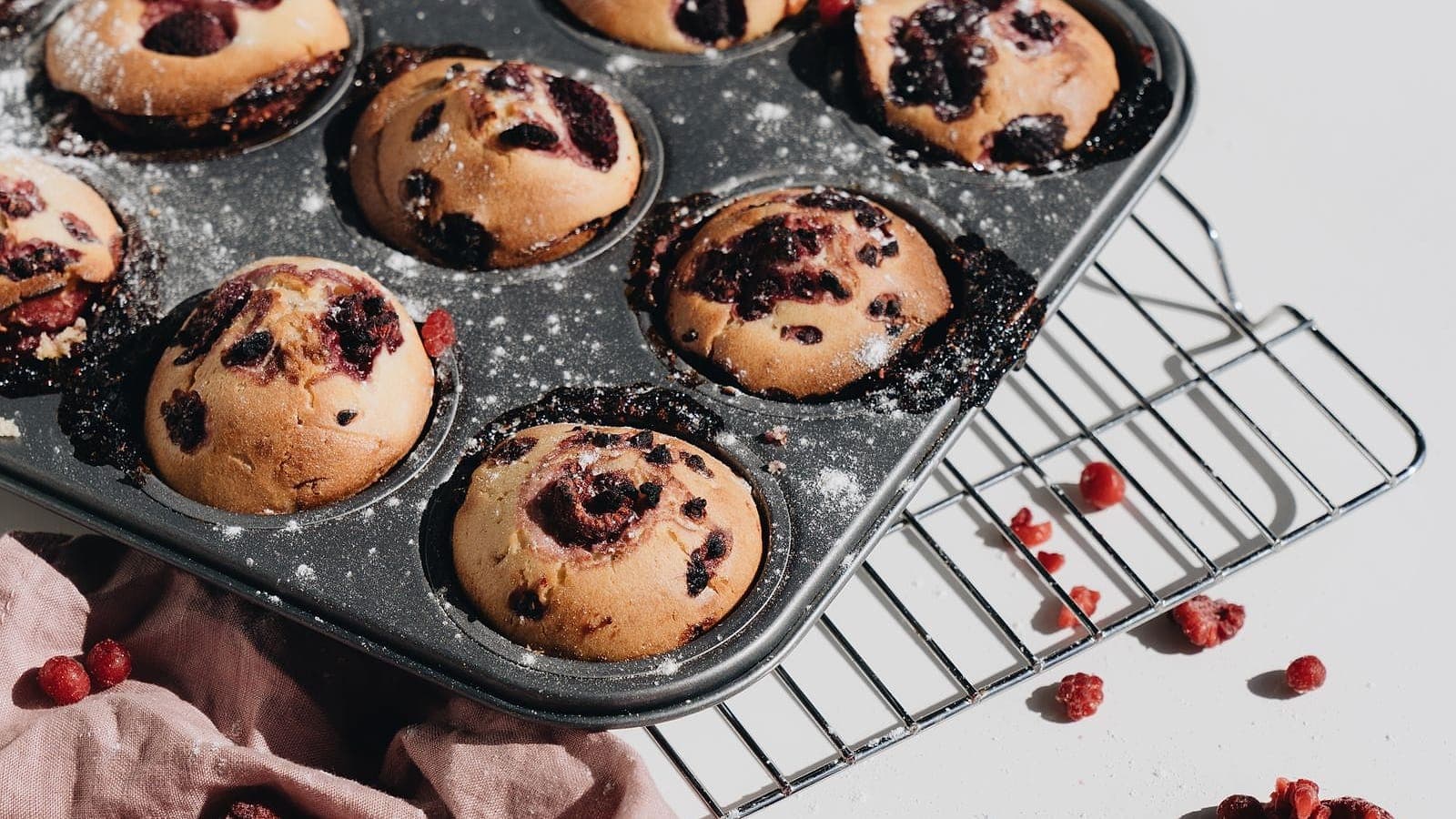
A good muffin pan does two humble things well: it bakes evenly, so tops and edges brown at the same pace, and it releases cleanly, so your muffins don’t leave half their crust behind in the cups. The pan that does both for the most people is the USA Pan 12-Cup Muffin Pan — heavy aluminized steel with a nonstick coating and a warp-resistant rim that will outlast a whole drawer of flimsy tins. Baking on a budget? The Wilton Perfect Results Muffin Pan handles casual muffins and cupcakes for a fraction of the price. The honest caveat on both: a heavy pan browns more evenly than a thin one, but even the best pan bakes its cleanest with paper liners or a good greasing.
This guide is about standard 12-cup metal muffin pans — the everyday workhorse that bakes muffins and cupcakes alike. If you’re stocking a kitchen from scratch, a muffin pan is one of about five pieces genuinely worth owning, and our best bakeware sets guide lays out the open-stock essentials worth building toward instead of a padded boxed set.
At a glance
| Pick | Best for | Material | Price band |
|---|---|---|---|
| USA Pan 12-Cup Muffin Pan | Best overall | Aluminized steel, nonstick | $$ |
| Wilton Perfect Results Muffin Pan | Best budget | Nonstick-coated steel | $ |
Price bands: $ budget · $$ midprice. Bakeware is inexpensive, so both picks land at the affordable end — the gap between them is build quality and how long the pan lasts, not a big jump in price. Materials and coatings are described only as the makers specify them.
What to look for
Gauge and material. This is the whole ballgame. Heavy-gauge aluminized steel — a light steel core bonded with aluminum — heats fast and browns evenly, and its weight is what keeps it flat in a hot oven. Thin, flimsy steel is the opposite: it develops hot spots that scorch some muffins while others stay pale, and it can warp or “pop” when the oven’s hot. King Arthur Baking, whose test kitchen is a trusted authority on technique, is consistent on the point that metal heats quickly and browns better than other materials. When in doubt, pick up the pan: heavier is better.
Coating. A nonstick coating over that steel makes release easier and cleanup faster. It’s a real convenience, but treat it as a helper, not a guarantee — nonstick still benefits from a light greasing or a liner for the cleanest release, and the coating wears over years of use, faster if you scrape it with metal or run it through the dishwasher.
Size and cup shape. The standard 12-cup pan is the default, and it bakes both muffins and cupcakes without fuss. “Crown” muffin pans have slightly larger, taller cups designed for bakery-style domed tops; they’re a nice extra, not a necessity. Unless you specifically want tall bakery muffins, a standard 12-cup is the pan to own first.
Handles. Extended handles or a wide lip give you something to grab with a mitt, which matters more than it sounds when you’re pulling a hot, full pan out of the oven with both hands. It’s a small feature that makes the pan safer to use.
Skip the floppy silicone. Silicone muffin “pans” release easily and store flat, and that’s the whole of their appeal. They brown poorly — silicone doesn’t conduct heat the way metal does, so tops and sides stay pale — and a full silicone pan flops and sags the moment you try to move it, which is how batter ends up on the oven floor. For everyday baking, a heavy metal pan is the better tool. If it’s the easy release you’re after, a metal pan plus paper liners gets you there without giving up browning.
Best overall: USA Pan 12-Cup Muffin Pan
The USA Pan 12-Cup Muffin Pan is the pan we’d hand to almost anyone. It’s heavy aluminized steel, which is exactly the material that browns evenly and resists the warping that plagues cheap tins, and it carries a nonstick coating for easy release. The build is the kind you buy once: substantial in the hand, made in the USA, with a rim engineered to stay flat rather than buckle in a hot oven. That combination — even bakes plus a pan that won’t warp — is why heavy aluminized steel is the standard serious bakers reach for, and why this pan earns the top spot.
It isn’t the cheapest muffin pan on the shelf, but it sits comfortably in the midprice band, and for a piece you’ll use for years the small premium over a bargain tin is easy to justify. Give the cups a light greasing or drop in liners and release is clean; hand-wash it and the coating will keep doing its job for a long time. If you bake muffins, cupcakes, or egg cups with any regularity, this is the pan that stops you thinking about the pan.
Best budget: Wilton Perfect Results Muffin Pan
Not everyone bakes muffins every week, and for casual baking the Wilton Perfect Results Muffin Pan does the job for noticeably less money. It’s a nonstick-coated steel pan, widely available wherever kitchen gear is sold, and it releases muffins and cupcakes well with a light greasing or liners. Wilton lists it as dishwasher-safe, though hand-washing will keep any nonstick coating alive longer — the dishwasher’s heat and detergent shorten the life of the coating and dull the finish over time.
The honest trade-off is build. It’s a lighter pan than the USA Pan, so it browns a touch less evenly and is more prone to warping under high or uneven heat, especially if you blast it near a hot broiler element. For occasional muffins and cupcakes, none of that is a dealbreaker, and the low price makes it a sensible first pan or a spare for when you’re baking a double batch. If you find yourself baking more than you expected, that’s your cue to graduate to the heavier pan.
Liners vs. greasing
Once you’ve got a good pan, the last decision is how you keep muffins from sticking — and both answers are fine. Paper or foil liners are the easiest route: no greasing, no scrubbing, and clean, uniform sides on every muffin. They’re the low-effort choice, and they make transport and lunchboxes tidier.
Greasing the cups directly — or trusting a good nonstick pan — gives you crispier edges and a better-developed crust, because the batter bakes against hot metal instead of paper. It’s the choice when you want texture on the outside of a muffin, not just a soft, even wall.
Neither is “correct.” Buy a heavy pan, then choose per recipe: liners for tender muffins and easy cleanup, greasing for crisp-edged, crusty ones. The pan is the part worth spending on; the liner-or-grease call is just about the muffin you want that day.
The rest of your bakeware
A muffin pan is one piece of a small, sensible bakeware kit — and you rarely need a boxed set to build it. Our best bakeware sets guide makes the case for buying the four or five essentials open-stock instead. For layer cakes and sheet cakes, see our best cake pans roundup; for the single most-used piece of bakeware you’ll own, our best baking sheets guide covers the half sheet. And when you’re stirring big batches of muffin or cupcake batter, a stand mixer earns its counter space fast.
To make any muffin pan last, the same care rules apply as to the rest of your metal bakeware — hand-wash, skip metal utensils on nonstick, and don’t shock a cold pan under the broiler; our guide on how to care for baking sheets covers the details that keep a pan flat and releasing for years. Shopping for someone who bakes? A good muffin pan is a genuinely useful gift — see our gifts for bakers picks.
Sources
- King Arthur Baking, “Your complete guide to baking pans”: https://www.kingarthurbaking.com/blog/2023/06/05/your-complete-guide-to-baking-pans
- King Arthur Baking, “Glass or metal or stoneware”: https://www.kingarthurbaking.com/blog/2018/03/29/glass-or-metal-or-stoneware