The best cake pans give you two things: even heat, so the cake bakes level instead of doming, and a clean release, so the layers come out whole. For most bakers that combination lives in the Fat Daddio’s Anodized Aluminum Round Cake Pans (9x2, 2-Pack) — the pastry-kitchen standard, sold as a pair for layer cakes, uncoated so there’s nothing to scratch off, and safe with acidic batters like red velvet or lemon. Prefer to trade a little pro-flat precision for the easiest possible release? The USA Pan Round Cake Pan (9-Inch) adds a nonstick coating. And for sheet cakes, brownies, and bars, a metal USA Pan Rectangular Cake Pan (9x13) browns better and cools faster than a glass dish. One habit ties all three together, and it’s the single most important thing on this page: grease the pan and line the bottom with a parchment round — even a nonstick one — and your cake releases clean every time.
At a glance
| Pick | Best for | Material | Coating | Price band |
|---|---|---|---|---|
| Fat Daddio’s Anodized Aluminum Round Cake Pans (9x2, 2-Pack) | Layer cakes | Anodized aluminum | Uncoated | $$ |
| USA Pan Round Cake Pan (9-Inch) | Easy release | Aluminized steel | Nonstick (Americoat) | $$ |
| USA Pan Rectangular Cake Pan (9x13) | Sheet cakes & brownies | Aluminized steel | Nonstick (Americoat) | $$ |
Price bands: $ = under $15 · $$ = $15–40 · $$$ = $40 and up. Bakeware is inexpensive, which is why every pick here sits in the $$ band — you are buying heavy-gauge metal and even heat, not a premium badge.
How we chose
Cookloom is a new site, so let’s be plain: we have not lab-tested these pans ourselves, and we won’t pretend otherwise. Instead, we’ve reconciled the long-standing consensus of professional bakers and pastry kitchens — where anodized and aluminized-steel pans have been the working default for years — with the technique guidance from King Arthur Baking’s guide to baking pans and their glass-versus-metal testing. Where those authorities speak to material, browning, and release, we’ve followed them and attributed every technique claim in the text.
What to look for
Material. Light-colored aluminum and aluminized steel are the all-round standard for cake pans: they heat quickly and brown evenly, which is what gives you a level top instead of a domed one you have to trim. Anodized aluminum — the Fat Daddio’s construction — is uncoated, even-heating, and non-reactive, so acidic batters won’t pick up a metallic edge. What you want to avoid is a thin, flimsy pan: cheap gauges warp under oven heat and hand you uneven bakes.
Coated vs. uncoated. This is the real fork in the road, and it’s an honest trade rather than a clear winner. Uncoated anodized aluminum never wears out — there’s no coating to scratch, flake, or degrade — but it always needs greasing and a parchment round. Nonstick (a coating over aluminized steel) releases more easily and is friendlier for casual bakers, but the coating ages over years of use and tends to run a little darker, which browns bottoms faster. Plenty of serious bakers pick uncoated for exactly the “lasts forever” reason; plenty of home bakers happily pick nonstick for the easy turn-out. Neither is wrong.
Shape and size. For layers, buy two matching rounds so both cakes bake at once and stack evenly — 8-inch and 9-inch are the everyday sizes, and straight sides give you cleaner edges than flared ones. For sheet cakes, brownies, and bars, a 9x13 is the workhorse. Whether that 9x13 should be metal or glass is its own question — metal browns and crisps better, glass is gentler and goes oven-to-table — and it’s worth reading our glass vs. metal bakeware guide before you commit.
Best for layer cakes: Fat Daddio’s Anodized Aluminum Round Cake Pans (9x2, 2-Pack)
The verdict: For most people building layer cakes, the Fat Daddio’s Anodized Aluminum Round Cake Pans (9x2, 2-Pack) are the pans to own.
They earn it on three counts. First, anodized aluminum heats evenly, so cakes bake with flat tops that stack without trimming. Second, the pans are uncoated — there is no nonstick layer to scratch off, wear out, or worry about, which is why this construction is a fixture in professional pastry kitchens. Third, anodized aluminum is non-reactive, so acidic batters (think lemon, buttermilk, red velvet, anything with a lot of cocoa) won’t take on any off-flavor. They arrive as a pair, which is precisely what a layer cake needs, in a full 2-inch depth (the 9x2 in the name) that suits standard recipes.
The honest catch: uncoated means you must grease and line them — a bare anodized pan is not a nonstick pan, and skipping that step is how cakes stick. Do the parchment round (see below) and release is a non-issue. Over time bare aluminum can darken to a patina; that’s normal and harmless, not a defect.
Best nonstick round: USA Pan Round Cake Pan (9-Inch)
The verdict: If you want the easiest possible turn-out and don’t mind a coating that ages, the USA Pan Round Cake Pan (9-Inch) is the round to buy.
It’s heavy-gauge aluminized steel with USA Pan’s Americoat nonstick, so it releases reliably and cleans up fast — a friendlier pan for beginners and anyone who bakes occasionally and wants one less thing to think about. The trade you’re accepting is the one every nonstick pan asks: the coating won’t last indefinitely the way bare anodized aluminum does, and a darker surface browns bottoms a touch faster, so keep an eye on the underside toward the end of the bake. Note that USA Pan sells rounds as singles, so buy two if you’re making layers. And here’s the part people skip because “nonstick” sounds like permission not to: still grease and line it with a parchment round for a truly foolproof release.
Best for sheet cakes & brownies: USA Pan Rectangular Cake Pan (9x13)
The verdict: For a single-layer sheet cake, a tray of brownies, or a pan of bars, the metal USA Pan Rectangular Cake Pan (9x13) beats a glass dish for most bakes.
Metal heats fast, browns better, crisps edges, and — this is the underrated part — cools quickly once it’s out of the oven, so brownies and bars stop cooking on schedule instead of coasting warm in a heat-retaining dish. Glass is a heat sink: King Arthur Baking notes it bakes slower and can over-bake the centers and edges of brownies and bars, which is exactly where you don’t want it. This USA Pan is aluminized steel with the same Americoat nonstick and heavy gauge as its rounds, so it won’t warp and it releases well. When a recipe was written for metal — and most are — this is the pan it had in mind.
How to get a clean release
This is the load-bearing habit of the whole guide, so it gets its own section: grease the pan and line the bottom with a parchment round. Do it even for nonstick pans. Butter or spray the inside, drop in a circle of parchment cut to the pan’s base, then a light grease over the parchment itself. That’s it — that one step prevents the great majority of “my cake stuck to the pan” disasters.
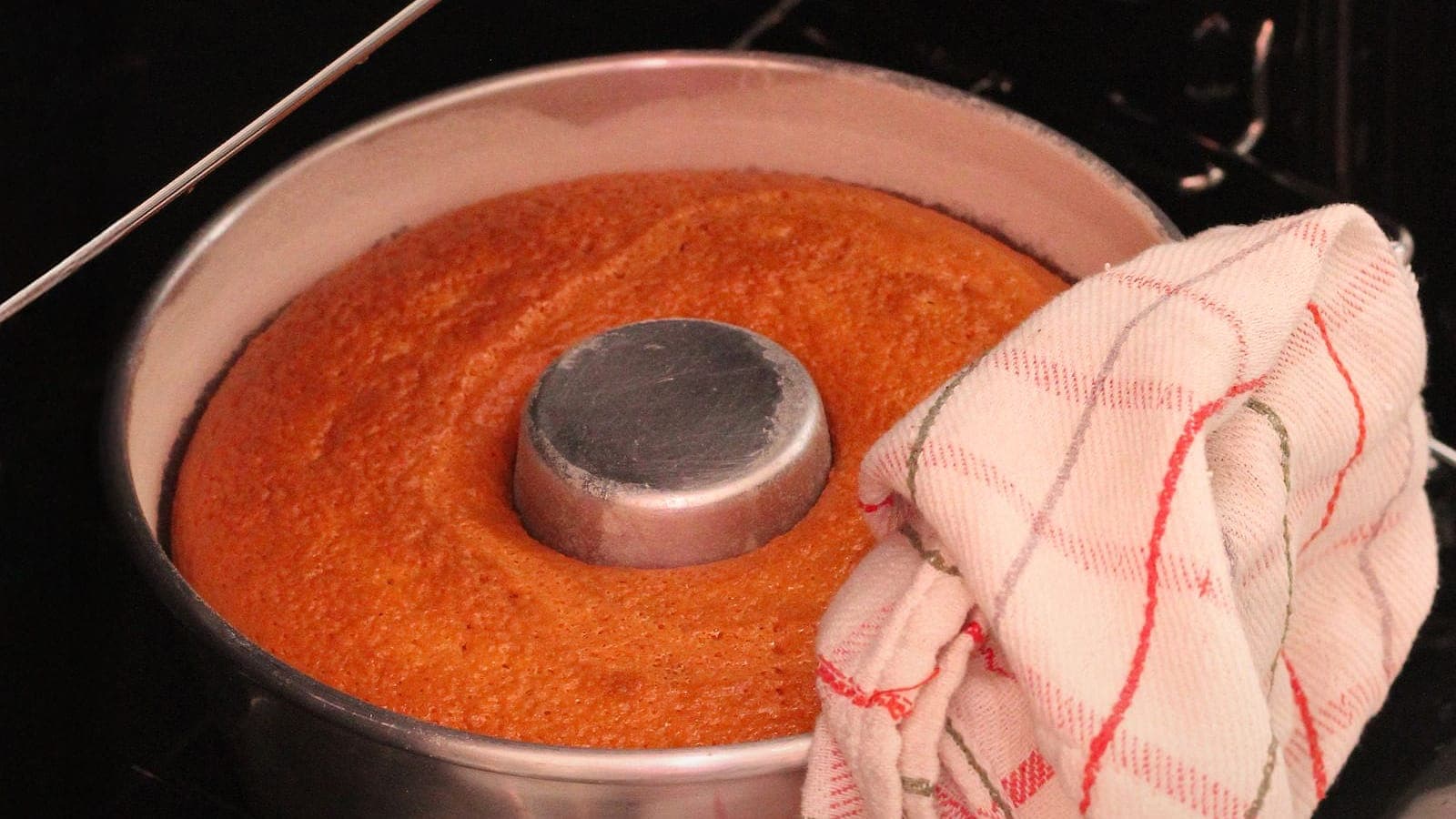
A few refinements. For a fluted or Bundt pan, there’s no lining a shape like that, so grease every crevice thoroughly (and flour it, or use a baking spray with flour). Let a cake cool in the pan for just a few minutes — long enough to firm up, not so long that it steams and grips — then turn it out while it’s still slightly warm. And protect your surfaces: a parchment round doesn’t just ease release, it keeps the pan itself cleaner, which matters most for the bare anodized pans you’ll hand-wash rather than run through a dishwasher.
Metal vs. glass for cakes
The short version: metal wins for cakes. It browns and rises better and is the test-kitchen default, which is why King Arthur Baking tests its recipes in metal. Glass has real strengths — it’s non-reactive, see-through so you can watch the bottom, and goes straight from oven to table — but it heats slowly, holds that heat, and browns less, so it tends to over-bake the edges of cakes, brownies, and bars.
Two practical rules follow. If a recipe specifies metal and all you have is glass, lower the oven by about 25°F to compensate for glass’s heat retention. And mind thermal shock: never move glass between temperature extremes — a cold dish into a hot oven, or a hot dish onto a cold, wet counter — because it can shatter. For casseroles and custards, glass is genuinely the better tool; for cakes, reach for metal. The full breakdown lives in our glass vs. metal bakeware guide.
The rest of your bakeware
Cake pans are one slice of a small, essential kit. If you’re building out from scratch, our best bakeware sets guide makes the case for buying the four or five pieces you’ll actually use open-stock rather than a padded boxed set. The single most-used piece of all — a half sheet — has its own roundup in best baking sheets. And once you’re baking layer cakes with any regularity, a stand mixer is the natural companion for creaming butter and whipping meringue; start with our best stand mixers guide.