TL;DR — Tanghulu is fruit dipped in molten sugar that cools into a thin, glassy shell. It only works if you cook the sugar to the hard-crack stage, about 300°F (149°C); below that it stays sticky. The one tool that decides glass-versus-glue is a thermometer — and it is also what keeps you safe, because that syrup is hotter than boiling water and clings to skin. Cheap, fast, genuinely fun. One real rule: stovetop only, and never the microwave shortcut.
What is tanghulu?
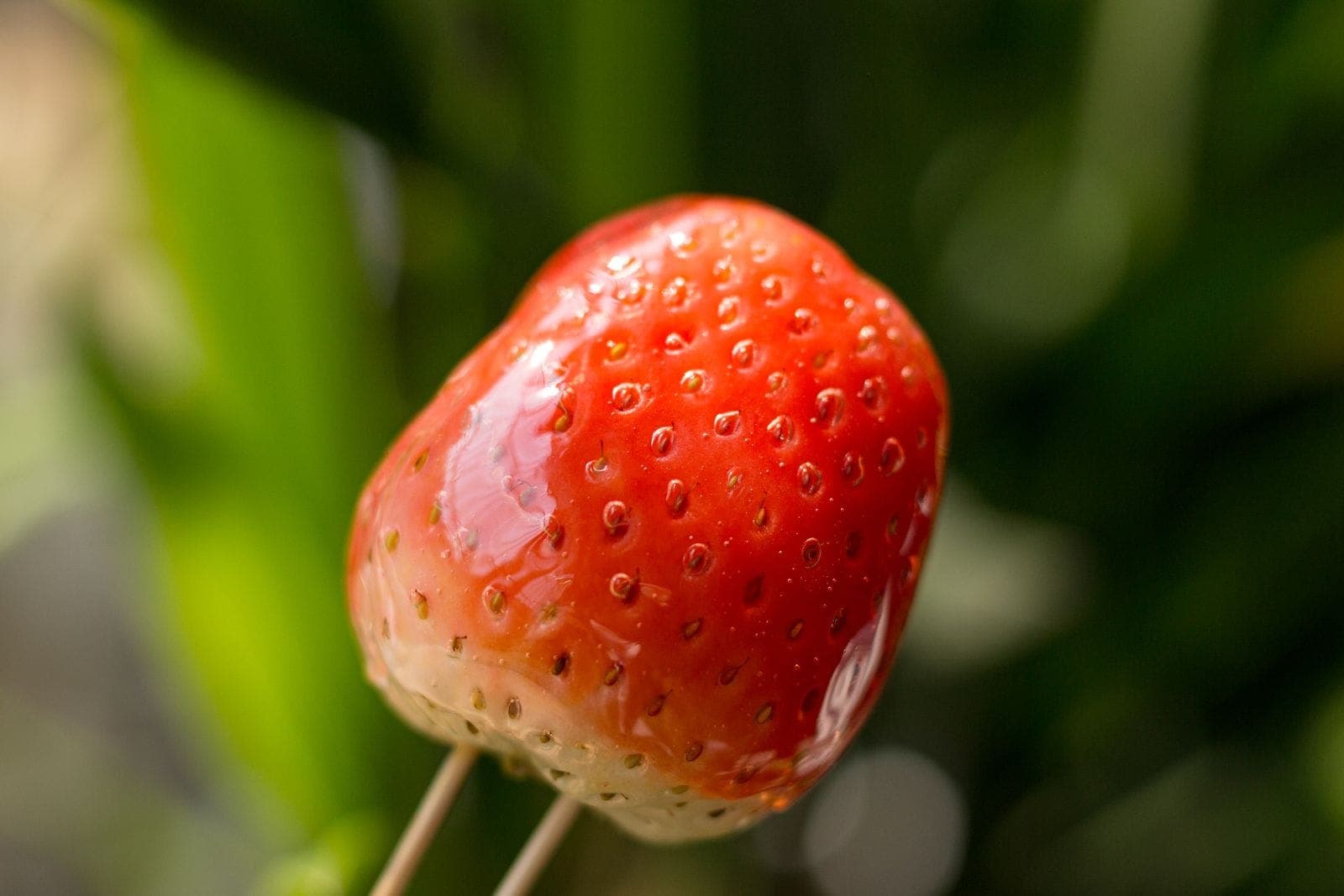
Tanghulu (糖葫芦) is one of the simplest sweets there is: skewered fruit, dipped in hot sugar syrup, left to cool until the coating snaps into a thin sheet of edible glass. Bite through it and you get a loud, brittle crack, then the soft fruit underneath — that textural contrast is the whole appeal, and it is why the videos are so satisfying to watch.
Traditional versions use hawthorn, a tart little crabapple-like fruit; the TikTok era swapped in strawberries, grapes, and mandarin segments because they photograph like jewels. There are only two ingredients that truly matter — fruit and sugar (some cooks add a splash of water and a little corn syrup, some none at all) — which is exactly why it reads as beginner-friendly, and exactly why it goes wrong so often. Simple is not the same as easy.
Where it came from — and why it keeps going viral
Long before it was a hashtag, tanghulu was winter street food in northern China. By most accounts it dates to the Song dynasty and is still sold on sticks around Beijing and Tianjin, traditionally as bingtanghulu: rock-sugar-glazed hawthorn on a roughly 20-centimeter bamboo skewer. The name nods to its gourd-like, calabash shape.
Its modern life is a loop. Tanghulu does not trend once and fade — it resurfaces on FoodTok every few months, each cycle bringing a fresh wave of glossy “here’s how I make tanghulu” clips and, right behind them, the “why won’t mine harden” fails. Pop-culture moments, including K-pop stars making it on camera, helped accelerate its 2020s revival. I will be honest about the numbers rather than invent them: I do not have a verified, current view count worth quoting, so I won’t. What is reliably true is that the demand is evergreen. People look up how to make it, why it failed, and whether it is safe on a rolling basis, not in a single spike — which is the real reason it is worth explaining properly instead of chasing.
Does it actually work? The sugar science
Yes — but only if you respect one number.
Sugar syrup is sugar dissolved in water. As you boil it, water evaporates, the sugar concentration climbs, and the temperature rises right along with it. Temperature is a proxy for concentration: the higher the syrup gets before you stop, the harder it sets when it cools. To get a shell that shatters like glass, you have to drive out nearly all the water, and that happens at the hard-crack stage. The Exploratorium’s candy-science guide puts hard-crack at 300–310°F (149–154°C), where the syrup is roughly 99% sugar. Stop short of that and there is still enough water left that the coating cools into a softer stage — tacky, chewy, gluey — no matter how long you let it sit. That is the single most common reason a batch “won’t harden”: it never reached 300°F.
Humidity is the second villain. Sugar is hygroscopic, meaning it pulls moisture out of the air, so even a flawless shell will slowly weep and turn sticky on a humid day. Tanghulu is best eaten within an hour or two of dipping. It is not a make-ahead candy, and no technique changes that.
The sugar stages
Here is the ladder your syrup climbs, and why stopping early leaves you with glue instead of glass:
| Stage | Temperature | What the cooled sugar does |
|---|---|---|
| Thread | ~230–235°F / 110–113°C | Spins soft threads; syrupy, never sets |
| Soft-ball | ~235–240°F / 113–116°C | Forms a squishy ball — fudge territory |
| Soft-crack | ~270–290°F / 132–143°C | Bendy, chewy threads; still tacky |
| Hard-crack | ~300–310°F / 149–154°C | Snaps into brittle, glassy shards — this is tanghulu |
Temperatures follow the Exploratorium’s candy-making stages. Notice how narrow the useful window is: at soft-crack, just 10–20°F below target, the coating is still chewy. Go the other way, much past 310°F, and the sugar starts to caramelize — amber first, then bitter. The band you actually want sits right around 300°F, which is precisely why eyeballing it fails so often.
Why a thermometer is the difference between glass and glue
You cannot see 300°F. Sugar syrup looks nearly identical at 260°F and at 305°F — clear, bubbling, faintly straw-colored — but one makes glue and the other makes glass. The only reliable way to catch the moment is to measure it.
The cold-water test (drip syrup into ice water; at hard-crack it forms threads that snap) is the classic no-gear method, and it genuinely works. But it is slow and imprecise at exactly the point where the syrup is moving fastest and hottest — which is also where it is most dangerous to be leaning over the pot, guessing. A thermometer that reads well past the boil solves both problems at once.
Candy sits at the top of a good instant-read’s range: most read several hundred degrees past boiling, comfortably into hard-crack territory, so ~300°F is well within reach. One honest caveat, because it is the kind of detail our reviews live on — the tight ±0.5°F accuracy most instant-reads advertise applies to a lower band and widens a little up at candy temperatures. That is fine here, because hard-crack spans a full ten degrees (300–310°F) and you only need to know you have crossed into it, not pin the exact degree. If you want the full picture on which models actually hold their accuracy at high heat — and why a leave-in alarm probe is the safer choice for anyone who makes candy or fries often — see our guide to the best kitchen thermometers.
How to do it well
The method is short. The discipline is in the details.
- Dry the fruit completely. Wash it, then dry every piece like you mean it — pat with towels and let it air-dry. Surface water is the enemy: it dilutes the shell where it touches and makes the coating weep. Room-temperature fruit beads less condensation than cold, so bring it up from the fridge first.
- Skewer, leaving a long handle. Two or three pieces per stick, with plenty of bare skewer to hold. You want your hand nowhere near the pot. Longer skewers than feel necessary are a safety feature, not an aesthetic one.
- Cook a plain syrup to hard-crack. A common ratio is about 2 parts sugar to 1 part water (many cooks add a spoonful of corn syrup to discourage crystallizing; it is optional). Once the sugar dissolves, bring it to a boil without stirring — stirring can seed crystals and cloud the batch — and track it with a thermometer. Pull it off the heat right at 300°F; carryover will nudge it up a touch, keeping you inside the 300–310°F band.
- Dip fast, and let it drip. Working quickly, because the syrup thickens as it cools, roll each skewer through to coat, let the excess run off, and set it down. If the syrup stiffens too much, a few seconds back on low heat loosens it — do not crank the flame.
- Cool and eat soon. Some cooks plunge the coated fruit briefly into ice water to set the shell instantly and glassy; others rest them on parchment or a silicone mat. Either way, let them set fully, and eat them within an hour or two before humidity dulls the shine.
The part nobody films: burns
Here is the footage that does not make the montage.
Sugar at 300°F is far hotter than boiling water — and unlike water, it is thick and sticky, so if it lands on skin it clings and keeps transferring heat instead of running off. That combination is why molten-sugar burns can be worse than they look.
This is not hypothetical. News outlets have reported doctors sounding the alarm as the trend spread: TODAY covered tanghulu-related burns tied to the craze, and NBC Boston reported physicians warning of serious sugar burns linked to it, some severe. I am reporting what they reported — these are their accounts, not a tally of our own — and I am not going to put a number on injuries I cannot verify. But the pattern in the coverage is consistent enough to take seriously.
The most dangerous shortcut is the microwave. Melting sugar in the microwave to skip the stovetop is the move most associated with the injuries in that reporting, and it is uniquely risky: microwaved sugar heats unevenly, with scorching-hot pockets you cannot see and cannot measure, and it can erupt or stick to skin the moment you pull it out. No thermometer feedback, no visual cue, no control. Skip it. Make tanghulu on the stovetop, where you can watch the temperature and pull at the right moment.
The rest is basic heat discipline: long skewers, dry hands and dry surfaces (stray water hitting hot sugar spatters), and nobody reaching over the pot. Treat molten sugar with the same caution you would give a pot of frying oil at the same temperature — because that is essentially what it is.
Is it worth your time?
Honest verdict: yes, with your eyes open.
Tanghulu is cheap, fast, and genuinely fun, and the payoff — that glass-shattering crack — is real. It is also unforgiving in ways the videos hide. It is timing-sensitive (miss 300°F and you have made syrup-coated fruit), it weeps in humidity (a make-and-eat treat, not a prep-ahead one), and the molten sugar is a real burn hazard that deserves respect.
If you have a thermometer and ten minutes of undivided attention, it is a great weekend kitchen project and an easy win with kids watching from a safe distance. If you are tempted by the microwave hack because you would rather not babysit a pot, that is the one version worth skipping entirely. The whole thing rests on a single number: hit 300°F on the stovetop and you get glass; anything less, or anything faster, and you get glue — or a trip you did not plan.